Comparative Study
. 2007 May;59(5):367-75.
doi: 10.1007/s00251-007-0201-2. Epub 2007 Mar 3.

MHC class I A region diversity and polymorphism in macaque species

Affiliations
Comparative Study

MHC class I A region diversity and polymorphism in macaque species

Nel Otting et al. Immunogenetics. 2007 May.

Abstract

The HLA-A locus represents a single copy gene that displays abundant allelic polymorphism in the human population, whereas, in contrast, a nonhuman primate species such as the rhesus macaque (Macaca mulatta) possesses multiple HLA-A-like (Mamu-A) genes, which parade varying degrees of polymorphism. The number and combination of transcribed Mamu-A genes present per chromosome display diversity in a population of Indian animals. At present, it is not clearly understood whether these different A region configurations are evolutionarily stable entities. To shed light on this issue, rhesus macaques from a Chinese population and a panel of cynomolgus monkeys (Macaca fascicularis) were screened for various A region-linked variations. Comparisons demonstrated that most A region configurations are old entities predating macaque speciation, whereas most allelic variation (>95%) is of more recent origin. The latter situation contrasts the observations of the major histocompatibility complex class II genes in rhesus and cynomolgus macaques, which share a high number of identical alleles (>30%) as defined by exon 2 sequencing.


Figures
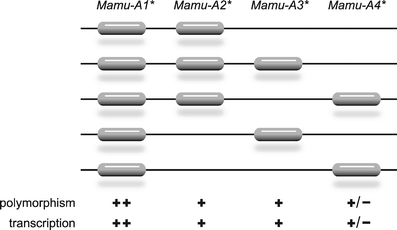
Fig. 1
Fig. 1
Schematic representation of different Mamu-A region configurations observed in Indian rhesus macaques. The exact order and physical distances of the loci on the genome are still unknown. The relative levels of polymorphism and transcription of the loci are indicated. Two Mamu-A region configurations (1 and 5) are confirmed by the sequencing of the complete rhesus MHC region (Daza-Vamenta et al. ; Kulski et al. 2004)
Fig. 2
Fig. 2
Phylogenetic tree of Mamu-A and Mafa-A gene/alleles detected in this study. The -A2 locus is represented by four alleles only. The tree is based on full-length sequences, although analyses on only exon 2 and 3 showed no significant differences. The nomenclature of the new alleles is based on a more extended tree (not shown) containing all the Mamu-A and Mafa-A alleles now available. Asterisk, three alleles of animal Ri081, of which one represents the locus Mamu-A5. Double asterisks, three alleles of animal Ri145, of which one represents the locus Mamu-A6. Triple asterisks, three alleles of animal Ri078, of which one represents the locus Mamu-A7
Fig. 3
Fig. 3
Pedigree of a cynomolgus macaque family showing segregation of Mafa-A alleles. The animals analyzed are indicated by shading. A question mark indicates that the sire has not been identified
Fig. 4
Fig. 4
Schematic representation of different Mafa-A region configurations in cynomolgus macaques. Four configurations (2–5) are shared with the Indian rhesus macaques (Fig. 1). One region configuration lacks the Mafa-A1 gene. It is not yet known whether the locus is really absent or missed because of PCR failure. Should a Mafa-A1 gene be found in extended studies than this region, configuration has to be deleted from the list

References

    1. {'text': '', 'ref_index': 1, 'ids': [{'type': 'DOI', 'value': '10.1007/s00251-006-0132-3', 'is_inner': False, 'url': 'https://doi.org/10.1007/s00251-006-0132-3'}, {'type': 'PubMed', 'value': '16802168', 'is_inner': True, 'url': 'https://pubmed.ncbi.nlm.nih.gov/16802168/'}]}
    2. Abbott KM, Wickings EJ, Knapp LA (2006) High levels of diversity characterize mandrill (Mandrillus sphinx) Mhc-DRB sequences. Immunogenetics 58:628–640 - PubMed
    1. {'text': '', 'ref_index': 1, 'ids': [{'type': 'DOI', 'value': '10.1034/j.1600-065x.2001.1830104.x', 'is_inner': False, 'url': 'https://doi.org/10.1034/j.1600-065x.2001.1830104.x'}, {'type': 'PubMed', 'value': '11782246', 'is_inner': True, 'url': 'https://pubmed.ncbi.nlm.nih.gov/11782246/'}]}
    2. Adams EJ, Parham P (2001) Species-specific evolution of MHC class I genes in the higher primates. Immunol Rev 183:41–64 - PubMed
    1. {'text': '', 'ref_index': 1, 'ids': [{'type': 'DOI', 'value': '10.1073/pnas.95.20.11745', 'is_inner': False, 'url': 'https://doi.org/10.1073/pnas.95.20.11745'}, {'type': 'PMC', 'value': 'PMC21711', 'is_inner': False, 'url': 'https://pmc.ncbi.nlm.nih.gov/articles/PMC21711/'}, {'type': 'PubMed', 'value': '9751736', 'is_inner': True, 'url': 'https://pubmed.ncbi.nlm.nih.gov/9751736/'}]}
    2. Antunes SG, de Groot NG, Brok H, Doxiadis G, Menezes AA, Otting N, Bontrop RE (1998) The common marmoset: a new world primate species with limited Mhc class II variability. Proc Natl Acad Sci USA 95:11745–11750 - PMC - PubMed
    1. {'text': '', 'ref_index': 1, 'ids': [{'type': 'DOI', 'value': '10.1038/357326a0', 'is_inner': False, 'url': 'https://doi.org/10.1038/357326a0'}, {'type': 'PubMed', 'value': '1317015', 'is_inner': True, 'url': 'https://pubmed.ncbi.nlm.nih.gov/1317015/'}]}
    2. Belich MP, Madrigal JA, Hildebrand WH, Zemmour J, Williams RC, Luz R, Petzl-Erler ML, Parham P (1992) Unusual HLA-B alleles in two tribes of Brazilian Indians. Nature 357:326–329 - PubMed
    1. {'text': '', 'ref_index': 1, 'ids': [{'type': 'DOI', 'value': '10.1007/s00251-006-0102-9', 'is_inner': False, 'url': 'https://doi.org/10.1007/s00251-006-0102-9'}, {'type': 'PubMed', 'value': '16572321', 'is_inner': True, 'url': 'https://pubmed.ncbi.nlm.nih.gov/16572321/'}]}
    2. Blancher A, Tisseyre P, Dutaur M, Apoil PA, Maurer C, Quesniaux V, Raulf F, Bigaud M, Abbal M (2006) Study of Cynomolgus monkey (Macaca fascicularis) MhcDRB (Mafa-DRB) polymorphism in two populations. Immunogenetics 58:269–282 - PubMed

Publication types
