


Is anterior release necessary in severe scoliosis treated by posterior segmental pedicle screw fixation?
- PMID: 17334792
- PMCID: PMC2200756
- DOI: 10.1007/s00586-007-0334-x
Is anterior release necessary in severe scoliosis treated by posterior segmental pedicle screw fixation?
Abstract
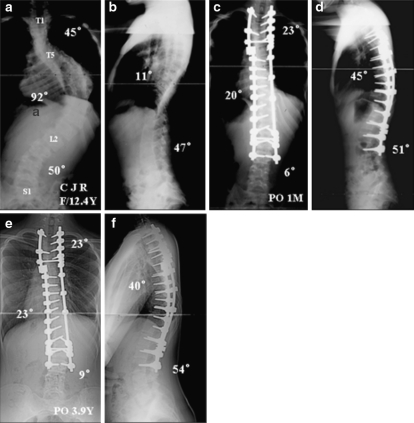
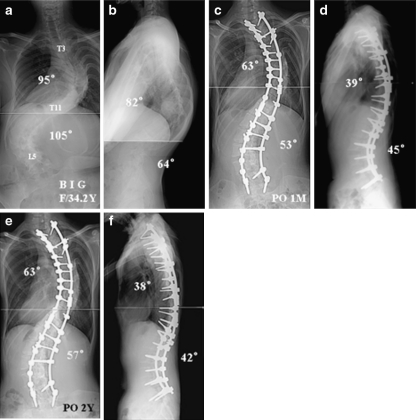
With the advent of segmental pedicle screw fixation that enables more powerful corrective forces, it is postulated that an additional anterior procedure may be unnecessary even in severe deformities. The purpose of this paper is to evaluate the results of a posterior procedure alone using segmental pedicle screw fixation in severe scoliotic curves over 70 degrees . Thirty-five scoliosis patients treated by pedicle screw fixation and rod derotation were retrospectively analyzed after a minimum follow-up of 2 years (range 2-10.4). The mean age of patients was 15.3 years (range 9.8-34.2). Diagnoses were idiopathic scoliosis in 29, neuromuscular scoliosis in 3 and scoliosis associated with Marfan syndrome in 3. Scoliosis consisted of single thoracic curve in 18, double thoracic in 5 and double major in 12. Twenty-five patients showed a major thoracic curve greater than 70 degrees (range 70-100), and different ten patients showed a major lumbar curve greater than 70 degrees (range 70-105), pre-operatively. The deformity angle, lowest instrumented vertebral tilt (LIVT) and spinal balance were measured. Pre-operatively there were nine patients with coronal decompensation. The pre-operative thoracic curve of 80 +/- 9 degrees with the flexibility of 45 +/- 11% (45 +/- 11 degrees in side-bending film) was corrected to 27 +/- 10 degrees at the most recent follow-up, showing a correction of 66% (53 degrees) and loss of correction of 3.0% (3.7 degrees). The pre-operative lumbar curve of 79 +/- 12 degrees with the flexibility of 62 +/- 14% (30 +/- 11 degrees in side-bending film) was corrected to 33 +/- 14 degrees at the most recent follow-up [59% (46 degrees) curve correction, 3.5% (3.0 degrees) loss of curve correction]. The pre-operative LIVT of 30 +/- 8 degrees was corrected to 11 +/- 6 degrees, showing a correction of 62% (19 degrees). Residual coronal decompensation was observed in three patients postoperatively. Pre-operative thoracic kyphosis of 27 degrees (range 0-82) improved postoperatively to 31 degrees (range 14-53). In conclusion, posterior segmental pedicle screw fixation without anterior release in severe scoliosis had satisfactory deformity correction without significant loss of curve correction. In this series a posterior procedure alone obviated the need for the anterior release and avoided complications related anterior surgery.
Figures
References
-
- Boucher HH (1559) A method of spinal fusion. J Bone Joint Surg 41-B:248–259 - PubMed
MeSH terms
LinkOut - more resources
Full Text Sources
Other Literature Sources
Medical
