


Actinobacillus actinomycetemcomitans lipopolysaccharide-mediated experimental bone loss model for aggressive periodontitis
- PMID: 17335380
- PMCID: PMC2683373
- DOI: 10.1902/jop.2007.060321
Actinobacillus actinomycetemcomitans lipopolysaccharide-mediated experimental bone loss model for aggressive periodontitis
Abstract
Background: Bacterial constituents, such as Gram-negative derived lipopolysaccharide (LPS), can initiate inflammatory bone loss through induction of host-derived inflammatory cytokines. The aim of this study was to establish a model of aggressive inflammatory alveolar bone loss in rats using LPS derived from the periodontal pathogen Actinobacillus actinomycetemcomitans.
Methods: Eighteen female Sprague-Dawley rats were divided into LPS test (N = 12) and saline control (N = 6) groups. All animals received injections to the palatal molar gingiva three times per week for 8 weeks. At 8 weeks, linear and volumetric alveolar bone loss was measured by micro-computed tomography (microCT). The prevalence of inflammatory infiltrate, proinflammatory cytokines, and osteoclasts was assessed from hematoxylin and eosin, immunohistochemical, or tartrate-resistant acid phosphatase (TRAP)-stained sections. Statistical analysis was performed.
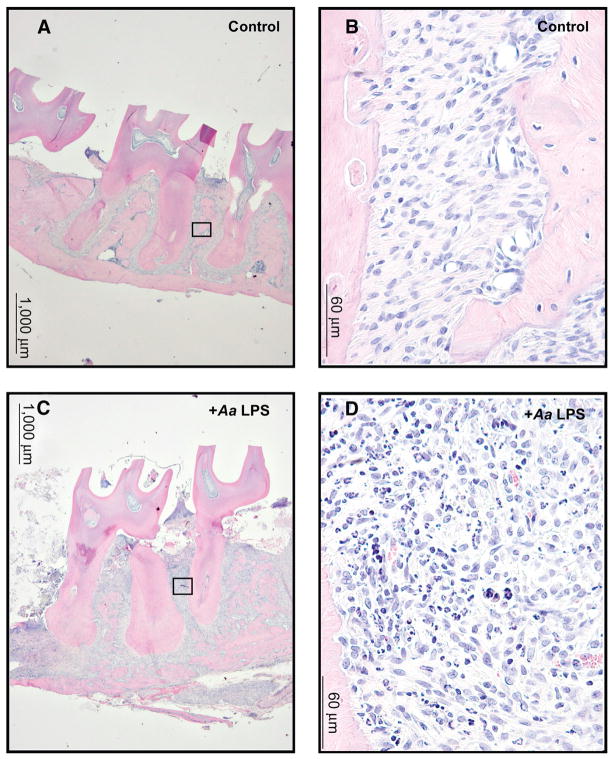
Results: A. actinomycetemcomitans LPS induced severe bone loss over 8 weeks, whereas control groups were unchanged. Linear and volumetric analysis of maxillae by microCT indicated significant loss of bone with LPS administration. Histologic examination revealed increased inflammatory infiltrate, significantly increased immunostaining for interleukin IL-6 and -1beta and tumor necrosis factor-alpha, and more TRAP-positive osteoclasts in the LPS group compared to controls.
Conclusion: Oral injections of LPS derived from the periodontal pathogen A. actinomycetemcomitans can induce severe alveolar bone loss and proinflammatory cytokine production in rats by 8 weeks.
Figures



References
-
- Akira S, Hemmi H. Recognition of pathogen-associated molecular patterns by TLR family. Immunol Lett. 2003;85:85–95. - PubMed
-
- Genco CA, Van Dyke T, Amar S. Animal models for Porphyromonas gingivalis-mediated periodontal disease. Trends Microbiol. 1998;6:444–449. - PubMed
-
- Listgarten MA, Wong MY, Lai CH. Detection of Actinobacillus actinomycetemcomitans, Porphyromonas gingivalis, and Bacteroides forsythus in an A. actinomycetemcomitans-positive patient population. J Periodontol. 1995;66:158–164. - PubMed
-
- Lee HJ, Kang IK, Chung CP, Choi SM. The subgingival microflora and gingival crevicular fluid cytokines in refractory periodontitis. J Clin Periodontol. 1995;22:885–890. - PubMed
-
- Leng SX, Elias JA. Interleukin-11 inhibits macrophage interleukin-12 production. J Immunol. 1997;159:2161–2168. - PubMed
