Treatment of cryptosporidiosis in immunocompromised individuals: systematic review and meta-analysis
- PMID: 17335543
- PMCID: PMC2203234
- DOI: 10.1111/j.1365-2125.2007.02873.x
Treatment of cryptosporidiosis in immunocompromised individuals: systematic review and meta-analysis
Abstract
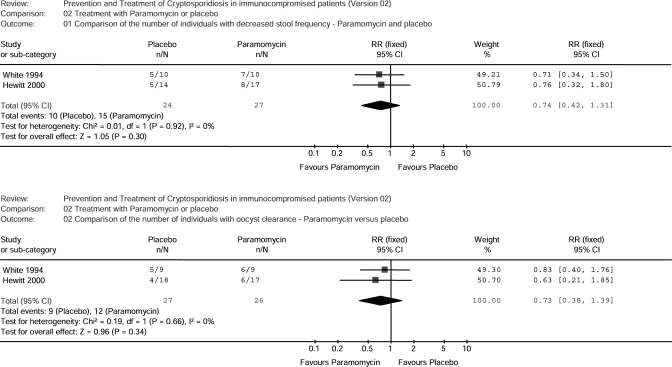
Cryptosporidium is a common cause of gastroenteritis and is associated with severe life-threatening illness among immunocompromised individuals. This review aimed to assess the efficacy of interventions for the treatment and prevention of cryptosporidiosis among immunocompromised patients. A search of Medline, Embase and other electronic databases was carried out up to August 2005. Two reviewers independently extracted data and assessed study quality. The relative risk for each intervention was calculated. Seven trials involving 169 participants were included. Nitazoxanide and paramomycin were associated with a relative risk (RR) of reduction in the duration and frequency of diarrhoea of 0.83 [95% confidence interval (CI) 0.36, 1.94] and 0.74 (95% CI 0.42, 1.31), respectively, showing no evidence of effectiveness. Nitazoxanide led to significant evidence of oocyst clearance compared with placebo with a RR of 0.52 (95% CI 0.30, 0.91). The effect was not significant for HIV-seropositive participants (RR 0.71, 95% CI 0.36, 1.37). HIV-seronegative participants on nitazoxanide had a significantly higher relative risk of achieving parasitological clearance of 0.26 (95% CI 0.09, 0.80) based on a single study. No other intervention was associated with either a reduction in diarrhoea, mortality or a significant parasitological response. This review confirms the absence of evidence for effective agents in the management of cryptosporidiosis. The results indicate that nitaxozanide reduces load of parasites and may be useful in immunocompetent individuals. The absence of effective therapy highlights the importance of preventive interventions in this group of patients.
Figures

References
-
- Havelaar A, Boonyakarnkul T, Cunliffe D, Grabow W, Sobsey M, Giddings M, Magara Y, Ohanian E, Toft P, Chorus I, Cotruvo J, Howard G, Jackson P. Guidelines for Drinking Water Quality Water Borne Pathogens. 3. Geneva: WHO; 2003.
-
- MacKenzie WR, Hoxie NJ, Proctor ME, Gradus MS, Blair KA, Peterson DE, Kazmierczak JJ, Addiss DG, Fox KR, Rose JB. A massive outbreak in Milwaukee of cryptosporidium infection transmitted through the public water supply. N Engl J Med. 1994;331:161–7. - PubMed
-
- McLauchlin J, Amar C, Pedraza-Diaz S, Nichols GL. Molecular epidemiological analysis of Cryptosporidium spp. in the United Kingdom: results of genotyping Cryptosporidium spp. in 1,705 fecal samples from humans and 105 fecal samples from livestock animals. J Clin Microbiol. 2000;38:3984–90. - PMC - PubMed
Publication types
MeSH terms
Substances
LinkOut - more resources
Full Text Sources
Other Literature Sources
Medical