


The use of clinical profiles in the investigation of foodborne outbreaks in restaurants: United States, 1982-1997
- PMID: 17335632
- PMCID: PMC2870766
- DOI: 10.1017/S0950268807008199
The use of clinical profiles in the investigation of foodborne outbreaks in restaurants: United States, 1982-1997
Abstract
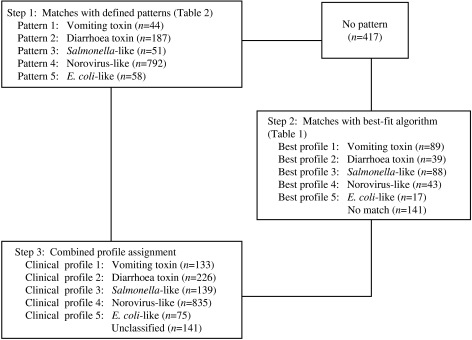
Improving the efficiency of outbreak investigation in restaurants is critical to reducing outbreak-associated illness and improving prevention strategies. Because clinical characteristics of outbreaks are usually available before results of laboratory testing, we examined their use for determining contributing factors in outbreaks caused by restaurants. All confirmed foodborne outbreaks reported to the Centers for Disease Control and Prevention (CDC) from 1982 to 1997 were reviewed. Clinical profiles were developed based on outbreak characteristics. We compared the percentage of contributing factors by known agent and clinical profile to their occurrence in outbreaks of unclassified aetiology. In total, 2246 foodborne outbreaks were included: 697 (31%) with known aetiology and 1549 (69%) with aetiology undetermined. Salmonella accounted for 65% of outbreaks with a known aetiology. Norovirus-like clinical profiles were noted in 54% of outbreaks with undetermined aetiology. Improper holding times and temperatures were associated with outbreaks caused by Clostridium perfringens, Bacillus cereus, Staphylococcus aureus, and Salmonella, and also with outbreaks of undetermined aetiology that fitted diarrhoea-toxin and vomiting-toxin clinical profiles. Poor personal hygiene was associated with norovirus, Shigella, and Salmonella, and also with outbreaks that fitted norovirus-like and vomiting-toxin clinical profiles. Contributing factors were similar for outbreaks with known aetiology and for those where aetiology was assigned by corresponding clinical profile. Rapidly categorizing outbreaks by clinical profile, before results of laboratory testing are available, can help identification of factors which contributed to the occurrence of the outbreak and will promote timely and efficient outbreak investigations.
Figures
References
-
- Olson SJ et al. Surveillance for foodborne disease outbreaks – United States, 1993–1997. Morbidity and Mortality Weekly Report. 2000;49:1–62. (Suppl. 1): - PubMed
-
- Deneen VC et al. The impact of foodborne calicivirus disease: The Minnesota Experience. Journal of Infectious Diseases. 2000;181:S281–283. (Suppl. 2): - PubMed
-
- Fankhauser RL et al. Molecular epidemiology of ‘Norwalk-like viruses’ in outbreaks of gastroenteritis in the United States. Journal of Infectious Diseases. 1998;178:1571–1578. - PubMed
Publication types
MeSH terms
LinkOut - more resources
Full Text Sources
Medical
