Review
. 2007 Apr;17(2):185-96.
doi: 10.1016/j.conb.2007.02.006. Epub 2007 Mar 2.

The neuroscience of remote memory

Affiliations
Review

The neuroscience of remote memory

Larry R Squire et al. Curr Opin Neurobiol. 2007 Apr.

Abstract

Recently, there has been renewed interest in the organization and neurobiology of remote memory, and the pace of work in this area has accelerated. Yet the recent literature does not suggest that a consensus is developing, and there is disagreement about both facts and their interpretation. This article undertakes a comprehensive review of the three kinds of evidence that have been most prominent in recent discussion: studies of retrograde amnesia in memory-impaired patients who have well-characterized lesions, neuroimaging of healthy volunteers, and work with experimental animals including lesion studies, imaging and mouse genetics. The available evidence tells a coherent story and leads to some straightforward conclusions about the neuroscience of remote memory.


Figures
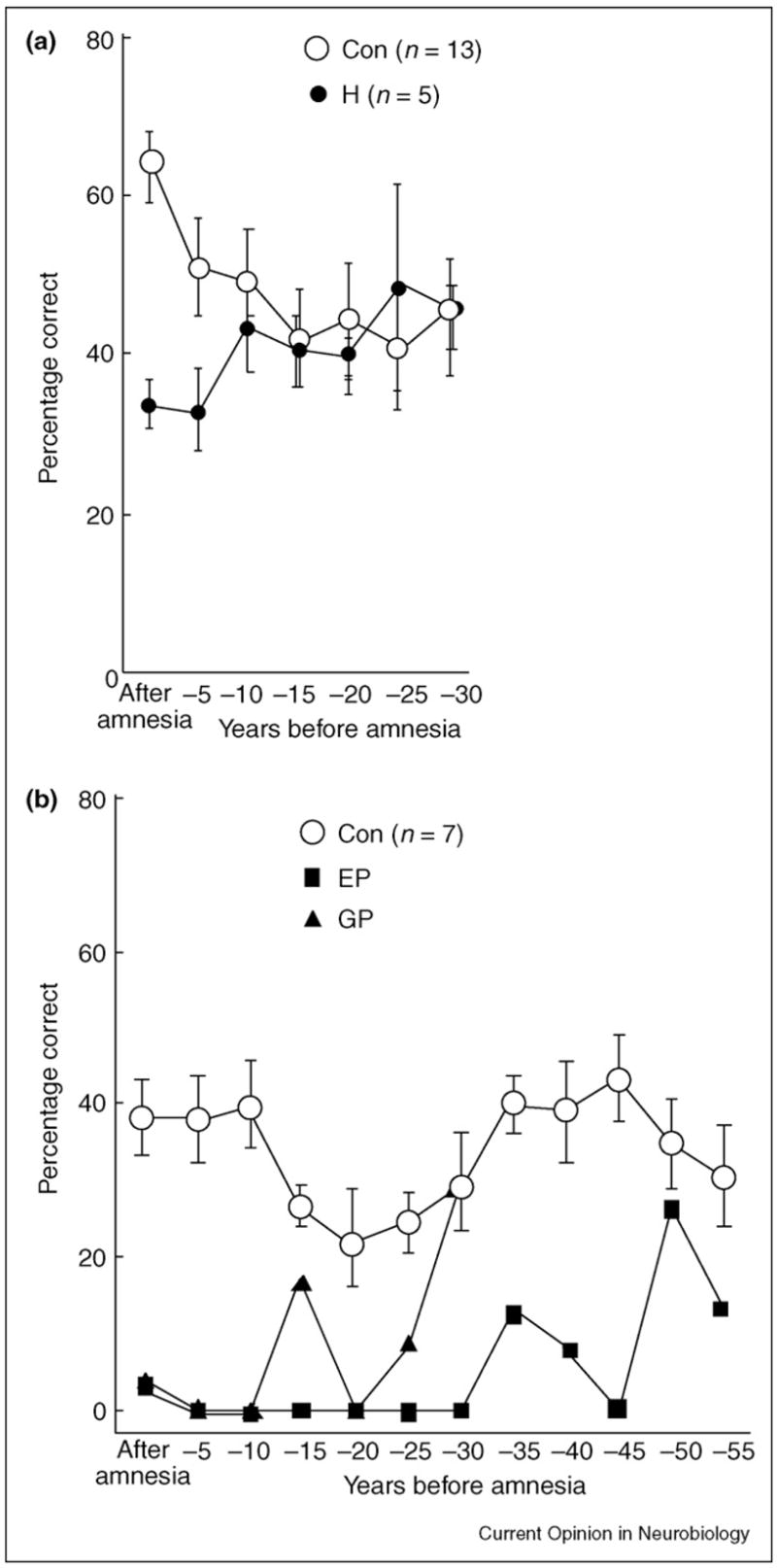
Figure 1
Figure 1
Recall performance on a test of news events. The scores of the patients have been aligned relative to the onset of their amnesia, so that performance can be shown for the time period after the onset of amnesia and for five-year intervals preceding the onset of amnesia (retrograde amnesia). The data point at –5 represents 1–5 years before amnesia, the point at –10 represents 6–10 years before amnesia, and so on. Brackets show standard error of the mean. (a) The scores for six patients with damage limited primarily to the hippocampal region (H) and 13 controls (Con) on 279 questions about news events that had occurred 1951–2005. (b) The scores for two patients (EP and GP) with large medial temporal lobe lesions and seven controls (Con) on questions about 279 news events that had occurred 1951–2005 (GP) or 300 news events that had occurred 1938–2005 (EP and the controls). GP became amnesic at the age of 41, and EP became amnesic at the age of 70. Adapted from [10•].
Figure 2
Figure 2
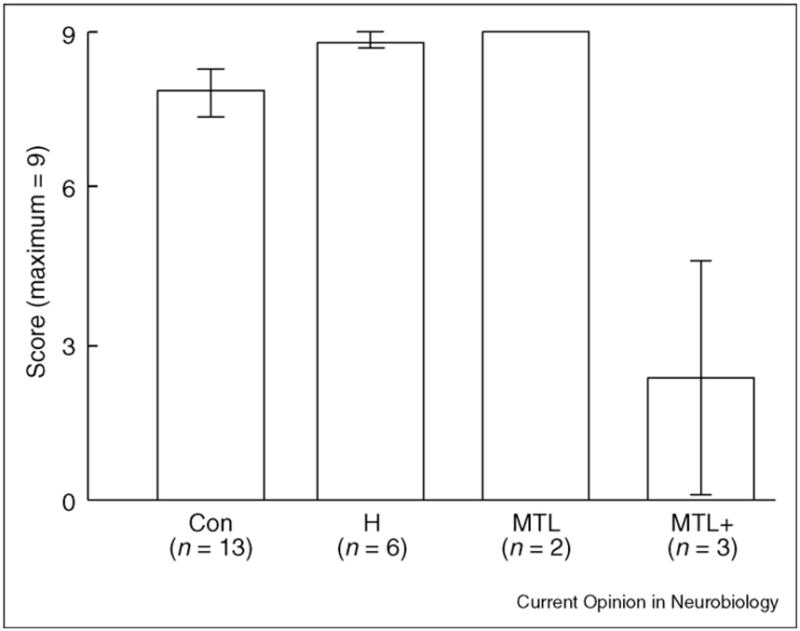
Performance on the childhood portion of the autobiographical memory interview (maximum score = 9). Abbreviations: Con, controls; H, patients who have circumscribed hippocampal lesions; MTL, patients EP and GP, who have large medial temporal lobe lesions; MTL+, patients with medial temporal lobe lesions and additional damage in the neocortex. Brackets show standard error of the mean. Adapted from [10•,27•].
Figure 3
Figure 3
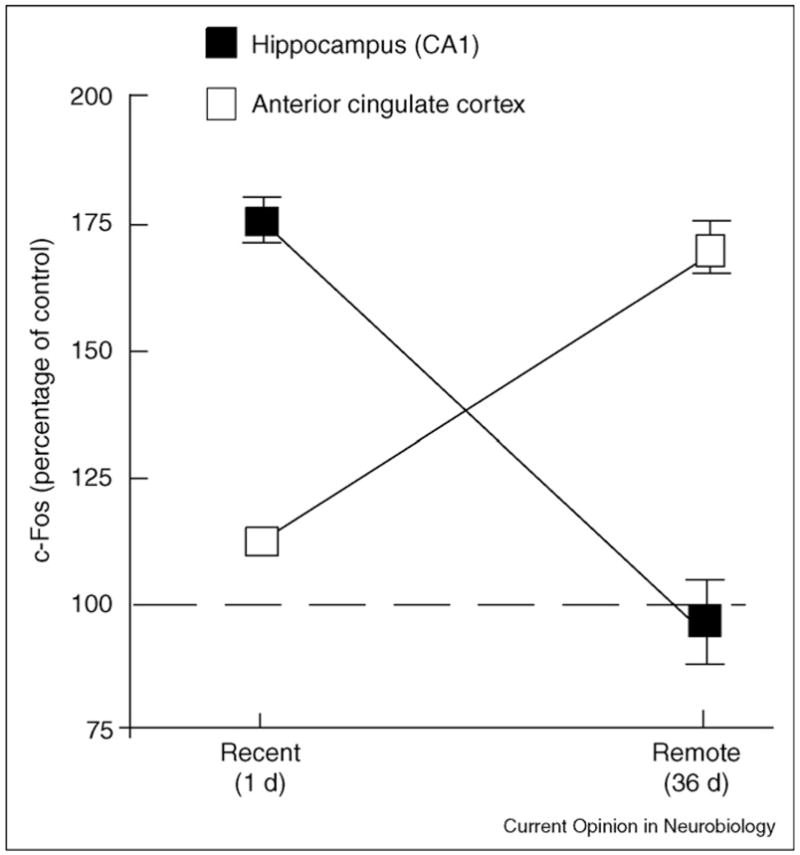
Expression of the activity-dependent gene c-Fos after recent and remote memory tests for contextual fear conditioning in mice. c-Fos expression is shown in two different brain regions as a percentage relative to controls that were not given footshock. The anterior cingulate cortex was one of several cortical regions that were more active during the remote test than during the recent test. Adapted, with permission, from [83].

References

    1. Ribot T. Les Maladies de la Memoire [English translation: Diseases of Memory] New York: Appleton-Century-Crofts; 1881.
    1. Russell WR, Nathan PW. Traumatic amnesia. Brain. 1946;69:280–300. - PubMed
    1. Sanders HI, Warrington DK. Memory for remote events in amnesic patients. Brain. 1971;94:661–668. - PubMed
    1. Squire LR, Slater PC, Chace PM. Retrograde amnesia: temporal gradient in very long-term memory following electroconvulsive therapy. Science. 1975;187:77–79. - PubMed
    1. Manns JR, Hopkins RO, Squire LR. Semantic memory and the human hippocampus. Neuron. 2003;38:127–133. - PubMed

Publication types

Substances