Review
. 2007 Mar;4(3 Suppl):S17-23.
doi: 10.1016/j.hrthm.2006.12.021. Epub 2006 Dec 15.

Triggered activity and atrial fibrillation

Affiliations
Review

Triggered activity and atrial fibrillation

Andrew L Wit et al. Heart Rhythm. 2007 Mar.

Abstract

In 1999, Haissaguerre et al published a landmark article showing that atrial fibrillation can be initiated by electrical activity in the pulmonary veins. Not only does it appear that electrical activity in the veins initiates fibrillation, but it also may be responsible for perpetuating fibrillation. Subsequently, similar evidence has suggested that other thoracic veins (vena cavae, coronary sinus, ligament of Marshall) initiate and perpetuate atrial fibrillation. How does electrical impulse initiation occur in the veins? The results of numerous in vivo and in vitro studies on this subject have not conclusively defined a mechanism. Impulse initiation by automaticity and triggered activity as well as impulse initiation resulting from reentry have been suggested. In this article, we focus only on those data suggesting the possibility that triggered activity initiates and/or perpetuates atrial fibrillation.


Figures
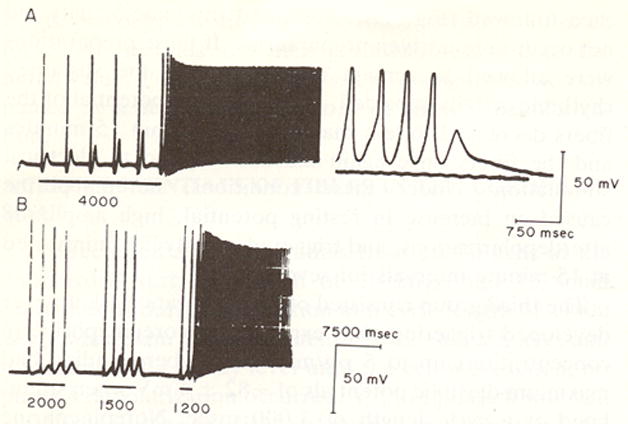
Figure 1
Figure 1
Transmembrane action potentials recorded from canine coronary sinus tissue in vitro. In A the preparation was stimulated at a cycle length of 4000 msec. DADs occur and get larger after each stimulated impulse until rapid triggered activity occurred. At the far right the time base was expanded and the shape of the triggered action potentials can be seen. Panel B shows effects of decreasing stimulation cycle length from 2000-1200 msec. DAD amplitude increases as stimulation cycle length is reduced until triggered activity occurred. (Reproduced from Wit and Cranefield Circ Res 1977 with permission)
Figure 2
Figure 2
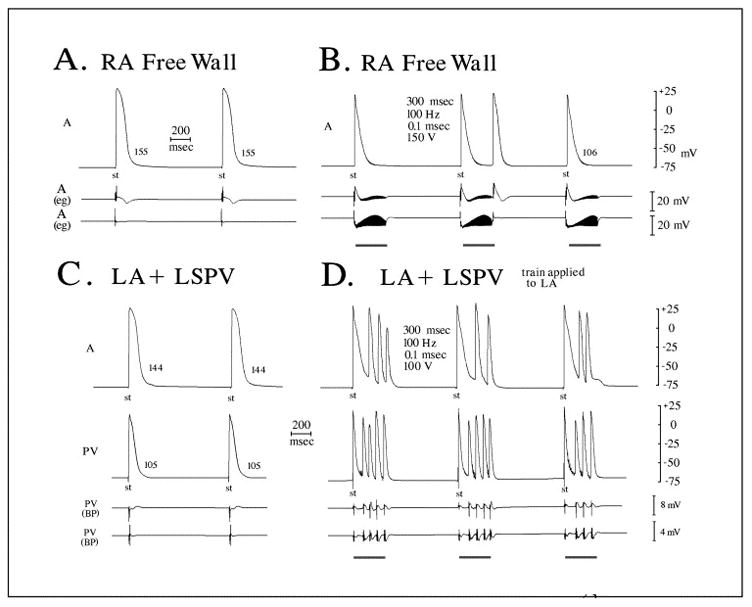
Autonomic nerve stimulation within right atrial free wall and within left atrium (LA) attached to pulmonary veins (PVs). A, B: Microelectrode and bipolar electrogram recordings from right atrial free wall (RA) before and during a maximal 150-V stimulus train. Although shortening is observed, only a break-shock beat is observed with stimulation. No arrhythmia was observed at less intense stimulus intensities. C, D: Microelectrode recordings from the left atrium (LA) and left superior pulmonary vein (LSPV) before and during a stimulus train introduced into LA myocardium, 3 mm from the PV os. Although shortening of the action potential is observed in both atrial and pulmonary vein recordings, triggered firing originates at a rapid rate within the PV sleeve 6 to 7 mm from the site where the stimulus train is introduced. The first beat appears earliest within the PV and precedes LA activation. (Reproduced from Patterson et al Heart Rhythm 2005;2:624 with permission))
Figure 3
Figure 3
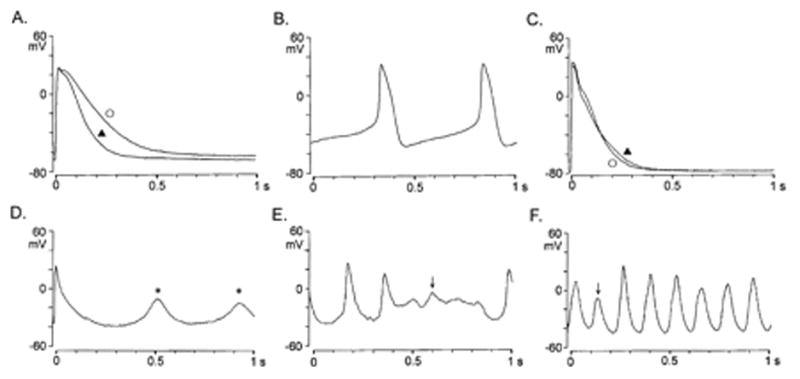
Action potential (APs) configurations and afterpotentials in control and right atrial paced (RAP) dog pulmonary vein myocytes (PVs). A and B, APs of control dog PV cardiomyocytes without and with pacemaker activity. C, APs of RAP dog PV cardiomyocytes without pacemaker activity; D, DAD in right atrial paced dog PV pacemaker cardiomyocytes during electrical stimulation at a rate of 0.1 Hz in normal Tyrode’s solution. E and F, EAD generated at depolarized levels during spontaneous beating. Electrical stimuli at 1 Hz (‘) and 0.1 Hz (_). Arrows indicate EAD; *, DAD. (Reproduced from Chen et al, Circulation. 2001;104:2849–2854 with permission.)
Figure 4
Figure 4
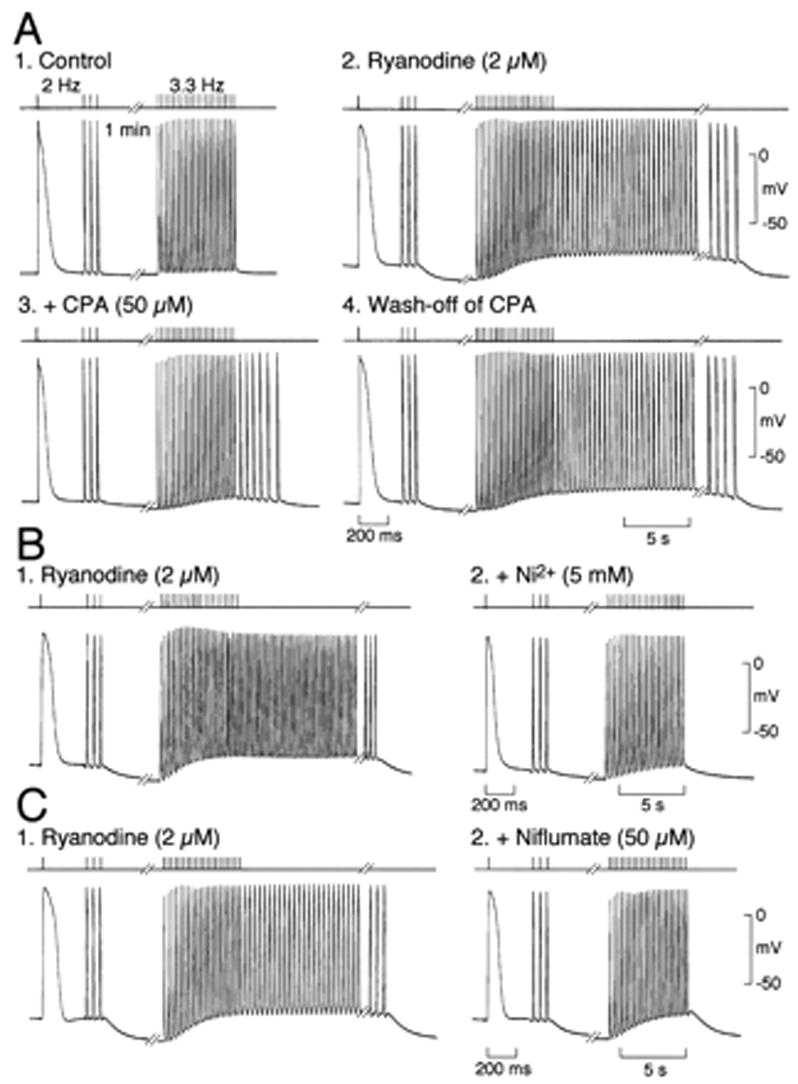
Effect of interventions that affect intracellular Ca2+ handling on pacing-induced spontaneous activity in PVMS from rabbit.. Stimulation in control superfusate, (A1) after treatment with 2 umol/L ryanodine (A2), in presence of 50 umol/L CPA after wash-off of ryanodine (A3), and after wash-off of cyclopiazonic acid (CPA) (A4). B, Same protocol after treatment with 2 umol/L ryanodine (B1) and in presence of 5 mmol/L Ni2 after wash-off of ryanodine (B2). C, Same protocol after treatment with 2 umol/L ryanodine (Ry) (C1) and in presence of 50 umol/L niflumate after wash-off of ryanodine (C2). Top, stimuli; bottom, membrane potential. (Reproduced from Honjo et al Circulation 107, 1937–1943 with permission)

References

    1. Mechanisms and Treatment. Blackwell Futura: 2004. Thoracic Vein Arrhythmias.
    1. Cranefield PF, Aronson RS. Cardiac Arrhythmias: The Role of Triggered Activity. 1. Mount Kisco: Futura Publishing Co. Inc; 1988.
    1. Wit AL, Janse MJ. Electrophysiological Mechanisms. Mount Kisco, NY: Futura Publishing Co, Inc; 1993. The Ventricular Arrhythmias of Ischemia and Infarction.
    1. Volkmer M, Antz M, Hebe J, Kuck KH. Focal atrial tachycardia originating from the musculature of the coronary sinus. J Cardiovasc Electr. 2002;13:68–71. - PubMed
    1. Oral H, Ozaydin M, Chugh A, Scharf C, Tada H, Hall B, Cheung P, Pelosi F, Knight BP, Morady F. Role of coronary sinus in maintenance of atrial fibrillation. J Cardiovasc Electr. 2003;14:1329–1336. - PubMed

Publication types

MeSH terms