


Intracardiac atrial defibrillation
- PMID: 17336885
- PMCID: PMC1868675
- DOI: 10.1016/j.hrthm.2006.12.030
Intracardiac atrial defibrillation
Abstract
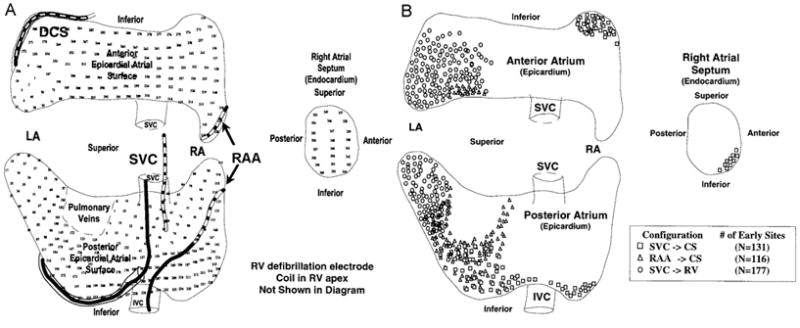
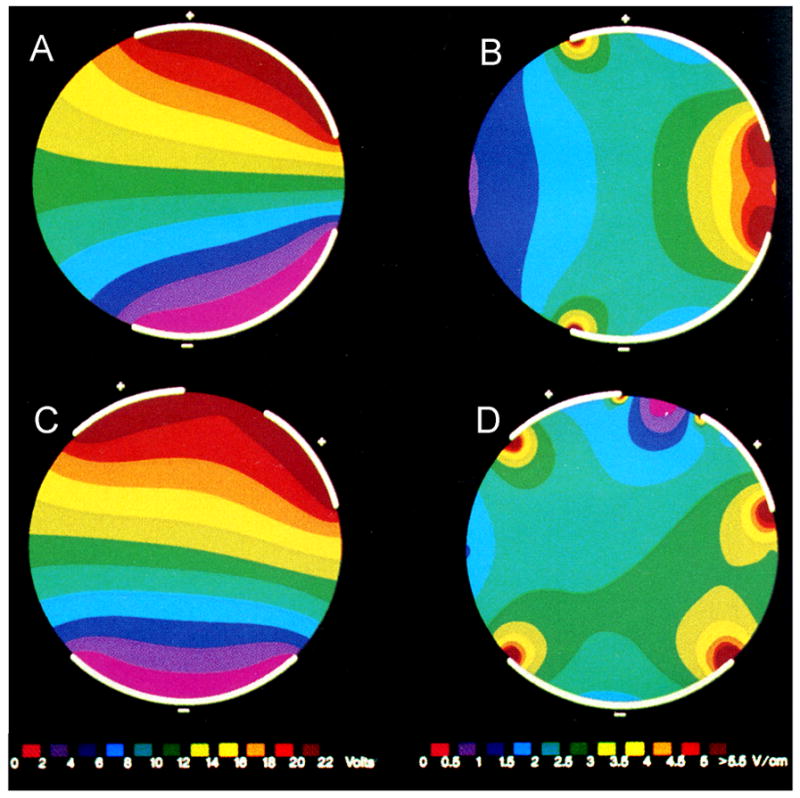
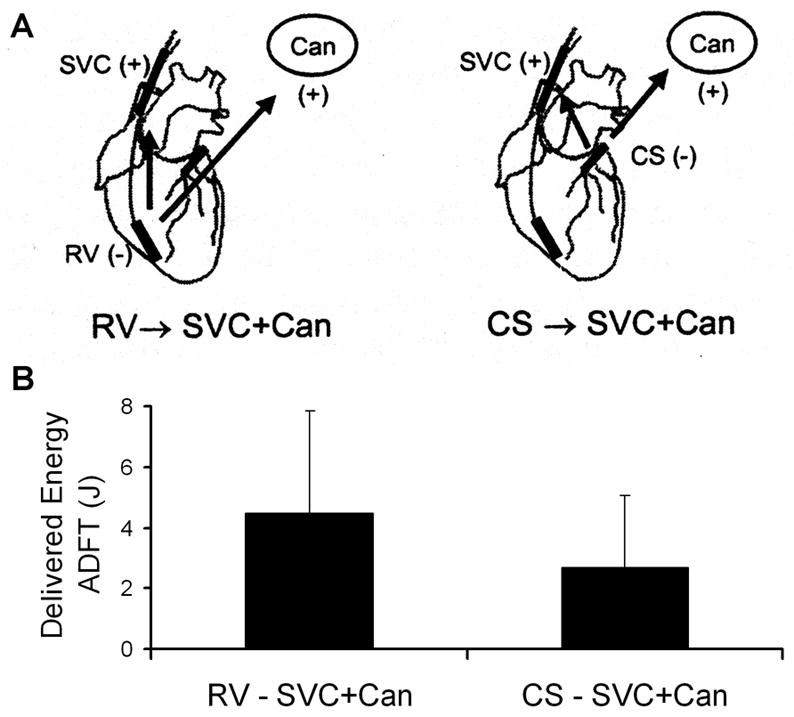
Intravascular ventricular defibrillation and intravascular atrial defibrillation have many similarities. An important factor influencing the outcome of the shock is the potential gradient field created throughout the ventricles or the atria by the shock. A minimum potential gradient is required throughout the ventricles and probably the atria in order to defibrillate. The value of this minimum potential gradient is affected by several factors, including the duration, tilt, and number of phases of the waveform. For shock strengths near the defibrillation threshold, earliest activation following failed shocks arises in a region in which the potential gradient is low. The defibrillation threshold energy can be decreased by adding a third and even a fourth defibrillation electrode in regions where the shock potential gradient is low for the shock field created by the first two defibrillation electrodes and giving two sequential shocks, each through a different set of electrodes. However, the addition of more electrodes and sequential shocks complicates both the device and its implantation. Because patients are conscious when the atrial defibrillation shock is given, they experience pain during the shock, which is one of the main drawbacks of intravascular atrial defibrillation. Unfortunately, the pain threshold for defibrillation shocks is so low that a shock less than 1 J is uncomfortable and is not much less painful than shocks several times stronger. Therefore, even though electrode configurations exist that have lower atrial defibrillation threshold energy requirements than the atrial defibrillation threshold with standard defibrillation electrode configurations used in implantable cardioverter-defibrillators (ICDs) for ventricular defibrillation, they are not clinically practical because their shocks are almost as painful as with the standard ICD electrode configurations. Such electrode configurations would make the ICD more complicated, leading to greater difficulty and longer time required for implantation.
Figures
References
-
- Go AS, Hylek EM, Phillips KA, Chang Y, Henault LE, Selby JV, Singer DE. Prevalence of diagnosed atrial fibrillation in adults: national implications for rhythm management and stroke prevention: the AnTicoagulation and Risk Factors in Atrial Fibrillation (ATRIA) Study. JAMA. 2001;285:2370–2375. - PubMed
-
- Fuster V, Ryden LE, Cannom DS, Crijns HJ, Curtis AB, Ellenbogen KA, Halperin JL, Le Heuzey JY, Kay GN, Lowe JE, Olsson SB, Prystowsky EN, Tamargo JL, Wann S, Smith SC, Jr, Jacobs AK, Adams CD, Anderson JL, Antman EM, Hunt SA, Nishimura R, Ornato JP, Page RL, Riegel B, Priori SG, Blanc JJ, Budaj A, Camm AJ, Dean V, Deckers JW, Despres C, Dickstein K, Lekakis J, McGregor K, Metra M, Morais J, Osterspey A, Zamorano JL. ACC/AHA/ESC 2006 Guidelines for the Management of Patients with Atrial Fibrillation: a report of the American College of Cardiology/American Heart Association Task Force on Practice Guidelines and the European Society of Cardiology Committee for Practice Guidelines (Writing Committee to Revise the 2001 Guidelines for the Management of Patients With Atrial Fibrillation): developed in collaboration with the European Heart Rhythm Association and the Heart Rhythm Society. Circulation. 2006;114:e257–354. - PubMed
-
- Mittal S, Ayati S, Stein KM, Schwartzman D, Cavlovich D, Tchou PJ, Markowitz SM, Slotwiner DJ, Scheiner MA, Lerman BB. Transthoracic cardioversion of atrial fibrillation: comparison of rectilinear biphasic versus damped sine wave monophasic shocks. Circulation. 2000;101:1282–1287. - PubMed
-
- Niebauer MJ, Brewer JE, Chung MK, Tchou PJ. Comparison of the rectilinear biphasic waveform with the monophasic damped sine waveform for external cardioversion of atrial fibrillation and flutter. Am J Cardiol. 2004;93:1495–1499. - PubMed
-
- Alatawi F, Gurevitz O, White RD, Ammash NM, Malouf JF, Bruce CJ, Moon BS, Rosales AG, Hodge D, Hammill SC, Gersh BJ, Friedman PA. Prospective, randomized comparison of two biphasic waveforms for the efficacy and safety of transthoracic biphasic cardioversion of atrial fibrillation. Heart Rhythm. 2005;2:382–387. - PubMed
Publication types
MeSH terms
Substances
Grants and funding
LinkOut - more resources
Full Text Sources
Other Literature Sources
Medical
