Comparative Study
. 2007 May;73(9):2777-86.
doi: 10.1128/AEM.00984-06. Epub 2007 Mar 2.

Two host-induced Ralstonia solanacearum genes, acrA and dinF, encode multidrug efflux pumps and contribute to bacterial wilt virulence

Affiliations
Comparative Study

Two host-induced Ralstonia solanacearum genes, acrA and dinF, encode multidrug efflux pumps and contribute to bacterial wilt virulence

Darby G Brown et al. Appl Environ Microbiol. 2007 May.

Abstract

Multidrug efflux pumps (MDRs) are hypothesized to protect pathogenic bacteria from toxic host defense compounds. We created mutations in the Ralstonia solanacearum acrA and dinF genes, which encode putative MDRs in the broad-host-range plant pathogen. Both mutations reduced the ability of R. solanacearum to grow in the presence of various toxic compounds, including antibiotics, phytoalexins, and detergents. Both acrAB and dinF mutants were significantly less virulent on the tomato plant than the wild-type strain. Complementation restored near-wild-type levels of virulence to both mutants. Addition of either dinF or acrAB to Escherichia coli MDR mutants KAM3 and KAM32 restored the resistance of these strains to several toxins, demonstrating that the R. solanacearum genes can function heterologously to complement known MDR mutations. Toxic and DNA-damaging compounds induced expression of acrA and dinF, as did growth in both susceptible and resistant tomato plants. Carbon limitation also increased expression of acrA and dinF, while the stress-related sigma factor RpoS was required at a high cell density (>10(7) CFU/ml) to obtain wild-type levels of acrA expression both in minimal medium and in planta. The type III secretion system regulator HrpB negatively regulated dinF expression in culture at high cell densities. Together, these results show that acrAB and dinF encode MDRs in R. solanacearum and that they contribute to the overall aggressiveness of this phytopathogen, probably by protecting the bacterium from the toxic effects of host antimicrobial compounds.


Figures
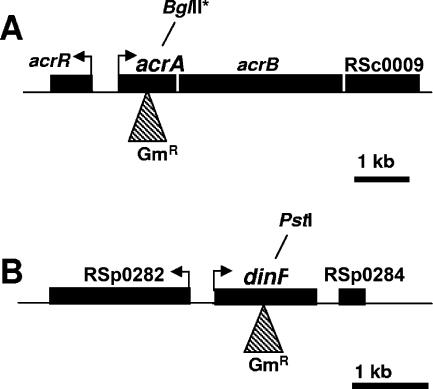
FIG. 1.
FIG. 1.
Generation of R. solanacearum acrA and dinF mutants. Mutations were created by inserting a gentamicin resistance cassette (GmR) into the ORF of either acrA (A) or dinF (B), as indicated. The arrows indicate the directions of transcription. Flanking genes are included for reference and are annotated as follows: RSc0009, encoding a drug efflux lipoprotein (NodT/FusA family); RSp0282, encoding a hypothetical amino acid permease; and RSp0284, encoding a hypothetical transmembrane protein. The asterisk indicates that the BglII site was introduced.
FIG. 2.
FIG. 2.
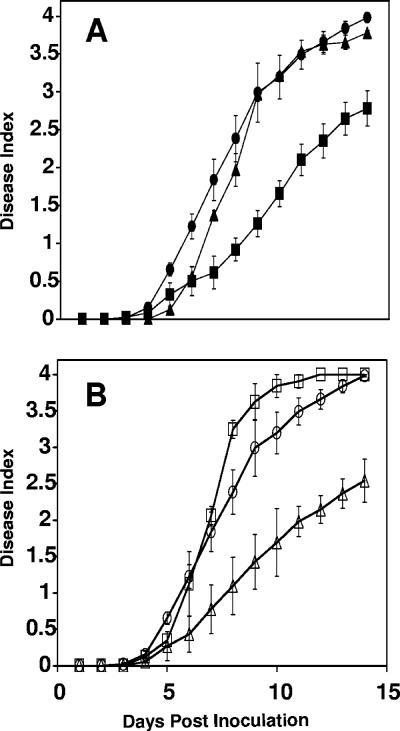
Virulence of R. solanacearum acrA and dinF strains on susceptible tomato cultivar Bonny Best is significantly reduced. The curves are disease progress curves for R. solanacearum acrA (A) and dinF (B) mutant strains. A bacterial suspension was added to the soil of 14-day-old tomato seedlings to obtain a bacterial density of approximately 3.1 × 10⁷ CFU/g of soil, and plants were rated on a disease index scale ranging from 0 to 4. (A) •, wild-type strain K60; ▪, acrA strain K1833; ▴, complemented strain K1833(pLAFacrA). (B) ○, wild-type strain K60; ▵, dinF strain KDF; □, complemented strain KDF(pLAFdinF). The symbols indicate the averages for six plant assays, each performed with 16 plants per treatment; the error bars indicate the standard errors of the means.
FIG. 3.
FIG. 3.
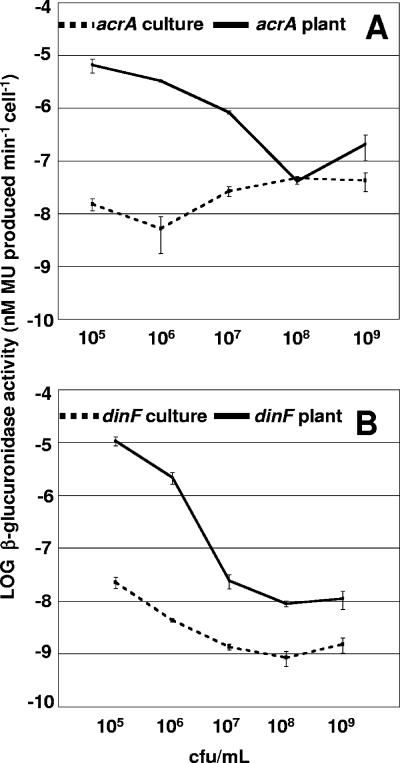
dinF and acrA are highly expressed in planta. The GUS activities produced by strains carrying a dinF::uidA or acrA::uidA transcriptional fusion were measured for cells grown to different cell densities in planta (susceptible tomato) and in vitro (minimum broth). The cell density (expressed in CFU/ml of broth or xylem fluid) is indicated on the x axis. The data are the averages ± standard errors of the means for three independent experiments performed with six plants per treatment. (A) acrA expression (in R. solanacearum strain K60 with pVOacrA); (B) dinF expression (in R. solanacearum strain K60 with pVOdinF).
FIG. 4.
FIG. 4.
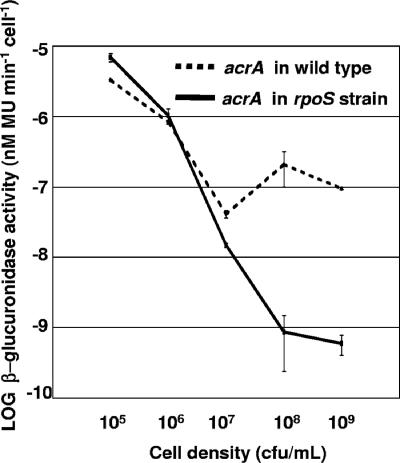
RpoS is required for full acrA expression in planta at a high cell density. GUS activity in cells grown in the susceptible tomato cultivar Bonny Best was determined. The acrA::uidA fusion was introduced into wild-type K60 cells and the rpoS mutant strain (K999). The adjusted cell density (CFU/ml of xylem fluid) is indicated on the x axis. The data are the means ± standard errors of the means for three independent measurements obtained using six plants per treatment.
FIG. 5.
FIG. 5.
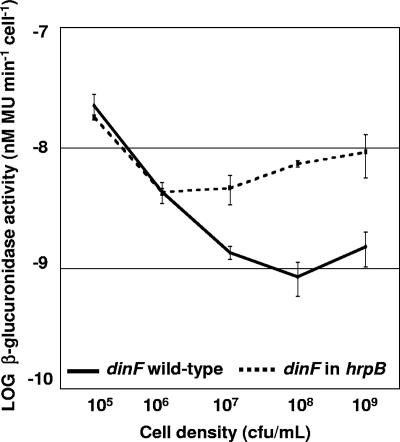
dinF expression is increased in an hrpB strain at a high cell density. The GUS activity of the dinF::uidA fusion introduced into wild-type strain K60 and the hrpB mutant strain (K200) was measured using cells grown to different cell densities in BMM supplemented with 0.2% glucose. The cell density (CFU/ml) is indicated on the x axis. The data are the averages ± standard errors of the means for three independent determinations.

References

    1. Allen, C., Y. Huang, and L. Sequeira. 1991. Cloning of genes affecting polygalacturonase production in Pseudomonas solanacearum. Mol. Plant-Microbe Interact. 4:147-154.
    1. Altschul, S. F., T. L. Madden, A. A. Schaffer, J. Zhang, Z. Zhang, W. Miller, and D. J. Lipman. 1997. Gapped BLAST and PSI-BLAST: a new generation of protein database search programs. Nucleic Acids Res. 25:3389-3402. - PMC - PubMed
    1. Arlat, M., C. L. Gough, C. Zischeck, P. A. Barberis, A. Trigalet, and C. Boucher. 1992. Transcriptional organization and expression of the large hrp gene cluster of Pseudomonas solanacearum. Mol. Plant-Microbe Interact. 5:187-193. - PubMed
    1. Ausubel, F., R. Brent, R. Kingston, D. Moore, J. Seidman, J. Smith, and K. Struhl. 1995. Short protocols in molecular biology, 3rd ed. John Wiley and Sons, New York, NY.
    1. Barabote, R. D., O. L. Johnson, E. Zetina, S. K. San Francisco, J. A. Fralick, and M. J. D. San Francisco. 2003. Erwinia chrysanthemi tolC is involved in resistance to antimicrobial plant chemicals and is essential for phytopathogenesis. J. Bacteriol. 185:5772-5778. - PMC - PubMed

Publication types

MeSH terms