. 2007 Feb;62(2):126-35.
doi: 10.1093/gerona/62.2.126.

A demographic analysis of the fitness cost of extended longevity in Caenorhabditis elegans

Affiliations

A demographic analysis of the fitness cost of extended longevity in Caenorhabditis elegans

Jianjun Chen et al. J Gerontol A Biol Sci Med Sci. 2007 Feb.

Abstract

We monitored survival and reproduction of 1000 individuals of Caenorhabditis elegans wild type (N2) and 800 individuals of clk-1 and daf-2, and used biodemographic analysis to address fitness as the integrative consequence of the entire age-specific schedules of survival and reproduction. Relative to N2, the mutants clk-1 and daf-2 extended average life span by 27% and 111%, respectively, but reduced net reproductive rate by 44% and 18%. The net result of differences in survival and fertility was a significant differential in fitness, with both clk-1 (lambda = 2.74) and daf-2 (lambda = 3.78) at a disadvantage relative to N2 (lambda = 3.85). Demographic life table response experiment (LTRE) analysis revealed that the fitness differentials were due to negative effects in mutants on reproduction in the first 6-7 days of life. Fitness costs in clk-1 and daf-2 of C. elegans are consistent with the theory of antagonistic pleiotropy for the evolution of senescence.


Figures
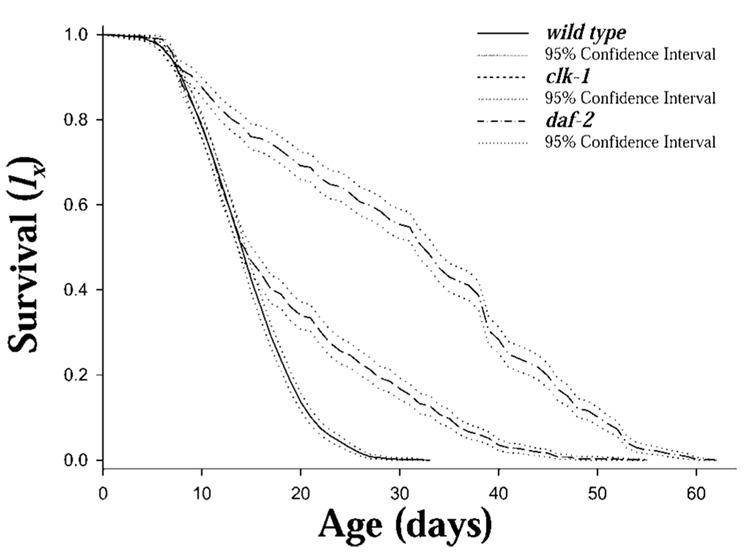
Figure 1
Figure 1
Cohort survival (lx) of Caenorhabditis elegans (strains N2, clk-1, and daf-2) maintained as individuals on nematode growth medium and OP-50 at 20°C (n=1000, 800, and 800 for N2, clk-1, and daf-2, respectively) with survival and reproduction monitored daily (bootstrap 95% confidence intervals shown).
Figure 2
Figure 2
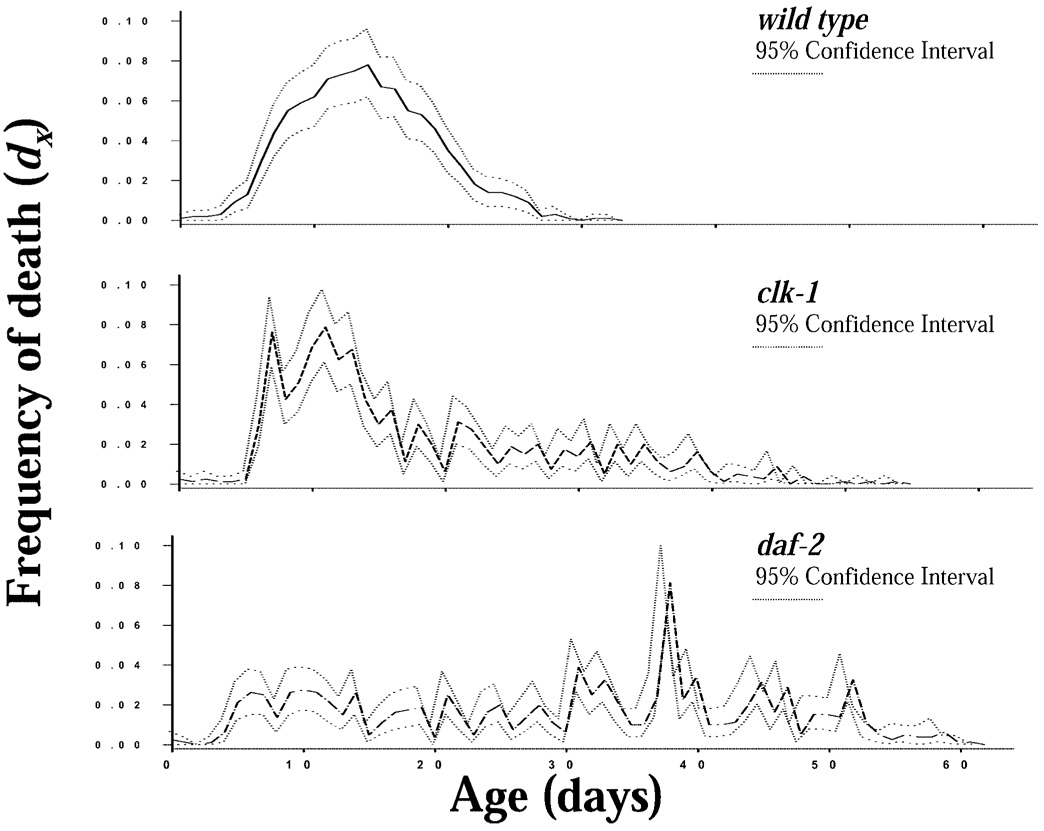
Frequency of death (dx) for cohorts of Caenorhabditis elegans (strains N2, clk-1, and daf-2) individuals maintained on nematode growth medium and OP-50 at 20°C (n=1000, 800, and 800 for N2, clk-1, and daf-2, respectively) with survival and reproduction monitored daily (bootstrap 95% confidence intervals shown).
Figure 3
Figure 3
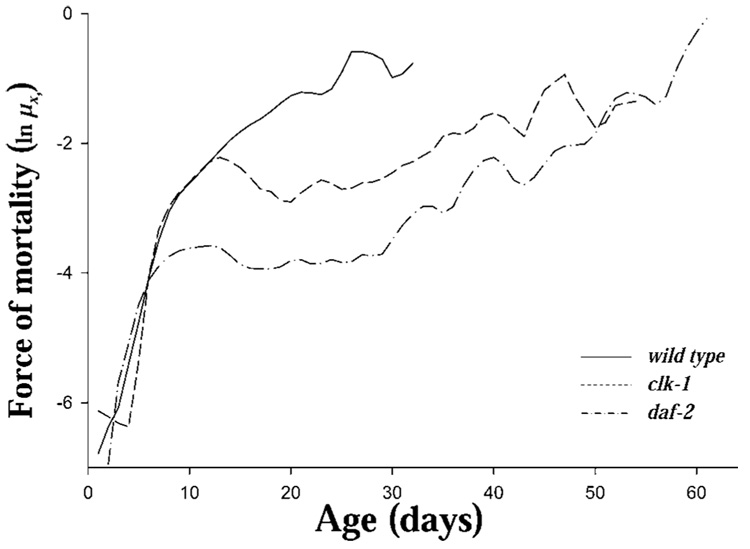
Force of mortality (µ x) for cohorts of Caenorhabditis elegans (strains N2, clk-1, and daf-2) individuals maintained on nematode growth medium and OP-50 at 20°C (n = 1000, 800, and 800 for N2, clk-1, and daf-2, respectively) with survival and reproduction monitored daily. The smoothed mortality rate curves were obtained using a locally weighted regression (LOESS) procedure.
Figure 4
Figure 4
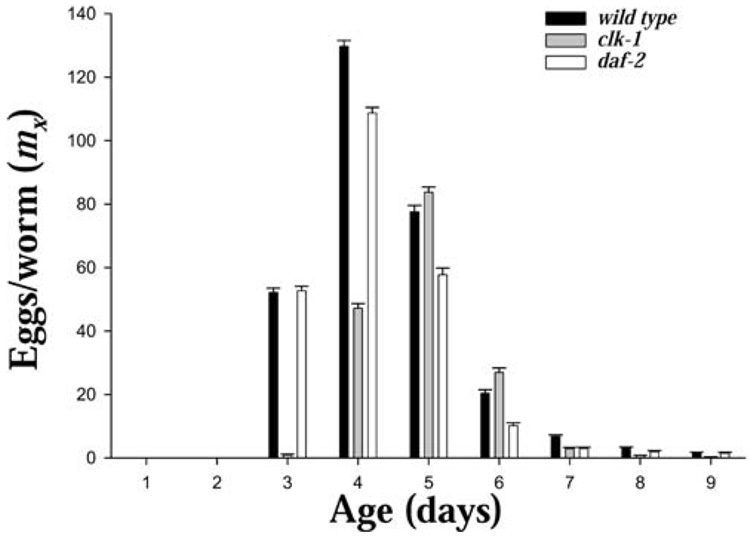
Age-specific reproduction (mx) from cohorts of Caenorhabditis elegans (strains N2, clk-1, and daf-2) maintained as individuals on nematode growth medium and OP-50 at 20°C (n = 1000, 800, and 800 for N2, clk-1, and daf-2, respectively) with survival and reproduction monitored daily (bootstrap 95% confidence intervals shown).
Figure 5
Figure 5
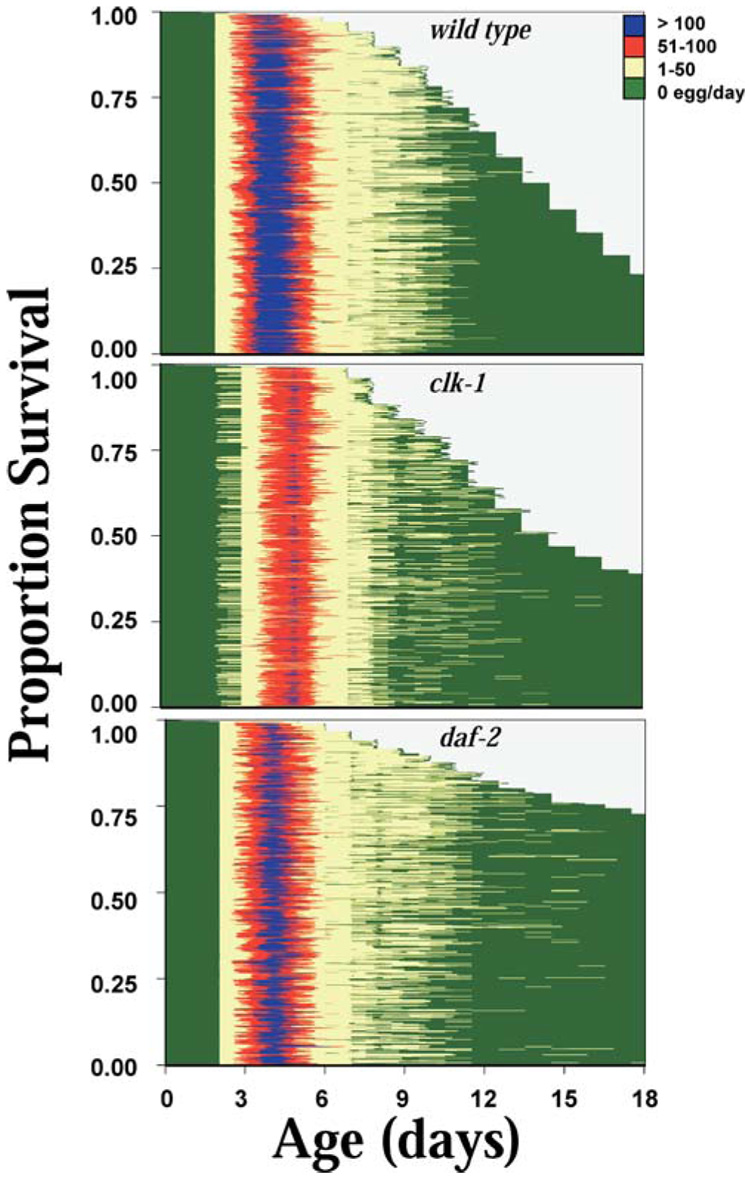
Event history diagrams showing daily survival versus age for Caenorhabditis elegans cohorts, with individual reproduction at each age indicated by color. Individuals of C. elegans (strains N2, clk-1, and daf-2) were maintained separately on nematode growth medium and OP-50 at 20°C (n = 1000, 800, and 800 for N2, clk-1, and daf-2, respectively) with survival and reproduction monitored daily.
Figure 6
Figure 6
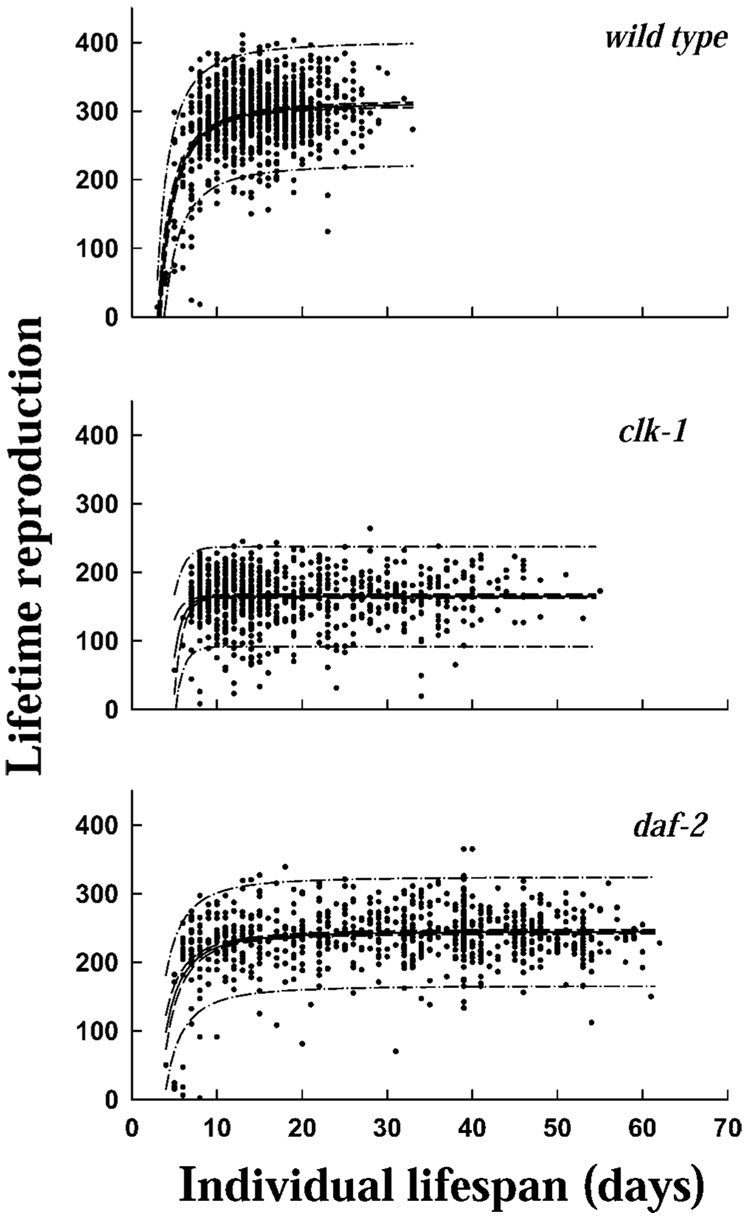
Individual life span (in days) versus lifetime total reproduction for Caenorhabditis elegans (strains N2, clk-1, and daf-2) individuals maintained separately on nematode growth medium and OP-50 at 20°C (n=1000, 800, and 800 for N2, clk-1, and daf-2, respectively) and survival and reproduction monitored daily. Curves depicted include fit, 95% confidence intervals, and 95% prediction intervals (N2: y=312 − 3201/x2, Fit Standard Error=45.4; clk-1: y=164 − 13045e−x, Fit Standard Error = 37.1; daf-2: y = 245 − 2346/x2, Fit Standard Error = 40.4).
Figure 7
Figure 7
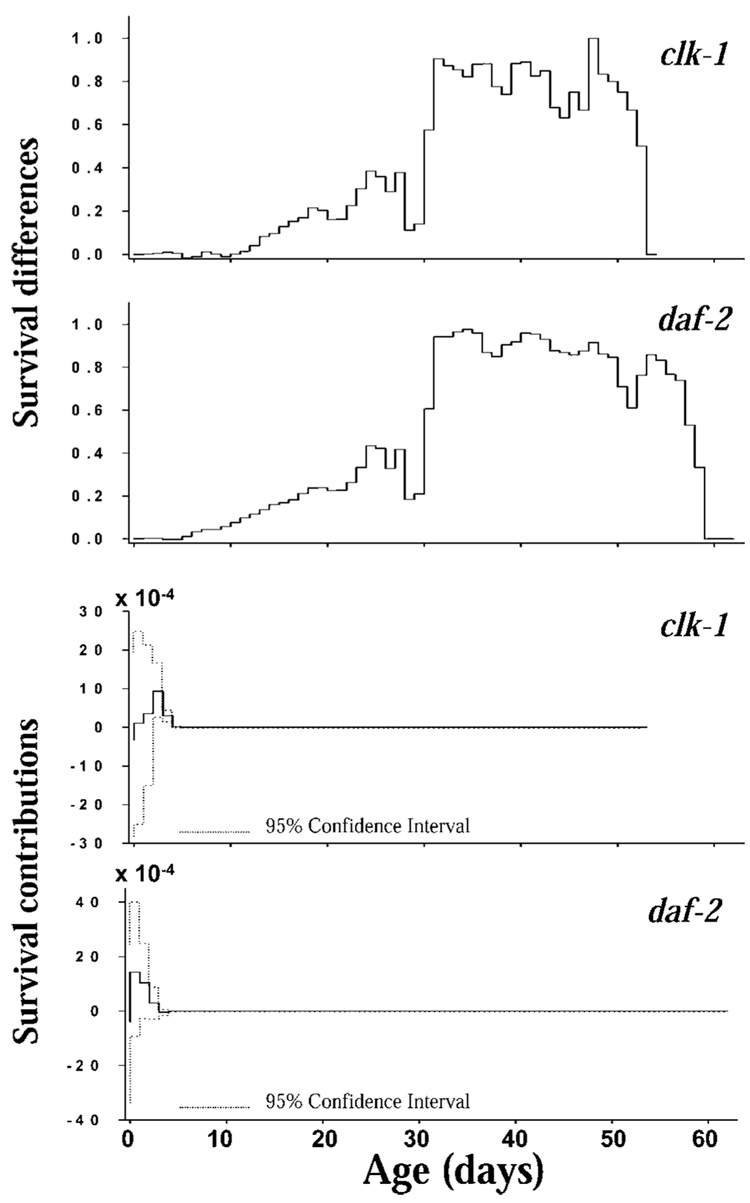
Life table response experiment analysis of the survival differences and survival contributions to fitness in clk-1 and daf-2 relative to N2 (bootstrap 95% confidence intervals shown).
Figure 8
Figure 8
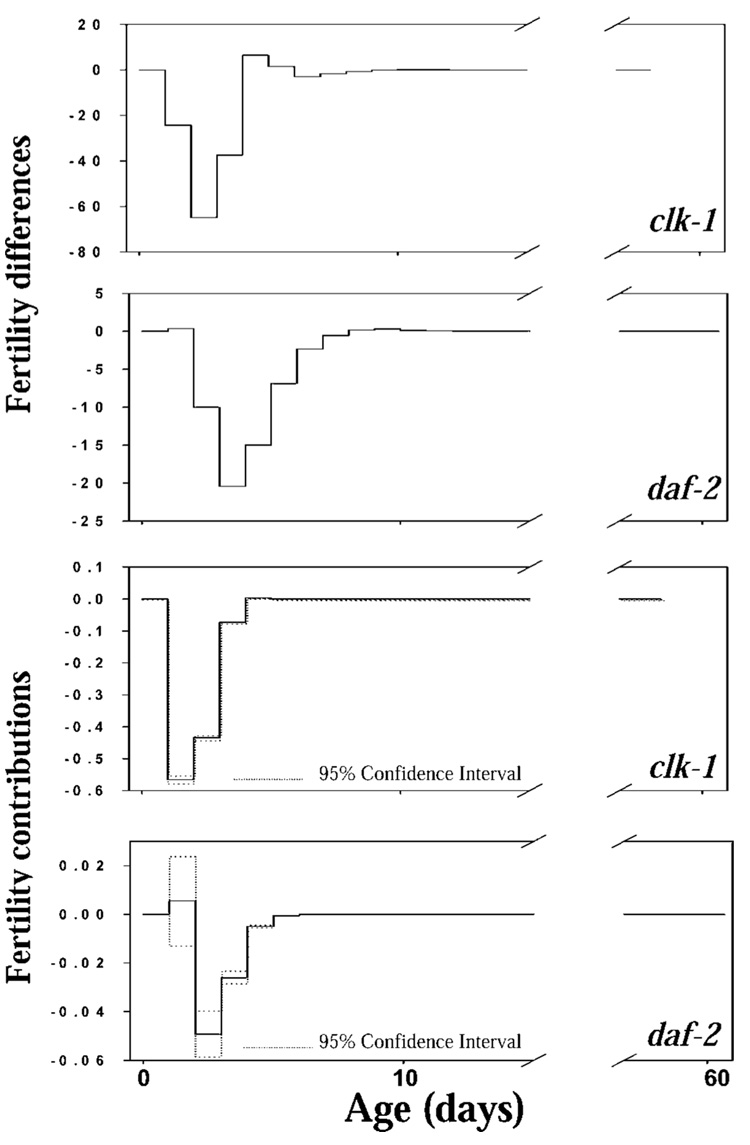
Life table response experiment analysis of the fertility differences and fertility contributions to fitness in clk-1 and daf-2 relative to N2 (bootstrap 95% confidence intervals shown).

Comment in

References

    1. Kenyon C, Chang J, Gensch E, Rudner A, Tabtiang R. A C. elegans mutant that lives twice as long as wild type. Nature. 1993;366:461–464. - PubMed
    1. Wang JL, Muller HG, Capra WB, Carey JR. Rates of mortality in populations of Caenorhabditis elegans. Science. 1994;266:827–828. - PubMed
    1. Gems D, Sutton AJ, Sundermeyer ML, et al. Two pleiotropic classes of daf-2 mutation affect larval arrest, adult behavior, reproduction and longevity in Caenorhabditis elegans. Genetics. 1998;150:129–155. - PMC - PubMed
    1. Apfeld J, Kenyon C. Regulation of lifespan by sensory perception in Caenorhabditis elegans. Nature. 1999;402:804–809. - PubMed
    1. Felkai S, Ewbank JJ, Lemieux J, Labbe JC, Brown GG, Hekimi S. CLK-1 controls respiration, behavior and aging in the nematode Caenorhabditis elegans. EMBO J. 1999;18:1783–1792. - PMC - PubMed

Publication types

Substances