


Gender and respiratory factors associated with dyspnea in chronic obstructive pulmonary disease
- PMID: 17341300
- PMCID: PMC1821020
- DOI: 10.1186/1465-9921-8-18
Gender and respiratory factors associated with dyspnea in chronic obstructive pulmonary disease
Abstract
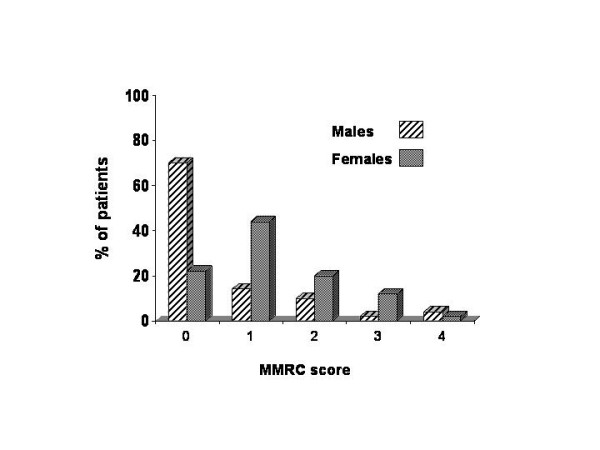
Rationale: We had shown that COPD women expressed more dyspnea than men for the same degree of airway obstruction.
Objectives: Evaluate gender differences in respiratory factors associated with dyspnea in COPD patients.
Methods: In a FEV1 % matched population of 100 men and women with COPD we measured: age, MMRC, FEV1, FVC, TLC, IC/TLC, PaO2, PaCO2, DLCO, Pimax, P0.1, Ti/Ttot, BMI, ffmi, 6MWD and VAS scale before and after the test, the Charlson score and the SGRQ. We estimated the association between these parameters and MMRC scores. Multivariate analysis determined the independent strength of those associations.
Results: MMRC correlated with: BMI (men:-0.29, p = 0.04; women:-0.28, p = 0.05), ffmi (men:-0.39, p = 0.01), FEV1 % (men:-0.64, p < 0.001; women:-0.29, p = 0.04), FVC % (men:-0.45, p = 0.001; women:-0.33, p = 0.02), IC/TLC (men:-0.52, p < 0.001; women: -0.27, p = 0.05), PaO2 (men:-0.59, p < 0.001), PaCO2 (men:0.27, p = 0.05), DLCO (men:-0.54, p < 0.001), P0.1/Pimax (men:0.46, p = 0.002; women:0.47, p = 0.005), dyspnea measured with the Visual Analog Scale before (men:0.37, p = 0.04; women:0.52, p = 0.004) and after 6MWD (men:0.52, p = 0.002; women:0.48, p = 0.004) and SGRQ total (men:0.50, p < 0.001; women:0.59, p < 0.001). Regression analysis showed that P0.1/Pimax in women (r2 = 0.30) and BMI, DLCO, PaO2 and P0.1/Pimax in men (r2 = 0.81) were the strongest predictors of MMRC scores.
Conclusion: In mild to severe COPD patients attending a pulmonary clinic, P0.1/Pimax was the unique predictor of MMRC scores only in women. Respiratory factors explain most of the variations of MMRC scores in men but not in women. Factors other than the respiratory ones should be included in the evaluation of dyspnea in women with COPD.
Figures
References
-
- Leidy NK, Traver G. Psychophysiologic factors contributing to functional performance in people with COPD: are there gender differences? Research in Nursing and Health. 1995;18:535–546. - PubMed
-
- ATS official statement. Dyspnea. Mechanisms, Assessment, and Management: A Consensus Statement. Am J Respir Crit Care Med. 1999;159:321–340. - PubMed
MeSH terms
LinkOut - more resources
Full Text Sources
Medical
