Accuracy of pulse oximetry in screening for congenital heart disease in asymptomatic newborns: a systematic review
- PMID: 17344253
- PMCID: PMC2675324
- DOI: 10.1136/adc.2006.107656
Accuracy of pulse oximetry in screening for congenital heart disease in asymptomatic newborns: a systematic review
Abstract
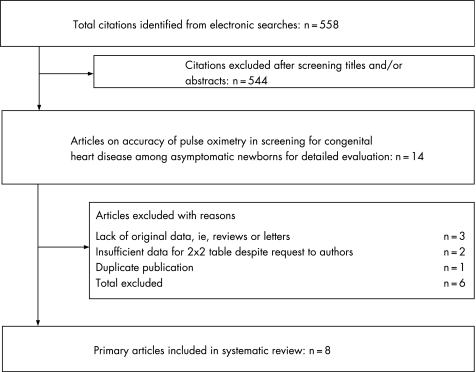
Objective: To evaluate the accuracy of pulse oximetry as a screening tool for congenital heart disease in asymptomatic newborns. DESIGN, DATA SOURCES AND METHODS: Systematic review of relevant studies identified through MEDLINE, EMBASE, Cochrane Library, MEDION, and bibliographies of retrieved primary and review articles. Two reviewers independently extracted data on study characteristics, quality and results to construct 2x2 tables with congenital heart disease as the reference standard. A random-effects bivariate model was used to meta-analyse estimates of sensitivity and specificity. Logit pairs of sensitivity and specificity of each study were analysed in a single model, accounting for their correlation due to differences in threshold between studies.
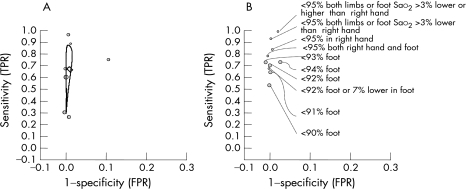
Results: Eight studies were included with a total of 35 960 newborns. Pulse oximetry was performed on asymptomatic newborns in all studies; three studies excluding newborns with an antenatal diagnosis of congenital heart disease. Either functional or fractional oxygen saturation was measured by pulse oximetry with oxygen saturation below 95% as the cut-off level in most studies. On the basis of the eight studies, the summary estimates of sensitivity and specificity were 63% (95% CI 39% to 83%) and 99.8% (95% CI 99% to 100%), respectively, yielding a false positive rate of 0.2% (95% CI 0% to 1%).
Conclusion: Pulse oximetry was found to be highly specific tool with very low false positive rates to detect congenital heart disease. Large, well-conducted prospective studies are needed to assess its sensitivity with higher precision.
Conflict of interest statement
Competing interests: None.
Comment in
-
Pulse oximetry: not a sensitive screening tool for congenital heart disease.Arch Dis Child Fetal Neonatal Ed. 2008 Jan;93(1):F77. Arch Dis Child Fetal Neonatal Ed. 2008. PMID: 18156450 No abstract available.
References
-
- Knowles R, Griebsch I, Dezateux C.et al Newborn screening for congenital heart defects: a systematic review and cost‐effectiveness analysis. Health Technol Assess 200591–168. - PubMed
-
- Kuehl K S, Loffredo C A, Ferenez C. Failure to diagnose congenital heart disease in infancy. Pediatrics 1999103743–747. - PubMed
-
- Malkin J D, Garber S, Broder M S.et al Infant mortality and early postpartum discharge. Obstetr Gynecol 200096183–188. - PubMed
-
- Meberg A, Otterstad J E, Froland G.et al Early clinical screening for congenital heart disease: the cases we miss. Cardiol Young 19999169–174. - PubMed
Publication types
MeSH terms
LinkOut - more resources
Full Text Sources
Medical