. 2007 May;81(10):4981-90.
doi: 10.1128/JVI.02361-06. Epub 2007 Mar 7.

Biologic, antigenic, and full-length genomic characterization of a bovine-like coronavirus isolated from a giraffe

Affiliations

Biologic, antigenic, and full-length genomic characterization of a bovine-like coronavirus isolated from a giraffe

Mustafa Hasoksuz et al. J Virol. 2007 May.

Abstract

Coronaviruses (CoVs) possess large RNA genomes and exist as quasispecies, which increases the possibility of adaptive mutations and interspecies transmission. Recently, CoVs were recognized as important pathogens in captive wild ruminants. This is the first report of the isolation and detailed genetic, biologic, and antigenic characterization of a bovine-like CoV from a giraffe (Giraffa camelopardalis) in a wild-animal park in the United States. CoV particles were detected by immune electron microscopy in fecal samples from three giraffes with mild-to-severe diarrhea. From one of the three giraffe samples, a CoV (GiCoV-OH3) was isolated and successfully adapted to serial passage in human rectal tumor 18 cell cultures. Hemagglutination assays, receptor-destroying enzyme activity, hemagglutination inhibition, and fluorescence focus neutralization tests revealed close biological and antigenic relationships between the GiCoV-OH3 isolate and selected respiratory and enteric bovine CoV (BCoV) strains. When orally inoculated into a BCoV-seronegative gnotobiotic calf, GiCoV-OH3 caused severe diarrhea and virus shedding within 2 to 3 days. Sequence comparisons and phylogenetic analyses were performed to assess its genetic relatedness to other CoVs. Molecular characterization confirmed that the new isolate belongs to group 2a of the mammalian CoVs and revealed closer genetic relatedness between GiCoV-OH3 and the enteric BCoVs BCoV-ENT and BCoV-DB2, whereas BCoV-Mebus was more distantly related. Detailed sequence analysis of the GiCoV-OH3 spike gene demonstrated the presence of a deletion in the variable region of the S1 subunit (from amino acid 543 to amino acid 547), which is a region associated with pathogenicity and tissue tropism for other CoVs. The point mutations identified in the structural proteins (by comparing GiCoV-OH3, BCoV-ENT, BCoV-DB2, and BCoV-Mebus) were most conserved among GiCoV-OH3, BCoV-ENT, and BCoV-DB2, whereas most of the point mutations in the nonstructural proteins were unique to GiCoV-OH3. Our results confirm the existence of a bovine-like CoV transmissible to cattle from wild ruminants, namely, giraffes, but with certain genetic properties different from those of BCoVs.


Figures
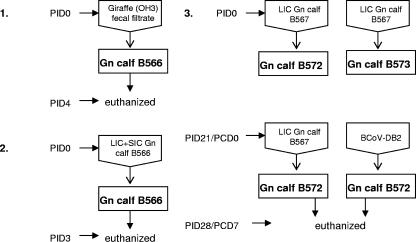
FIG. 1.
FIG. 1.
Diagram of the experimental design, illustrating the initial giraffe CoV inoculum and its subsequent serial passage in Gn calves. Parts: 1, inoculation of the original GiCoV-OH3-containing feces into a Gn calf (B566); 2, second passage of GiCoV-OH3 in a Gn calf (B567); 3, demonstration of cross-protection between GiCoV-OH3 and BCoV-DB2 in which two Gn calves (B572 and 573) were initially inoculated with GiCoV-OH3 and then either rechallenged with GiCoV (B572) or challenged with BCoV-DB2 (B573).
FIG. 2.
FIG. 2.
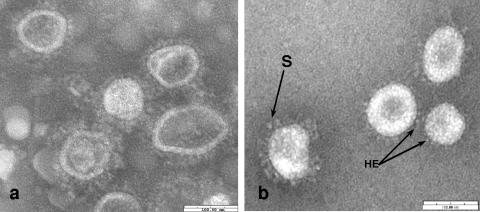
IEM of (a) the giraffe CoV (GiCoV-OH3) in feces from the second passage in a Gn calf (B567) and (b) plaque-isolated, sucrose-purified GiCoV-OH3 from an HRT-18 cell culture. Both samples were incubated with Gn-calf hyperimmune antiserum to BCoV, leading to the specific viral-antibody aggregates with an antibody fringe evident on particles in panel a. S denotes longer spikes, and HE indicates a shorter hemagglutinin layer. The bar represents 100 nm.
FIG. 3.
FIG. 3.
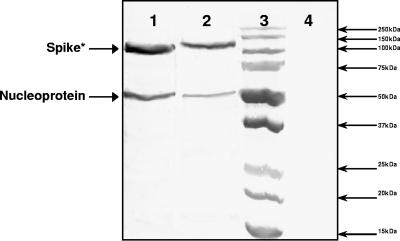
Demonstration of cross-reactivity between BCoV-DB2 and GiCoV-OH3 by Western blotting with a pool of BCoV-Mebus spike and nucleoprotein MAbs. Lanes: 1, supernatant of HRT-18 cells infected with BCoV-DB2; 2, supernatant of HRT-18 cells infected with GiCoV-OH3; 3, protein ladder (Precision Plus protein standards, dual color; Bio-Rad, Hercules, CA); 4, supernatant of mock-infected HRT-18 cells. *, the smaller size of the band corresponding to the spike protein is due to proteolytic cleavage between the S1 and S2 subunits. The glycosylated S1 subunit represented on the blot has a molecular mass of about 120 kDa.
FIG. 4.
FIG. 4.
Schematic diagram representing the genome organization of the GiCoV-OH3 isolate and BCoV. RdRp, RdRp replication protein complex; 32, 32-kDa NSP; HE, hemagglutinin-esterase protein; S, spike glycoprotein; 4.9, 4.9-kDa NSP; 4.8, 4.8-kDa NSP; 12.7, 12.7-kDa NSP; E, small membrane/envelope protein; M, membrane protein; N, nucleoprotein. Below the diagram, the length of each protein in amino acids is represented for the GiCoV-OH3 isolate and the BCoV-Mebus and BCoV-ENT strains. Protein lengths that differ between GiCoV-OH3 and BCoVs are underlined.
FIG. 5.
FIG. 5.
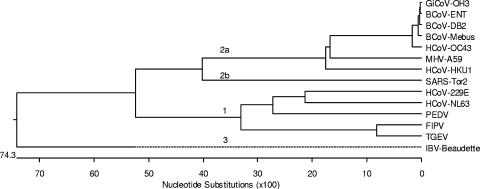
Phylogenetic analysis of the GiCoV-OH3 isolate based on full-length genome sequencing. For phylogenetic tree construction, the following CoVs were used: group 1, HCoV-229E, HCoV-NL63, PEDV, FIPV, and TGEV; group 2a, BCoV-ENT, BCoV-DB2, BCoV-Mebus, HCoV-OC43, HCoV-HKU1, and MHV-A59; group 2b, SARS-CoV; group 3, infectious bronchitis virus (IBV).

References

    1. Barker, M. G., D. H. Percy, D. J. Hovland, and J. I. MacInnes. 1994. Preliminary characterization of the structural proteins of the coronaviruses, sialodacryoadenitis virus and Parker's rat coronavirus. Can. J. Vet. Res. 58:99-103. - PMC - PubMed
    1. Benfield, D. A., and L. J. Saif. 1990. Cell culture propagation of a coronavirus isolated from cows with winter dysentery. J. Clin. Microbiol. 28:1454-1457. - PMC - PubMed
    1. Birch, C. J., H. J. Clothier, A. Seccull, T. Tran, M. C. Catton, S. B. Lambert, and J. D. Druce. 2005. Human coronavirus OC43 causes influenza-like illness in residents and staff of aged-care facilities in Melbourne, Australia. Epidemiol. Infect. 133:273-277. - PMC - PubMed
    1. Chasey, D., D. J. Reynolds, J. C. Bridger, T. G. Debney, and A. C. Scott. 1984. Identification of coronaviruses in exotic species of Bovidae. Vet. Rec. 115:602-603. - PubMed
    1. Cho, K. O., M. Hasoksuz, P. R. Nielsen, K. O. Chang, S. Lathrop, and L. J. Saif. 2001. Cross-protection studies between respiratory and calf diarrhea and winter dysentery coronavirus strains in calves and RT-PCR and nested PCR for their detection. Arch. Virol. 146:2401-2419. - PMC - PubMed

Publication types

MeSH terms

Associated data