. 2007 Mar 7;27(10):2646-53.
doi: 10.1523/JNEUROSCI.4739-06.2007.

Microcircuitry for two types of achromatic ganglion cell in primate fovea

Affiliations

Microcircuitry for two types of achromatic ganglion cell in primate fovea

David J Calkins et al. J Neurosci. .

Abstract

Synaptic circuits in primate fovea have been quantified for midget/parvocellular ganglion cells. Here, based on partial reconstructions from serial electron micrographs, we quantify synaptic circuits for two other types of ganglion cell: the familiar parasol/magnocellular cell and a smaller type, termed "garland." The excitatory circuits both derive from two types of OFF diffuse cone bipolar cell, DB3 and DB2, which collected unselectively from at least 6 +/- 1 cones, including the S type. Cone contacts to DB3 dendrites were usually located between neighboring triads, whereas half of the cone contacts to DB2 were triad associated. Ribbon outputs were as follows: DB3, 69 +/- 5; DB2, 48 +/- 4. A complete parasol cell (30 microm dendritic field diameter) would collect from approximately 50 cones via approximately 120 bipolar and approximately 85 amacrine contacts; a complete garland cell (25 microm dendritic field) would collect from approximately 40 cones via approximately 75 bipolar and approximately 145 amacrine contacts. The bipolar types contributed differently: the parasol cell received most contacts (60%) from DB3, whereas the garland cell received most contacts (67%) from DB2. We hypothesize that DB3 is a transient bipolar cell and that DB2 is sustained. This would be consistent with their relative inputs to the brisk-transient (parasol) ganglion cell. The garland cell, with its high proportion of DB2 inputs plus its high proportion of amacrine synapses (70%) and dense mosaic, might correspond to the local-edge cell in nonprimate retinas, which serves finer acuity at low temporal frequencies. The convergence of S cones onto both types could contribute S-cone input for cortical areas primary visual cortex and the middle temporal area.


Figures
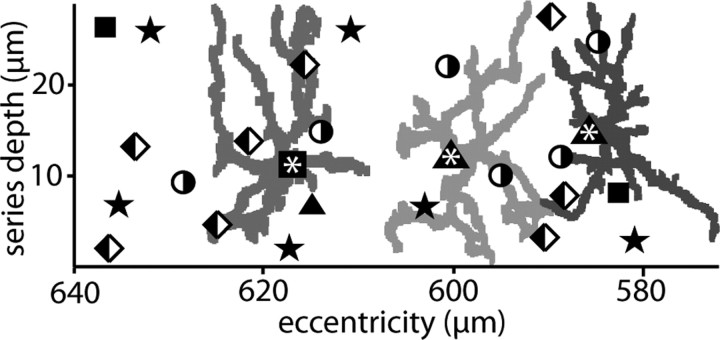
Figure 1.
Figure 1.
Tangential view of the reconstructed region. Plotted are the locations of 26 ganglion cell dendritic stalks in which they reach the OFF stratum. We could identify three parasol cells (squares) and three garland (triangles). Asterisks within larger symbols mark the locations for the three reconstructed cells, whose arbors are also shown in their actual positions. The garland arbors are displaced from their dendritic stalks compared with the parasol cell. There were also blue–yellow bistratified (half-filled circles) and unidentified cells, both bistratified (half-filled diamonds) and monostratified (stars).
Figure 2.
Figure 2.
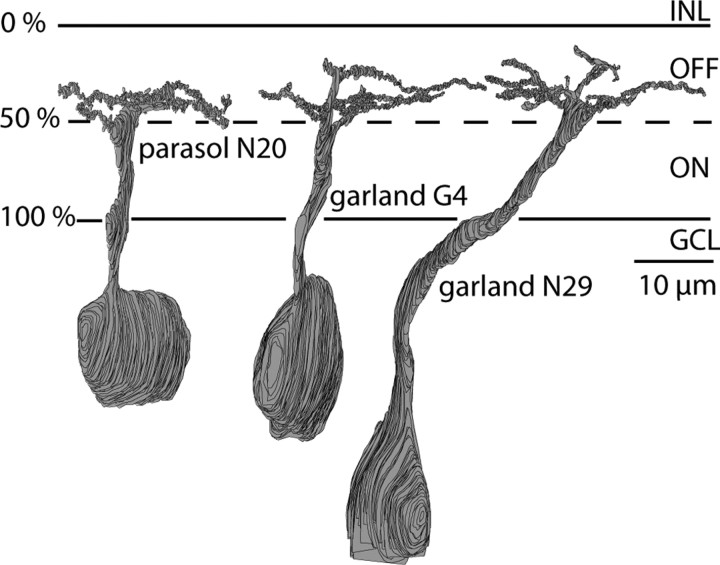
Radial views of reconstructed parasol and garland cells. The parasol dendrites stratify narrowly (30–50% level of inner plexiform layer) almost perpendicular to the cell body, whereas the garland dendrites stratify more broadly in the OFF stratum and are displaced from the cell body. Each cell has been rotated independently around its vertical axis without changing the level of stratification to optimally display dendritic complexity. The garland vertical axes are in their actual position with respect to one another; their overlap is better assessed in Figure 1. INL, Inner nuclear layer; GCL, ganglion cell layer.
Figure 3.
Figure 3.
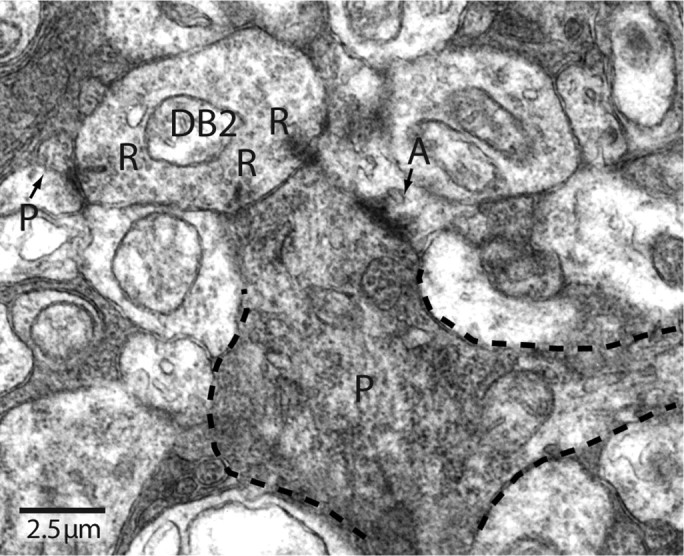
Identification of synaptic contacts to a parasol ganglion cell. Parasol dendrite (P) receiving three ribbon contacts (R) from a DB2 axon terminal (cell 28 in Fig. 4) and a conventional contact (arrow) from an amacrine cell process (A).
Figure 4.
Figure 4.
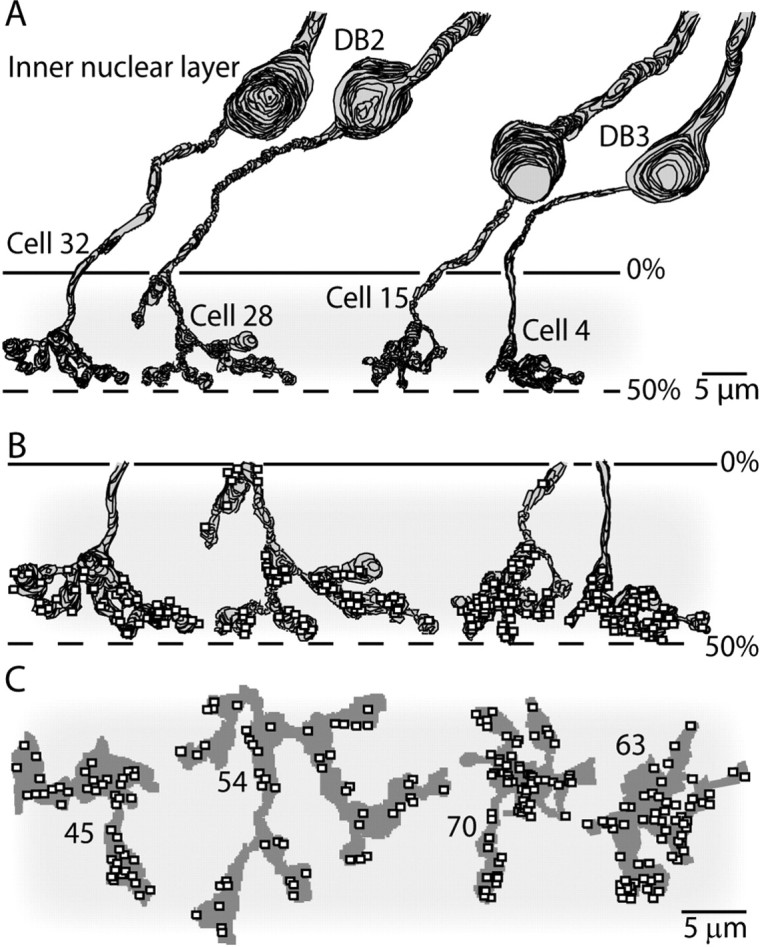
Stratification and axon arbors from diffuse bipolar types DB2 and DB3. A, Radial view shows DB2 somas higher in the nuclear layer and broader axonal arbors. B, Same terminals at higher magnification show DB3 with more synaptic ribbons. In tangential view of same terminals (C), DB3 ribbons are more numerous and cluster more densely. Some ribbons overlap. The scale is the same for B and C.
Figure 5.
Figure 5.
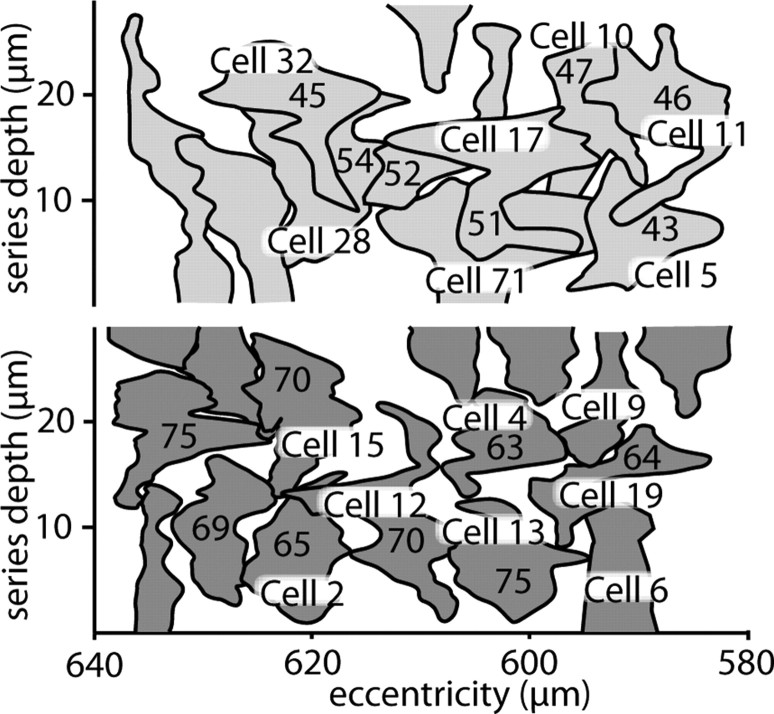
Tangential view of DB2 (top) and DB3 (bottom) axon arbors. The perimeter of neighboring DB2 and DB3 axon arbors indicate breadth of ramification; depth of terminals has been collapsed into a single plane. Numbers of synaptic ribbons are indicated for terminals complete within the series. Terminals contacting the parasol or garland cells are labeled, as is DB3 cell 4 from Figure 4. Scale is the same as in Figure 1.
Figure 6.
Figure 6.
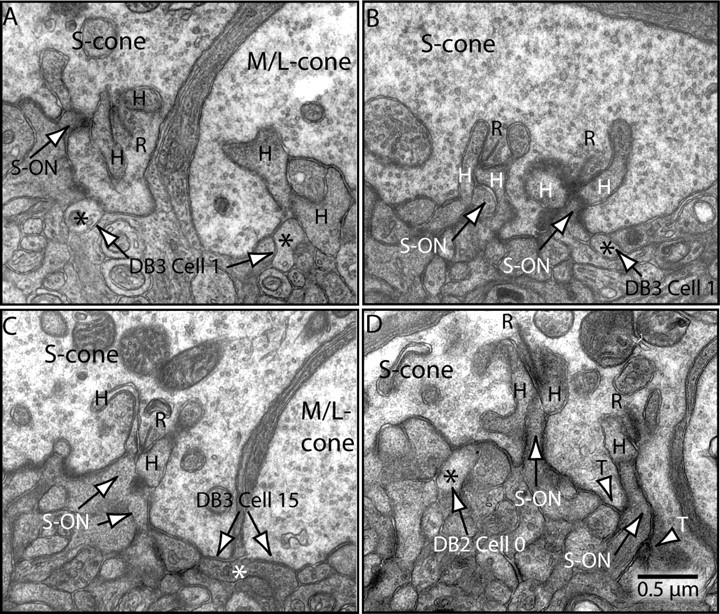
Cone contacts to DB2 and DB3 cells. A, Electron micrograph of adjacent S and M/L terminals showing synaptic ribbon (R), horizontal cell processes (H), and an invaginating dendrite of an S-ON bipolar cell. Asterisks mark dendrites of DB3 cell 1 receiving non-triad-associated basal contacts. B, The dendrite in A receiving a second non-triad-associated contact from the same S cone. C, Dendrite of DB3 cell 15 receiving non-triad-associated basal contacts from adjacent S and M/L cones. D, Dendrite of DB2 cell 0 receiving non-triad-associated contact from an S cone. Most non-triad-associated contacts at the cone base occur between two ribbons (Calkins et al., 1996; Chun et al., 1996); those illustrated here for the DB3 cells occur at the perimeter of the cone. Triad-associated (T) basal contacts are shown for reference.
Figure 7.
Figure 7.
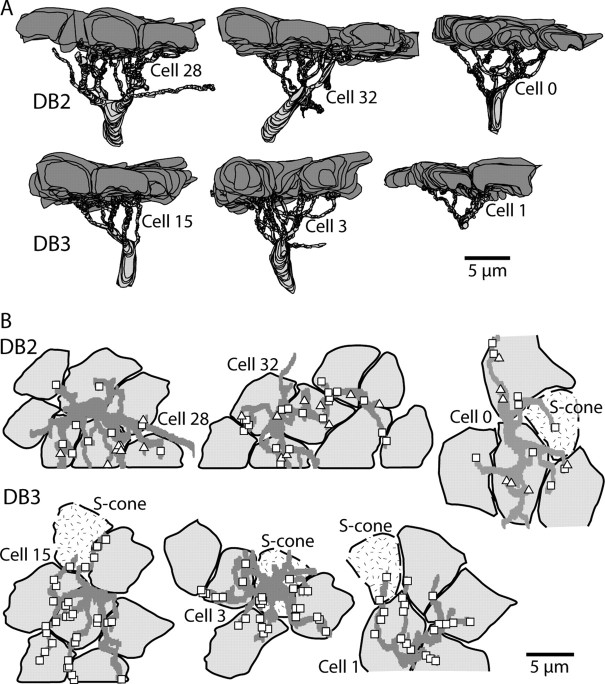
DB2 and DB3 cells collect indiscriminately from all cones within reach. A, Reconstructed dendritic trees (radial view) of DB2 and DB3 cells, each contacted by at least five to eight cones. Orientation is the same as in Figure 4. B, Reconstructed dendritic trees (tangential view) from the cells in Figure 6 showing profiles of overlying cone terminals. DB2 cells receive cone contacts from basal junctions, both triad associated (triangles) and non-triad associated (squares). DB3 cells receive contacts solely from non-triad-associated basal junctions. Each cell collects from all cones within reach, including S. Some contacts overlap.
Figure 8.
Figure 8.
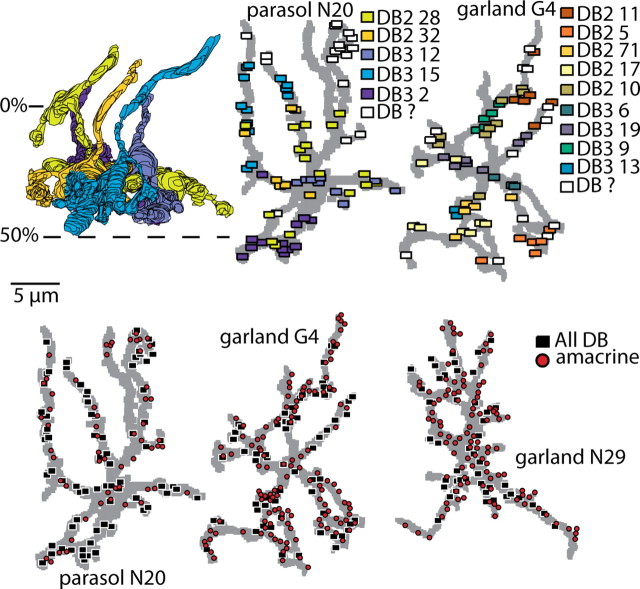
Synaptic contacts to parasol and garland cells. Top, Two DB2 (yellow hues) and three DB3 (blue hues) axons intertwine (radial view), with their contacts to the parasol ganglion cell shown in tangential view. The identified bipolar cells contributed 11 ± 6 synapses each to the ganglion cell; these tend to cluster with some interleaving. For the garland cell, a different set of identified bipolar cells contributed 5 ± 2 synapses each. Identified bipolar cells for both the parasol and garland cell are labeled in Figure 5. Symbols for some synapses overlap. Bottom, Amacrine and bipolar contacts distributed over 165 μm2 of membrane area for the parasol cell, 178 μm2 for garland G4, and 175 μm2 for garland N29. The latter had 52 bipolar contacts, none identified as to type. Orientations the same as in Figure 1.

References

    1. Ahmad KM, Klug K, Herr S, Sterling P, Schein S. Cell density ratios in a foveal patch in macaque retina. Vis Neurosci. 2003;20:189–209. - PubMed
    1. Boycott BB, Dowling JE. Organization of the primate retina: light microscopy. Philos Trans R Soc Lond B Biol Sci. 1969;255:109–184. - PubMed
    1. Boycott BB, Wässle H. Morphological classification of bipolar cells of the primate retina. Eur J Neurosci. 1991;3:1069–1088. - PubMed
    1. Calkins DJ. Synaptic organization of cone pathways in the primate retina. In: Gegenfurtner K, Sharpe L, editors. Color vision from molecular genetics to perception. Cambridge, MA: Cambridge UP; 1999.
    1. Calkins DJ. The representation of cone signals in the primate retina. J Opt Soc Am B. 2000;17:597–606. - PubMed

Publication types

MeSH terms