Review
. 2007;14(3):237-46.
doi: 10.2174/092986607780090829.

Critical enzymes involved in endocannabinoid metabolism

Affiliations
Review

Critical enzymes involved in endocannabinoid metabolism

Balapal S Basavarajappa. Protein Pept Lett. 2007.

Abstract

Investigations of the pathways involved in the metabolism of endocannabinoids have grown exponentially in recent years following the discovery of cannabinoid receptors (CB) and their endogenous ligands, such as anandamide (AEA) and 2-arachidonoylglycerol (2-AG). The in vivo biosynthesis of AEA has been shown to occur through several pathways mediated by N-acylphosphatidylethanolamide-phospholipase D (NAPE-PLD), a secretory PLA(2) and PLC. 2-AG, a second endocannabinoid is generated through the action of selective enzymes such as phosphatidic acid phsophohydrolase, diacylglycerol lipase (DAGL), phosphoinositide-specific PLC (PI-PLC) and lyso-PLC. A putative membrane transporter or facilitated diffusion is involved in the cellular uptake or release of endocannabinoids. AEA is metabolized by fatty acid amidohydrolase (FAAH) and 2-AG is metabolized by both FAAH and monoacylglycerol lipase (MAGL). The author presents an integrative overview of current research on the enzymes involved in the metabolism of endocannabinoids and discusses possible therapeutic interventions for various diseases, including addiction.


Figures

Figure 1
Figure 1. The potential enzymes involved in anandamide biosynthesis
Stimulation of adenylate cyclase and cAMP-dependent protein kinase potentiate the N-acyltransferase (Ca2+-dependent transacylase) NAT. A fatty arachidonic acid chain is transferred by NAT from the sn-1 position of phospholipids (phosphoglycerides, PG) to the primary amine of phosphatidylethanolamine (PE) in a Ca2+-dependent manner, forming an N-arachidonyl phosphatidylethanolamine (N-ArPE). This N-ArPE intermediate is then hydrolyzed by a phospholipase D (PLD)-like enzyme to yield anandamide (AEA). In addition, possible alternative pathways for AEA formation from N-ArPE are shown. Once synthesized, AEA can be transported to the outside of the cell through a process that has not yet been well characterized. AMT, anandamide membrane transporter.
Figure 2
Figure 2. Scheme illustrating the potential proteins and enzymes involved in anandamide uptake and degradation
Anandamide can be internalized by neurons through an as yet unidentified transport mechanism, “the endocannabinoid transporter (AMT)”. Once inside neurons, AEA is rapidly cleaved by the hydrolytic enzyme fatty acid amide hydrolase (FAAH) to give arachidonic acid (AA) and ethanolamine (EA). Alternatively, different lipoxygenases (LOXs) and cyclooxygenase-2 (COX-2) can metabolize AEA, generating hydroxyl derivatives of AEA (HAEAs) and prostaglandins-ethanolamides (PG-EAs), respectively. On the other hand, in FAAH (−/−) mice, AEA is converted into o-phosphorylcholine (o-PC)-AEA by an unidentified biosynthetic pathway and o-PC-AEA can in turn be catabolized to AA by a choline-specific phosphodiesterase (NPP6). AMT, anandamide membrane transporter.
Figure 3
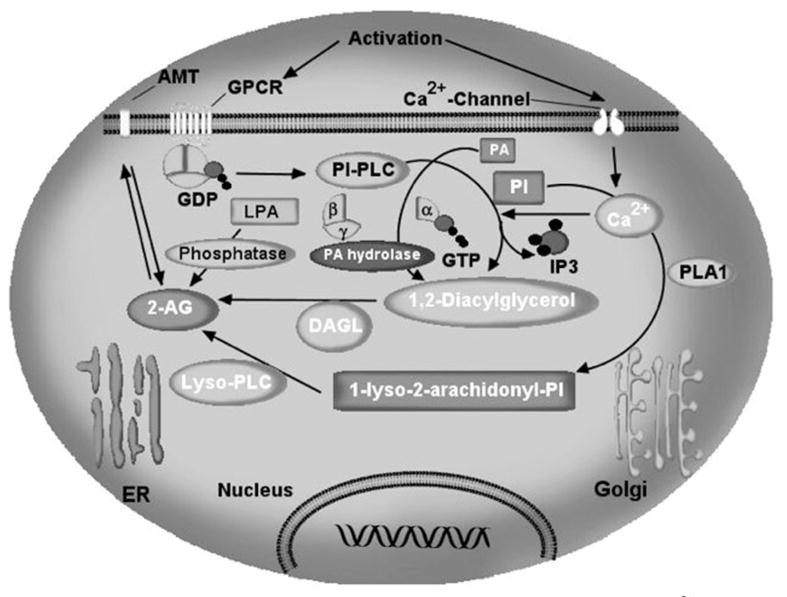
Figure 3. The enzymes involved in the biosynthetic pathways of 2-arachidonylglycerol
Intracellular Ca2+ initiates 2-AG biosynthesis by inducing the formation of diacylglycerol (DAG) in the membrane by stimulating the phosphatidyl-inositol-phospholipase C (PI-PLC) pathway. Alternatively, the formation of DAG involves the hydrolysis of phosphatidic acid through Mg2+ and Ca2+-dependent PA phsophohydrolase activity. 2-AG is the product of DAG-lipase (DAGL) acting on DAG. The second pathway involves hydrolysis of PI by phospholipase A1 (PLA1) and hydrolysis of the resultant lyso-PI by a specific lyso-PLC. In certain conditions 2-AG can also be synthesized through the conversion of 2-arachidonyl lysophosphatidic acid (LPA) by a phosphatase to yield 2-AG. Once synthesized, 2-AG can be transported to the outside of the cell through a process that has not yet been characterized. AMT, anandamide membrane transporter.
Figure 4
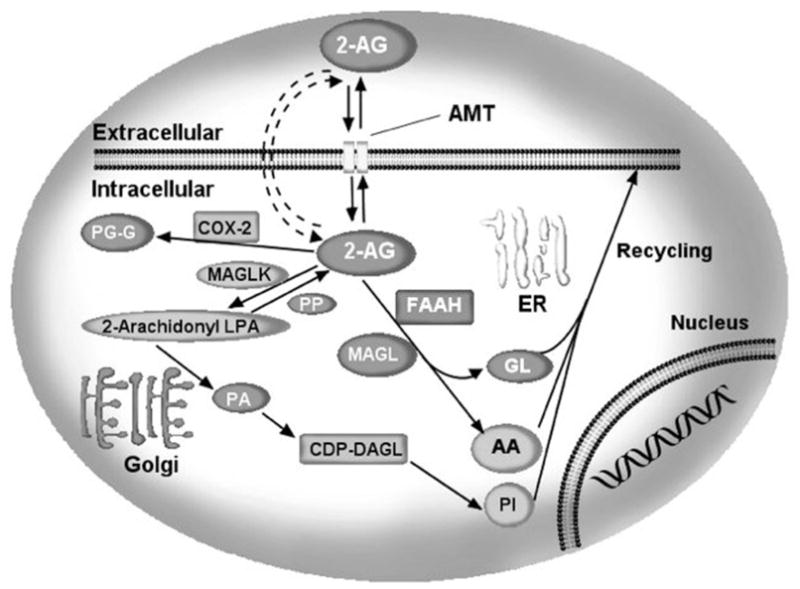
Figure 4. Schematic summary of the proteins and enzymes involved in 2-AG uptake and degradation
2-Arachidonylglycerol can be internalized by neurons through an as yet unidentified transport mechanism, “the endocannabinoid transporter (AMT)”. Once inside neurons, 2-AG can be hydrolyzed by the enzymes fatty acid amide hydrolase (FAAH) or monoacylglycerol lipase (MAGL). Alternatively, 2-AG can be metabolized to 2-arachidonyl LPA (2-AG-LPA) through the action of monoacyl glycerol kinase(s) (MAGLK). 2-AG-LPA is then converted into 1-steroyl-2-arachidonyl PA. 1-Steroyl-2-arachidonyl PA is further utilized in the de novo synthesis of PC and PE. Furthermore, 2AG is metabolized by enzymatic oxygenation of 2-AG by COX-2 into PGH2 glycerol esters (PG-G). AMT, anandamide membrane transporter.

References

    1. Adams IB, Compton DR, Martin BR. J Pharmacol Exp Ther. 1998;284:1209. - PubMed
    1. Basavarajappa BS. J Clin Res. 2005;11:16.
    1. Basavarajappa BS. In: New Research on Alcoholism. Baye DR, editor. Nova Science Publishers, Inc; New York: 2006. in press.
    1. Basavarajappa BS, Hungund BL. J Neurochem. 1999;72:522. - PubMed
    1. Basavarajappa BS, Saito M, Cooper TB, Hungund BL. Biochemica Biophysica Acta. 2000;1535:78. - PubMed

Publication types

MeSH terms