


Review
doi: 10.1113/jphysiol.2007.129429.
Epub 2007 Mar 8.
Multi-tasking in the spinal cord--do 'sympathetic' interneurones work harder than we give them credit for?
Affiliations
- PMID: 17347266
- PMCID: PMC2075457
- DOI: 10.1113/jphysiol.2007.129429
Item in Clipboard
Review
Multi-tasking in the spinal cord--do 'sympathetic' interneurones work harder than we give them credit for?
J Physiol.
.
Abstract
The role of interneurones in the control of sympathetic activity has been somewhat of a mystery since, for many years, it was difficult to target these cells for study. Recently scientists have started to unravel the action potential properties of these neurones, where they receive their inputs from and where they project to. This review looks at the information known to date about sympathetic interneurones. The locations of these neurones and their local axonal ramifications suggest that they play a more widespread function than previously thought. Therefore the data to support such a theory are also examined.
Figures
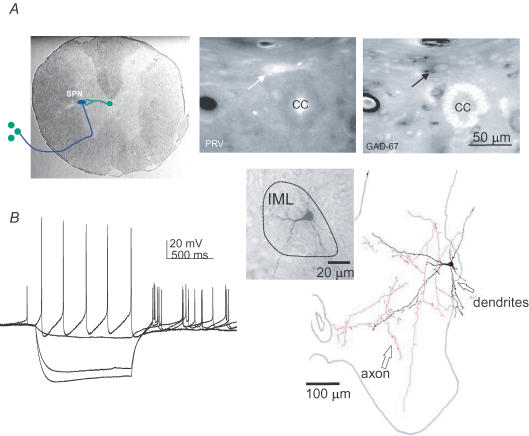
A, transneuronal tracing (depicted in left panel) using pseudorabies viral injections into the adrenal gland labels a neurone in lamina X of the spinal cord (arrow, middle panel) that contains the mRNA for GAD67 (arrow, right panel). B, this interneurone was recorded in the intermediolateral cell column (IML) and the voltage responses to hyperpolarizing and depolarizing current pulses are shown in the left panel. It was then filled and a drawing of the filled neurone is shown on the right with axon and dendrites extending throughout the spinal cord. The inset shows the photomontage of the filled soma and proximal dendrites.
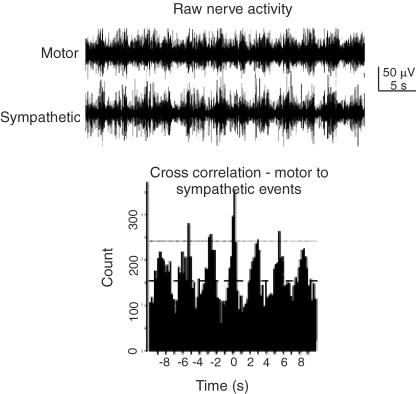
Top trace, raw nerve activity showing correlation between activity in the femoral motor nerve and abdominal sympathetic chain during application of NMDA. Bottom trace, cross correlogram of sympathetic activity triggered from the peaks of motor activity shows clearly the degree of correlation between the 2 outflows. Adapted from Chizh et al. (1998).
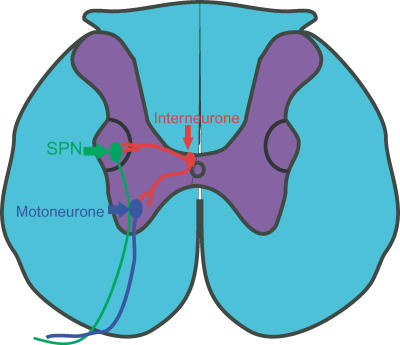
Line drawing showing putative interneurones innervating SPNs and motoneurones to synchronize outflow.
References
-
- Bacon SJ, Smith AD. A monosynaptic pathway from an identified vasomotor centre in the medial prefrontal cortex to an autonomic area in the thoracic spinal cord. Neuroscience. 1993;54:719–728. - PubMed
-
- Barman SM, Gebber GL. Spinal interneurons with sympathetic nerve-related activity. Am J Physiol. 1984;247:R761–R767. - PubMed
-
- Brooke RE, Pyner S, McLeish P, Buchan S, Deuchars J, Deuchars SA. Spinal cord interneurones labelled transneuronally from the adrenal gland by a GFP-herpes virus construct contain the potassium channel subunit Kv3.1b. Auton Neurosci. 2002;98:45–50. - PubMed
-
- Cabot JB, Alessi V, Carroll J, Ligorio M. Spinal cord lamina V and lamina VII interneuronal projections to sympathetic preganglionic neurons. J Comp Neurol. 1994;347:515–530. - PubMed
Publication types
MeSH terms
Grants and funding
LinkOut - more resources
Full Text Sources
