Review
. 2007 Mar;71(1):97-120.
doi: 10.1128/MMBR.00033-06.

Biosynthesis of ether-type polar lipids in archaea and evolutionary considerations

Affiliations
Review

Biosynthesis of ether-type polar lipids in archaea and evolutionary considerations

Yosuke Koga et al. Microbiol Mol Biol Rev. 2007 Mar.

Abstract

This review deals with the in vitro biosynthesis of the characteristics of polar lipids in archaea along with preceding in vivo studies. Isoprenoid chains are synthesized through the classical mevalonate pathway, as in eucarya, with minor modifications in some archaeal species. Most enzymes involved in the pathway have been identified enzymatically and/or genomically. Three of the relevant enzymes are found in enzyme families different from the known enzymes. The order of reactions in the phospholipid synthesis pathway (glycerophosphate backbone formation, linking of glycerophosphate with two radyl chains, activation by CDP, and attachment of common polar head groups) is analogous to that of bacteria. sn-Glycerol-1-phosphate dehydrogenase is responsible for the formation of the sn-glycerol-1-phosphate backbone of phospholipids in all archaea. After the formation of two ether bonds, CDP-archaeol acts as a common precursor of various archaeal phospholipid syntheses. Various phospholipid-synthesizing enzymes from archaea and bacteria belong to the same large CDP-alcohol phosphatidyltransferase family. In short, the first halves of the phospholipid synthesis pathways play a role in synthesis of the characteristic structures of archaeal and bacterial phospholipids, respectively. In the second halves of the pathways, the polar head group-attaching reactions and enzymes are homologous in both domains. These are regarded as revealing the hybrid nature of phospholipid biosynthesis. Precells proposed by Wächtershäuser are differentiated into archaea and bacteria by spontaneous segregation of enantiomeric phospholipid membranes (with sn-glycerol-1-phosphate and sn-glycerol-3-phosphate backbones) and the fusion and fission of precells. Considering the nature of the phospholipid synthesis pathways, we here propose that common phospholipid polar head groups were present in precells before the differentiation into archaea and bacteria.


Figures
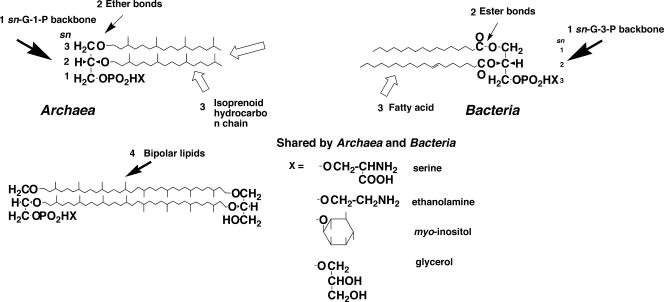
FIG. 1.
FIG. 1.
Characteristics of archaeal polar lipids. Archaeal phospholipids are characterized by (i) G-1-P backbone, (ii) ether bonds, (iii) isoprenoid hydrocarbon chains, and (iv) bipolar tetraether lipids. Most of the polar head groups of phospholipids are shared by archaea and bacteria.
FIG. 2.
FIG. 2.
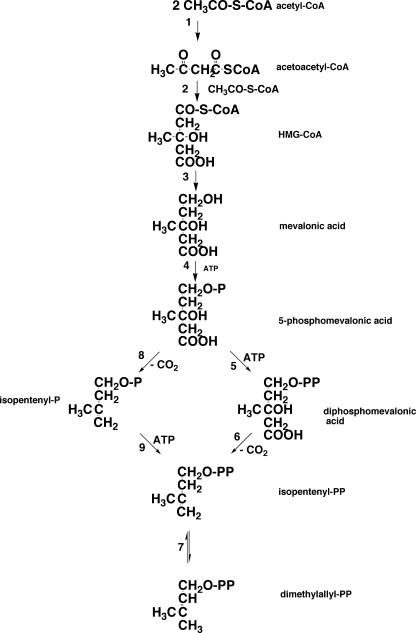
MVA pathway for synthesis of isopentenyl diphosphate and dimethylallyl diphosphate. 1, acetyl-CoA acetyltransferase; 2, HMG-CoA synthase; 3, HMG-CoA reductase; 4, MVA kinase; 5, phosphomevalonate kinase; 6, diphosphomevalonate decarboxylase; 7, isopentenyl diphosphate isomerase; 8, hypothetical phosphomevalonate decarboxylase; 9, isopentenyl phosphate kinase. The classical MVA pathway proceeds from reaction 1 through reaction 7 via reactions 5 and 6, while a modified MVA pathway goes through reactions 8 and 9 (33). P and PP in the structural formula are phosphate and pyrophosphate, respectively.
FIG. 3.
FIG. 3.
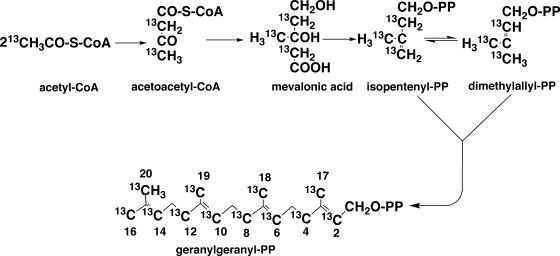
Expectation of 13C incorporation from [13CH3]acetate into GGPP via the MVA pathway (18, 28). PP in the structural formula is pyrophosphate.
FIG. 4.
FIG. 4.
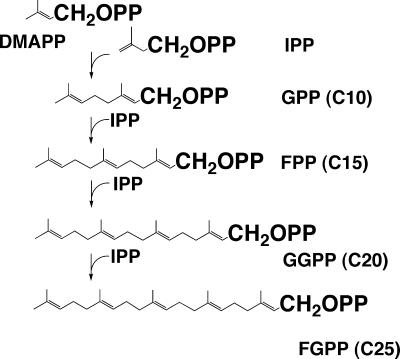
Synthetic pathway of polyprenyl diphosphate. PP in the structural formula is pyrophosphate.
FIG. 5.
FIG. 5.
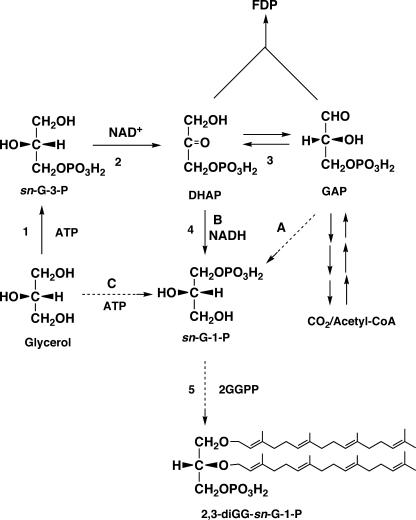
Three possible reactions for the direct formation of G-1-P: A, reduction of d-GAP; B, reduction of DHAP; C, phosphorylation of glycerol (G-1-P forming). Enzyme 1, glycerol kinase (G-3-P forming); enzyme 2, G-3-P dehydrogenase; enzyme 3, triose phosphate isomerase; enzyme 4, G-1-P dehydrogenase. Reaction 5, ether lipid synthesis. FDP, fructose diphosphate.
FIG. 6.
FIG. 6.
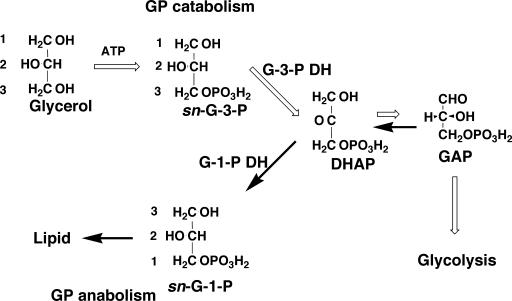
Glycerol metabolism and lipid biosynthesis in archaea. The reactions indicated with open arrows are the catabolic pathway of glycerol in heterotrophic archaea. Reactions shown with closed arrows are the synthetic pathway of phospholipid in archaea (79).
FIG. 7.
FIG. 7.
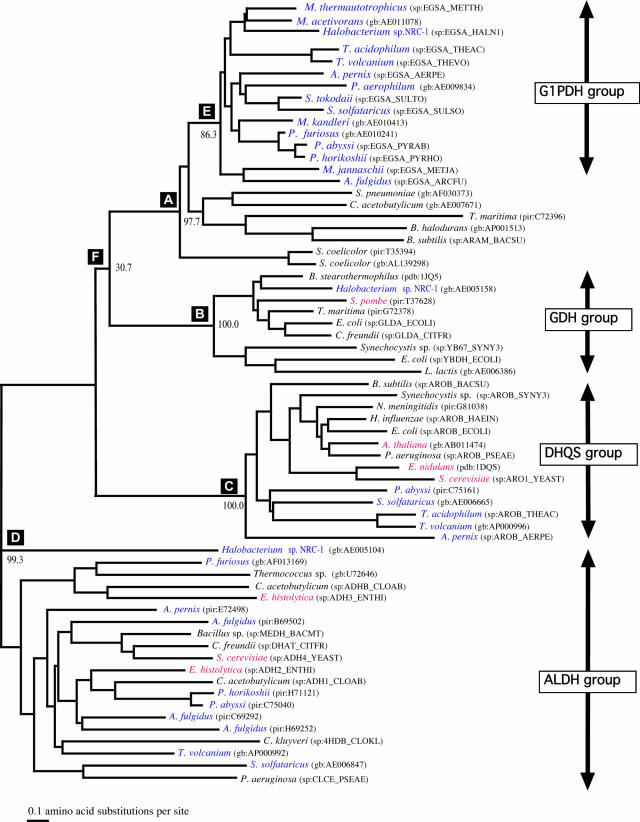
Phylogenetic tree of G-1-P dehydrogenase and its homologs. The sequence is indicated by the source name of the sequence database (sp, SwissProt; pir, PIR; gb, GenBank; pdb, PDB) and the identification code. G1PDH, sn-glycerol-1-phosphate dehydrogenase; GDH, glycerol dehydrogenase; DHQS, dehydroquinate synthase; ALDH, alcohol dehydrogenase type IV. (Reprinted from reference by permission of Oxford University Press.)
FIG. 8.
FIG. 8.
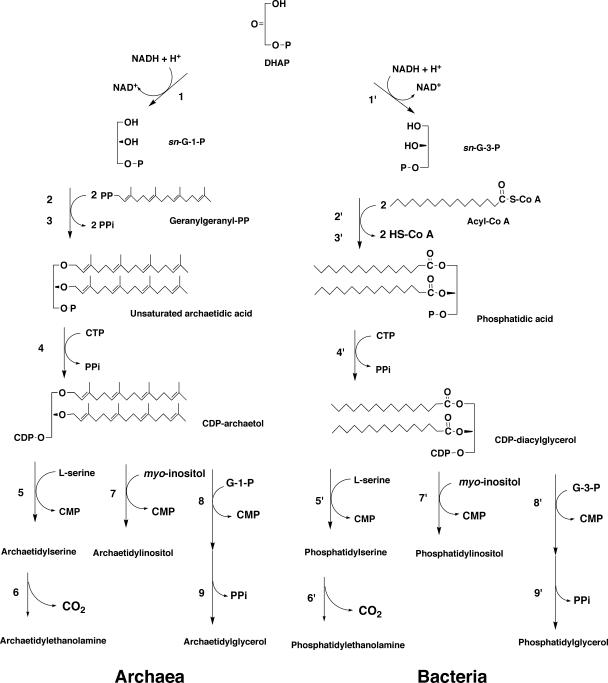
Possible biosynthetic pathway for phospholipids in archaea compared with their bacterial counterpart. Enzymes confirmed by in vitro experiments are as follows: 1, G-1-P dehydrogenase; 2, GGGP synthase; 3, DGGGP synthase; 4, CDP-archaeol synthase; 5, archaetidylserine synthase. Reactions and enzymes 6 to 9 are indicated by in vivo experiments or database searches of the relevant genes. 6, archaetidylserine decarboxylase; 7, archaetidylinositol synthase; 8, archaetidylglycerophosphate synthase; 9, archaetidylglycerophosphate phosphatase. The established enzymes for phospholipid biosynthesis in bacteria are as follows; 1′, G-3-P dehydrogenase; 2′, lysophosphatidic acid synthase; 3′, phosphatidic acid synthase; 4′, CDP-diacylglycerol synthase; 5′, phosphatidylserine synthase; 6′, phosphatidylserine decarboxylase; 7′, phosphatidylinositol synthase; 8′, phosphatidylglycerophosphate synthase; 9′, phosphatidylglycerophosphate phosphatase. P and PP in the structural formula are phosphate and pyrophosphate, respectively.
FIG. 9.
FIG. 9.
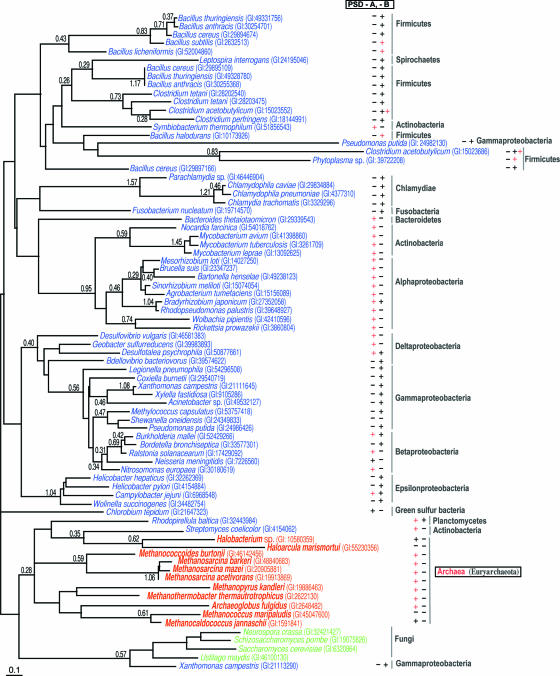
Phylogenetic tree of archaetidylserine synthase and phosphatidylserine synthase constructed by the maximum-likelihood method. The sequence is indicated by the source name and GI number from the National Center for Biotechnology Information. PSD-A and PSD-B are two groups (A and B) of phosphatidylserine decarboxylase that are divided by phylogenetic analysis (17). (Reprinted from reference by permission of the publisher.)
FIG. 10.
FIG. 10.
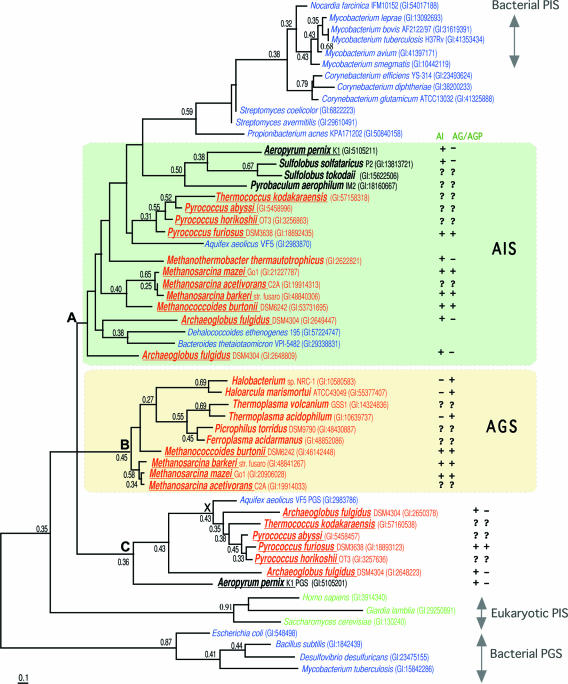
Phylogenetic tree of archaetidylinositol synthase and archaetidylglycerol synthase constructed by the maximum-likelihood method. The sequence is indicated by the source name and GI number from the National Center for Biotechnology Information. The presence or absence of archaetidylinositol (AI) or archaetidylglycerol (AG)/archaetidylglycerophosphate (AGP) in each species is indicated by a symbol, “+” or “−,” after the source name and GI number. The symbol “?” indicates that the lipid composition has not been reported for the species. For the characters “A,” “B,” “C,” and “X,” see reference . PIS, phosphatidylinositol synthase; PGS, phosphatidyglycerol synthase; AIS, archaetidylinositol synthase; AGS, archaetidylglycerol synthase. (Reprinted from reference by permission of the publisher.)
FIG. 11.
FIG. 11.
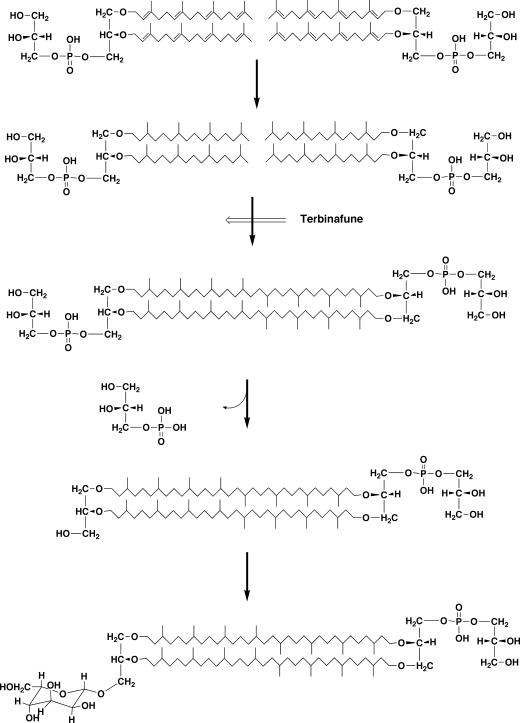
Proposed biosynthetic route of tetraether lipids in Thermoplasma acidophilum inferred from inhibition experiments with terbinafine (73).
FIG. 12.
FIG. 12.
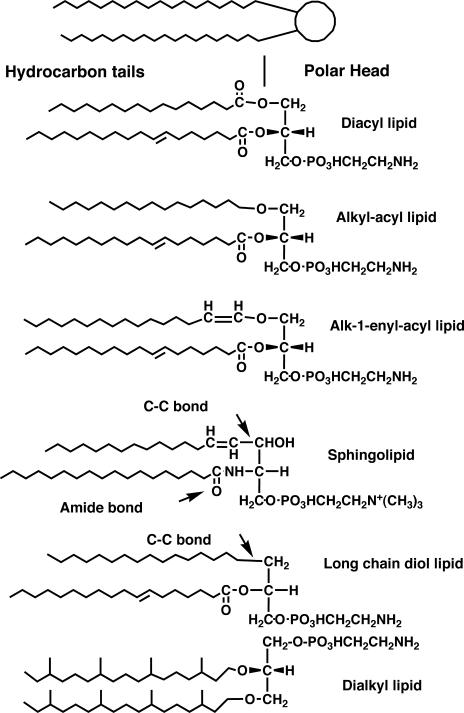
Uniformity and diversity of membrane lipids.

References

    1. Bachhawat, N., and S. C. Mande. 2000. Complex evolution of the inositol-1-phosphate synthase gene among archaea and eubacteria. Trends Genet. 16:111-113. - PubMed
    1. Barkley, S. J., R. M. Cornish, and C. D. Poulter. 2004. Identification of an archaeal type II isopentenyl diphosphate isomerase in Methanothermobacter thermautotrophicus. J. Bacteriol. 186:1811-1817. - PMC - PubMed
    1. Barnett, J. E. G., R. E. Brice, and D. L. Corina. 1970. A colorimetric determination of inositol monophosphates as an assay for d-glucose 6-phosphate-1-l-myoinositol 1-phosphate cyclase. Biochem. J. 119:183-186. - PMC - PubMed
    1. Baxter, R. M., and N. E. Gibbons. 1954. The glycerol dehydrogenases of Pseudomonas salinaria, Vibrio costicolus, and Escherichia coli in relation to bacterial halophilism. Can. J. Biochem. Physiol. 32:206-217. - PubMed
    1. Beisenherz, G. 1955. Triose phosphate isomerase from calf muscle. Methods Enzymol. 1:387-391.

Publication types

MeSH terms

Substances

LinkOut - more resources