


Allelic losses at genomic instability-associated loci in villous adenomas and adjacent colorectal cancers
- PMID: 17350461
- PMCID: PMC1855249
- DOI: 10.1016/j.cancergencyto.2006.11.001
Allelic losses at genomic instability-associated loci in villous adenomas and adjacent colorectal cancers
Abstract
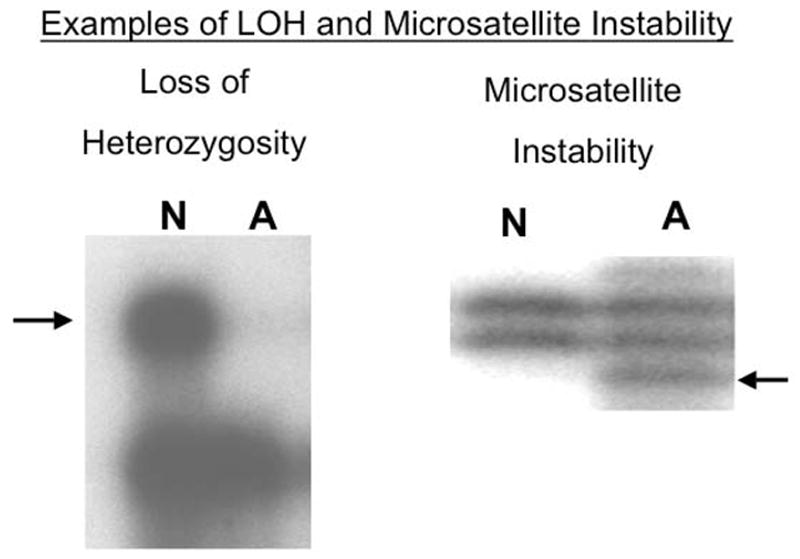
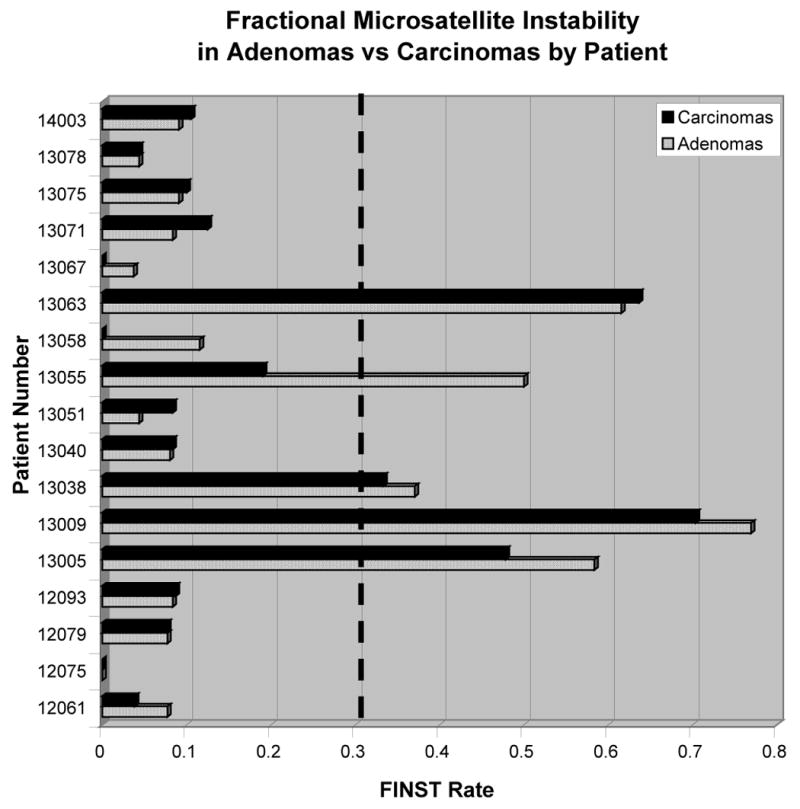
Allelic imbalances in premalignant villous adenomas were compared with those in adjacent microdissected colorectal carcinoma that had arisen directly from the adenomas. Carcinoma-adenoma pairs were examined from 17 patients who underwent resections for colorectal cancer. In all, 28 microsatellite markers were examined, from regions of the genome where individual allelic losses have been associated with overall genomic instability in colorectal carcinomas. Microsatellite instability (MSI) was also evaluated for each marker in each tissue type. Loss of heterozygosity for multiple markers was found in 35% of adenomas and 65% of carcinomas; the average fractional allelic loss rate was 2.5 times higher in carcinomas than in adenomas. Of the 17 patients, 4 had MSI for >30% of markers in both adenoma and carcinoma, with no significant differences between the two tissues. Markers with particularly high imbalance rates in adenomas were seen on chromosomes 11, 14, and 15. These findings provide further evidence that genomic instability is an ongoing process during carcinogenesis, with a markedly increased frequency of allelic losses seen in carcinomas, compared with adjacent adenomas. Markers on chromosomes 11, 14, and 15 may become valuable tools in the identification of patients destined to progress to colorectal carcinomas.
Figures


References
-
- Loeb KR, Loeb LA. Significance of multiple mutations in cancer. Carcinogenesis. 2000;21:379–85. - PubMed
-
- Hanahan D, Weinberg RA. The hallmarks of cancer. Cell. 2000;100:57–70. - PubMed
-
- Loeb LA. Mutator phenotype may be required for multistage carcinogenesis. Cancer Res. 1991;51:3075–9. - PubMed
-
- Mao X, Hamaoudi RA, Talbot IC, Baudis M. Allele-specific loss of heterozygosity in multiple colorectal adenomas: toward an integrated molecular cytogenetic map. Cancer Genet Cytogenet. 2006;167:1–14. - PubMed
-
- Alrawi SJ, Carroll RE, Hill HC, Gibbs JF, Tan D, Brenner BM, Nowak NJ, Stoler DL, Anderson GR. Genomic instability of human aberrant crypt foci: Inter-SSR PCR and aCGH. Mut Res. 2006 in press. - PubMed
Publication types
MeSH terms
Grants and funding
LinkOut - more resources
Full Text Sources
Medical
