


Second acyl homoserine lactone production system in the extreme acidophile Acidithiobacillus ferrooxidans
- PMID: 17351095
- PMCID: PMC1907126
- DOI: 10.1128/AEM.02948-06
Second acyl homoserine lactone production system in the extreme acidophile Acidithiobacillus ferrooxidans
Abstract
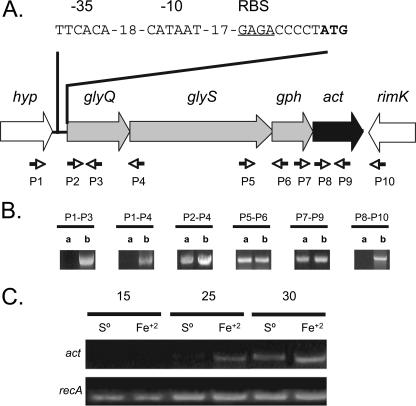
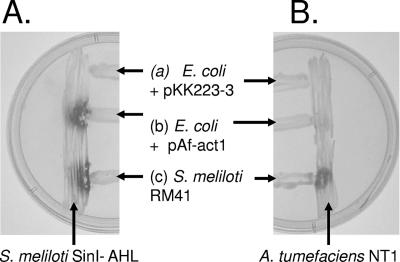
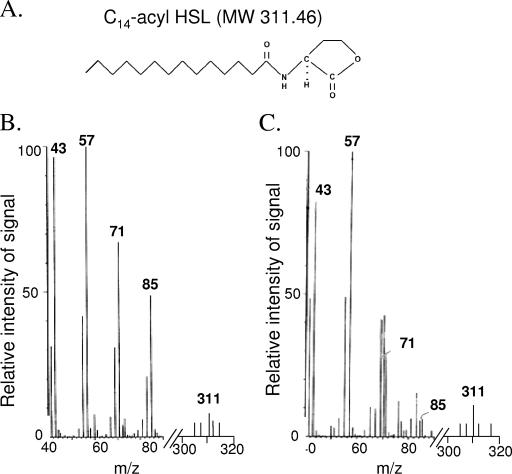
The acidophilic proteobacterium Acidithiobacillus ferrooxidans is involved in the industrial biorecovery of copper. It is found in acidic environments in biofilms and is important in the biogeochemical cycling of metals and nutrients. Its genome contains a cluster of four genes, glyQ, glysS, gph, and act, that are predicted to encode the alpha and beta subunits of glycine tRNA synthetase, a phosphatase, and an acyltransferase, respectively (GenBank accession no. DQ149607). act, cloned and expressed in Escherichia coli, produces acyl homoserine lactones (AHLs) principally of chain length C14 according to gas chromatography and mass spectrometry measurements. The AHLs have biological activity as shown by in vivo studies using the reporter strain Sinorhizobium meliloti Rm41 SinI-. Reverse transcription-PCR (RT-PCR) experiments indicate that the four genes are expressed as a single transcript, demonstrating that they constitute an operon. According to semiquantitative RT-PCR results, act is expressed more highly when A. ferrooxidans is grown in medium containing iron than when it is grown in medium containing sulfur. Since AHLs are important intercellular signaling molecules used by many bacteria to monitor their population density in quorum-sensing control of gene expression, this result suggests that A. ferrooxidans has two quorum-sensing systems, one based on Act, as described herein, and the other based on a Lux-like quorum-sensing system, reported previously. The latter system was shown to be upregulated in A. ferrooxidans grown in sulfur medium, suggesting that the two quorum-sensing systems respond to different environmental signals that may be related to their abilities to colonize and use different solid sulfur- and iron-containing minerals.
Figures
References
-
- Baysse, C., M. Cullinane, V. Denervaud, E. Burrowes, J. M. Dow, J. P. Morrisey, L. Ram, J. T. Trevors, and F. O'Gara. 2005. Modulation of quorum sensing in Pseudomonas aeruginosa through alteration of membrane properties. Microbiology 151:2529-2542. - PubMed
-
- Chen, X., S. Schauder, N. Potier, A. Van Dorsselaer, I. Pelczer, B. L. Bassler, and F. M. Hughsonet. 2002. Structural identification of a bacterial quorum sensing signal containing boron. Nature 415:545-549. - PubMed
-
- Cullinane, M., C. Baysse, J. P. Morrissey, and F. O'Gara. 2005. Identification of two lysophosphatidic acid acyltransferase genes with overlapping function in Pseudomonas fluorescens. Microbiology 151:3071-3080. - PubMed
Publication types
MeSH terms
Substances
Associated data
- Actions
- Actions
LinkOut - more resources
Full Text Sources
Molecular Biology Databases
