


Fatigue: an important feature of late-onset Pompe disease
- PMID: 17351726
- PMCID: PMC2779379
- DOI: 10.1007/s00415-006-0434-2
Fatigue: an important feature of late-onset Pompe disease
Abstract
Objective: To investigate the prevalence and severity of fatigue in adult patients with Pompe disease.
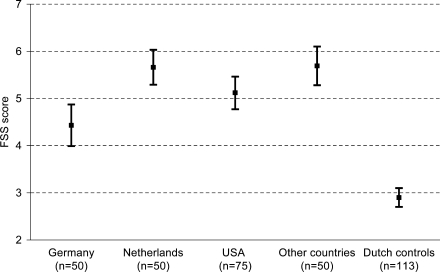
Methods: The Fatigue Severity Scale (FSS) was assessed in an international population of 225 adults with Pompe disease, a metabolic disorder presenting as a slowly progressive proximal myopathy. The FSS scores were compared to those of healthy controls and the relationship between the level of fatigue and other patient characteristics was investigated.
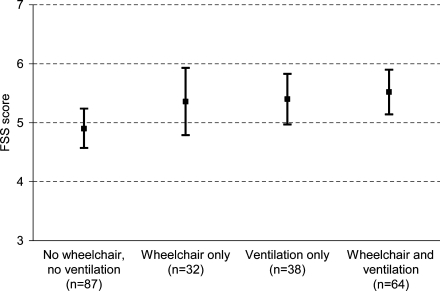
Results: The mean age of the participants was 47 (SD 13) years and the mean disease duration 11 (SD 8) years. 43% used a wheelchair and 46% had respiratory support, 29% needed both. 67% of the participants had a FSS score > or =5, indicating severe fatigue. The mean FSS score was 5.2 (SD 1.5), which was significantly higher than that of healthy controls (p < 0.001). Fatigue was not related to age, sex or disease duration. Patients who used a wheelchair or respiratory support were on average more fatigued than those who did not (p = 0.01). However, of the patients who did not use these aids, 59% also had a FSS score > or =5. FSS scores were highest among patients who reported a high frequency of sleep disorders, but patients who never experienced sleep difficulties were also fatigued (mean FSS score = 4.8).
Conclusion: Fatigue is highly prevalent among both mildly and severely affected adult patients with Pompe disease. The FSS appears a useful tool in assessing fatigue in Pompe disease.
Figures
Comment in
-
Adult onset Pompe disease associated with multiple sclerosis.J Neurol. 2011 Dec;258(12):2286-7. doi: 10.1007/s00415-011-6100-3. Epub 2011 May 26. J Neurol. 2011. PMID: 21614430 No abstract available.
References
MeSH terms
LinkOut - more resources
Full Text Sources
Medical
