Long-term 3T MR angiography follow-up after therapeutic occlusion of the internal carotid artery to detect possible de novo aneurysm formation
- PMID: 17353324
- PMCID: PMC7977854
Long-term 3T MR angiography follow-up after therapeutic occlusion of the internal carotid artery to detect possible de novo aneurysm formation
Abstract
Background and purpose: The purpose of this study was to assess the incidence of de novo aneurysm formation, the incidence of subarachnoid hemorrhage (SAH), and the growth of existing untreated aneurysms in 52 patients after therapeutic carotid artery balloon occlusion for carotid aneurysms.
Patients and methods: Between January 1996 and August 2004, 52 patients were treated with carotid artery balloon occlusion for carotid aneurysms. In June 2005, all patients, their next of kin, or family physicians were contacted and questioned concerning episodes of headache or hospital admissions that could be attributed to SAH. In addition, MR imaging and MR angiography (MRA) at 3T were performed in 26 of 44 surviving patients after a mean follow-up period of 50.2 months (median, 43.5 months; range, 14-107 months). MR imaging and MRA studies were compared with the digital subtraction angiograms at the time of carotid artery occlusion.
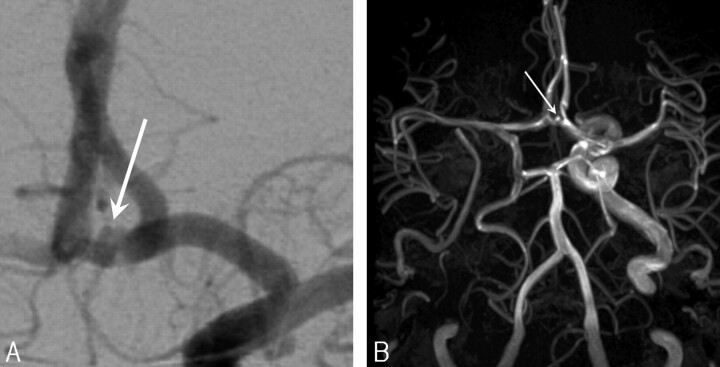
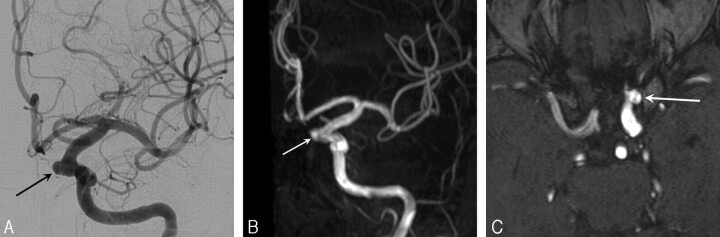
Results: During clinical follow-up of 52 patients at a mean of 50.3 months (median, 42.5 months; range, 0-107 months), no episodes of SAH were reported (0%; 97.5% confidence interval [CI], 0-8.2%). In the 26 patients with follow-up MR imaging, no de novo aneurysms were detected (0%; 97.5 CI, 0-13.2%). Five existing untreated small aneurysms in 5 patients had not enlarged after a mean follow-up of 40 months.
Conclusion: In this study, therapeutic carotid artery occlusion was not associated with development of new aneurysms or enlargement of existing untreated aneurysms with time.
Figures
Comment in
-
Long-term clinical follow-up of therapeutic internal carotid artery occlusion.AJNR Am J Neuroradiol. 2007 Oct;28(9):1626. doi: 10.3174/ajnr.A0680. Epub 2007 Sep 20. AJNR Am J Neuroradiol. 2007. PMID: 17885227 Free PMC article. No abstract available.
References
-
- van Rooij WJ, Sluzewski M, Metz NH, et al. Carotid balloon occlusion for large and giant aneurysms: evaluation of a new test occlusion protocol. Neurosurgery 2000;47:116–21 - PubMed
-
- van der Schaaf IC, Brilstra EH, Buskens E, et al. Endovascular treatment of aneurysms in the cavernous sinus: a systematic review on balloon occlusion of the parent vessel and embolization with coils. Stroke 2002;33:313–18 - PubMed
-
- Larson JJ, Tew JM Jr, Tomsick TA, et al. Treatment of aneurysms of the internal carotid artery by intravascular balloon occlusion: long-term follow-up of 58 patients. Neurosurgery 1990;36:23–30 - PubMed
Publication types
MeSH terms
LinkOut - more resources
Full Text Sources
Medical