


Effect of leptin on activation and cytokine synthesis in peripheral blood lymphocytes of malnourished infected children
- PMID: 17355247
- PMCID: PMC1941936
- DOI: 10.1111/j.1365-2249.2007.03361.x
Effect of leptin on activation and cytokine synthesis in peripheral blood lymphocytes of malnourished infected children
Abstract
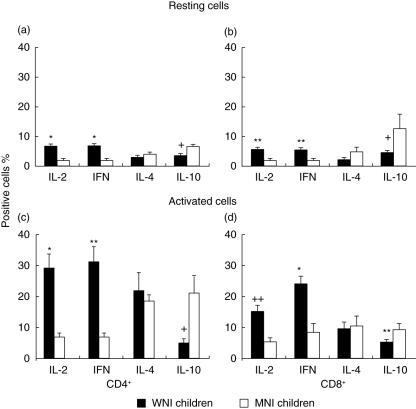
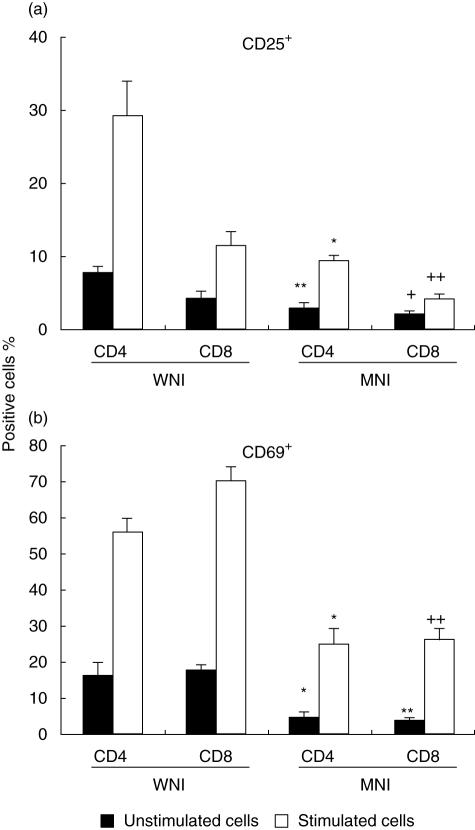
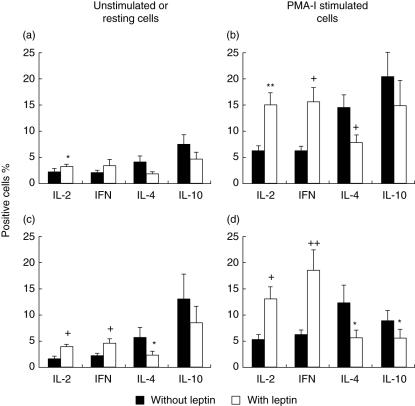
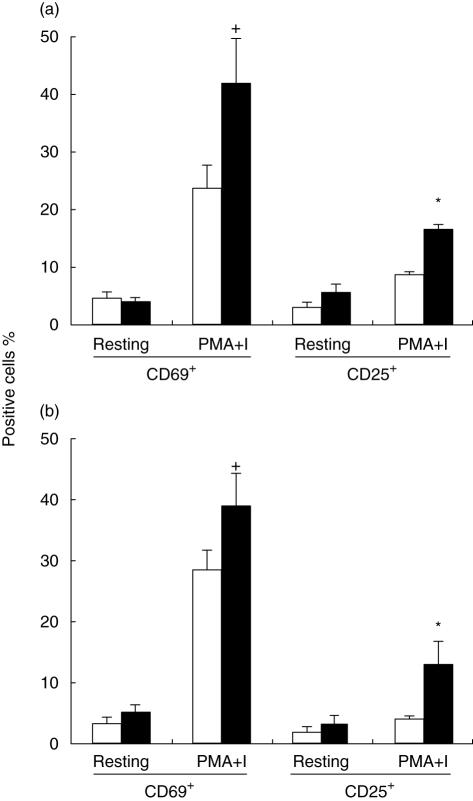
Malnutrition compromises immune function, resulting in reduced resistance to infection. Recent animal and human studies have suggested that leptin is capable of modulating the immune response and that its levels, which are regulated by nutritional status, fall rapidly during starvation. Leptin deficiency is associated with impaired cell-mediated immunity, an increased incidence of infectious disease and an associated increase in mortality. The purpose of this study was to examine the effect of leptin on activation and cytokine production in peripheral blood T cells from malnourished children. The data obtained in the present study demonstrate that leptin produced an increase in the percentage of CD4(+) and CD8(+) cells producing interleukin (IL)-2 and interferon (IFN)-gamma in 24-h cultures. Moreover, leptin decreased the percentage of CD4(+) and CD8(+) cells producing IL-4 and IL-10, and enhanced activation of circulating T cells when co-stimulated by phorbol 12-myristate 13 acetate (PMA)-ionomycin. Leptin enhanced the expression of activation markers CD69 and CD25 in both CD4(+) and CD8(+) cells after 5 h of stimulation. In conclusion, the results obtained show that leptin modulates CD4(+) and CD8(+) cell activation towards a T helper 1 (Th1) phenotype by stimulating the synthesis of IL-2 and IFN-gamma. In contrast, leptin decreases IL-4 and IL-10 production. Moreover, leptin enhanced the expression of CD69 and CD25 on CD4(+) and CD8(+) cells after stimulation with PMA-ionomycin.
Figures
References
-
- Matarese G. Leptin and the immune system: how nutritional status influences the immune response. Eur Cytokine Netw. 2000;11:7–14. - PubMed
-
- Ozata M, Ozdemir I, Licinio J. Human leptin deficiency caused by a missense mutation: multiple endocrine defects, decreased sympathetic tone, and immune system dysfunction indicate new targets for leptin action, greater central than peripheral resistance to the effects of leptin, and spontaneous correction of leptin-mediated defects. J Clin Endocrinol Metab. 1999;84:3686–95. - PubMed
-
- Faggioni R, Kenneth R, Feingold K, Grunfeld C. Leptin regulation of the immune response and the immunodeficiency of malnutrition. FASEB J. 2001;15:2565–71. - PubMed
-
- Zhang F, Chen Y, Heiman M, Dimarchi R. Leptin: structure, function and biology. Vitam Horm. 2005;71:345–72. - PubMed
Publication types
MeSH terms
Substances
LinkOut - more resources
Full Text Sources
Medical
Research Materials
