. 2007 Mar 13:7:17.
doi: 10.1186/1471-2334-7-17.

The influenza pandemic preparedness planning tool InfluSim

Affiliations

The influenza pandemic preparedness planning tool InfluSim

Martin Eichner et al. BMC Infect Dis. .

Abstract

Background: Planning public health responses against pandemic influenza relies on predictive models by which the impact of different intervention strategies can be evaluated. Research has to date rather focused on producing predictions for certain localities or under specific conditions, than on designing a publicly available planning tool which can be applied by public health administrations. Here, we provide such a tool which is reproducible by an explicitly formulated structure and designed to operate with an optimal combination of the competing requirements of precision, realism and generality.

Results: InfluSim is a deterministic compartment model based on a system of over 1,000 differential equations which extend the classic SEIR model by clinical and demographic parameters relevant for pandemic preparedness planning. It allows for producing time courses and cumulative numbers of influenza cases, outpatient visits, applied antiviral treatment doses, hospitalizations, deaths and work days lost due to sickness, all of which may be associated with economic aspects. The software is programmed in Java, operates platform independent and can be executed on regular desktop computers.

Conclusion: InfluSim is an online available software http://www.influsim.info which efficiently assists public health planners in designing optimal interventions against pandemic influenza. It can reproduce the infection dynamics of pandemic influenza like complex computer simulations while offering at the same time reproducibility, higher computational performance and better operability.


Figures
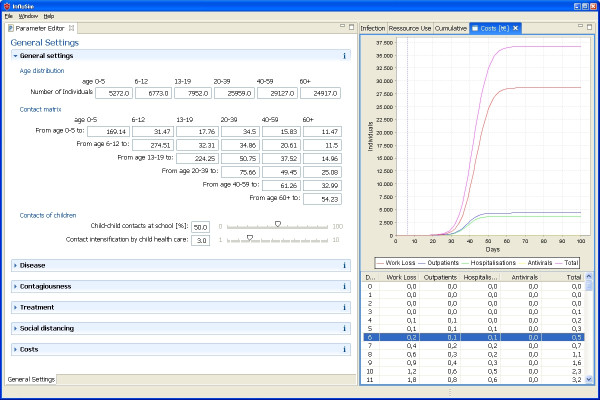
Figure 1
Figure 1
InfluSim user interface. Graphical user interface of InfluSim. Parameter values can be varied within different tabs (left hand side), divided into General settings (demography by age and risk group, contact matrix, economics), Disease (sojourn times, symptoms, hospitalizations, case fatality), Contagiousness (R0, infectivity over time and by disease severity), Treatment (therapeutic window, treatment schedules, antiviral properties), Social distancing (isolation schedules, general contact reduction, closing day care centres and schools, cancelling mass gatherings) and Costs (work loss, hospitalization, treatment). Time-dependent model output (right hand side) visualizes Infection prevalence (susceptible, exposed, asymptomatic, moderately sick, severely sick, dead, immune), Resource use (work loss, outpatients, hospital beds, antivirals), Cumulative numbers of the latter, and Costs.
Figure 2
Figure 2
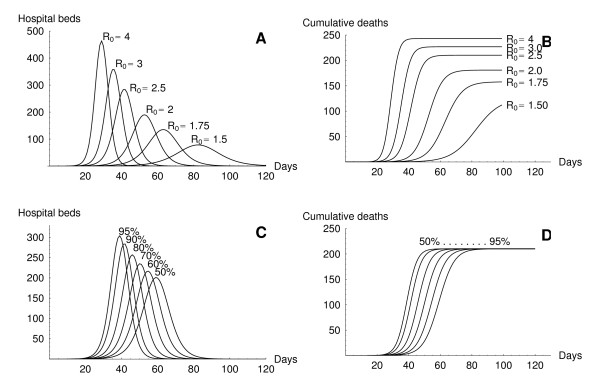
InfluSim output. Examples of InfluSim output for a population of 100,000 citizens. A: Number of hospital beds required during an influenza pandemic for values of R0 ∈ {1.5, 1.75, 2, 2.5, 3, 4}. B: Cumulative number of deaths for values of R0 as in A. C: Number of hospital beds for values of x50 ∈ {50, 60, 70, 80, 90, 95%} (e.g. x50 = 95% means that 95% of the cumulative contagiousness is concentrated during the first half of the contagious period, see Table 6). D: Cumulative number of deaths for values of x50 as in C. All other parameters as listed in Tables 2-6.

References

    1. Mounier-Jack S, Coker RJ. How prepared is Europe for pandemic influenza? Analysis of national plans. Lancet. 2006;367:1405–1411. doi: 10.1016/S0140-6736(06)68511-5. - DOI - PubMed
    1. Smith DJ. Predictability and preparedness in influenza control. Science. 2006;312:392–394. doi: 10.1126/science.1122665. - DOI - PubMed
    1. Levins R. The strategy of model building in population biology. American Scientist. 1966;54:421–431.
    1. Meltzer MI, Cox NJ, Fukuda K. The economic impact of pandemic influenza in the United States: priorities for intervention. Emerg Infect Dis. 1999;5:659–671. - PMC - PubMed
    1. Germann TC, Kadau K, Longini IM Jr., Macken CA. Mitigation strategies for pandemic influenza in the United States. Proc Natl Acad Sci U S A. 2006;103:5935–5940. doi: 10.1073/pnas.0601266103. - DOI - PMC - PubMed

Publication types

MeSH terms