


Stability of mRNA/DNA and DNA/DNA duplexes affects mRNA transcription
- PMID: 17356699
- PMCID: PMC1808433
- DOI: 10.1371/journal.pone.0000290
Stability of mRNA/DNA and DNA/DNA duplexes affects mRNA transcription
Abstract
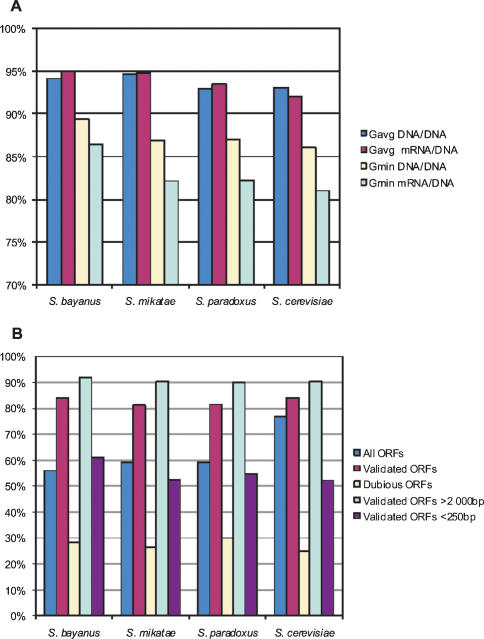
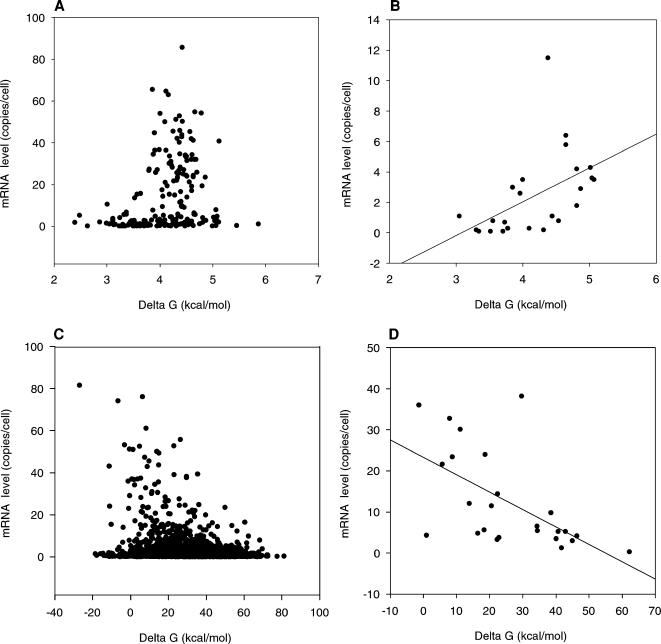
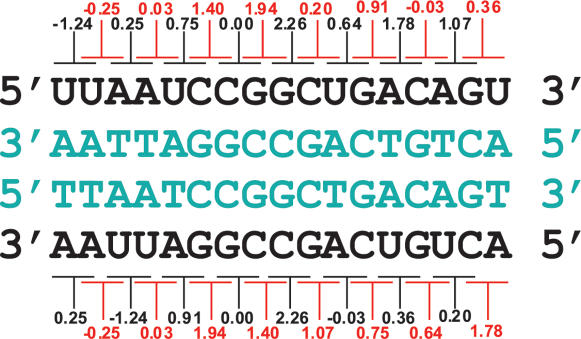
Nucleic acids, due to their structural and chemical properties, can form double-stranded secondary structures that assist the transfer of genetic information and can modulate gene expression. However, the nucleotide sequence alone is insufficient in explaining phenomena like intron-exon recognition during RNA processing. This raises the question whether nucleic acids are endowed with other attributes that can contribute to their biological functions. In this work, we present a calculation of thermodynamic stability of DNA/DNA and mRNA/DNA duplexes across the genomes of four species in the genus Saccharomyces by nearest-neighbor method. The results show that coding regions are more thermodynamically stable than introns, 3'-untranslated regions and intergenic sequences. Furthermore, open reading frames have more stable sense mRNA/DNA duplexes than the potential antisense duplexes, a property that can aid gene discovery. The lower stability of the DNA/DNA and mRNA/DNA duplexes of 3'-untranslated regions and the higher stability of genes correlates with increased mRNA level. These results suggest that the thermodynamic stability of DNA/DNA and mRNA/DNA duplexes affects mRNA transcription.
Conflict of interest statement
Figures

References
-
- Borer PN, Dengler B, Tinoco I,, Jr., Uhlenbeck OC. Stability of ribonucleic acid double-stranded helices. J Mol Biol. 1974;86:843–853. - PubMed
-
- Sugimoto N, Nakano S, Katoh M, Matsumura A, Nakamuta H, et al. Thermodynamic parameters to predict stability of RNA/DNA hybrid duplexes. Biochemistry. 1995;34:11211–11216. - PubMed
Publication types
MeSH terms
Substances
LinkOut - more resources
Full Text Sources
Other Literature Sources
Molecular Biology Databases
