. 2007 Apr;80(4):800-4.
doi: 10.1086/513322. Epub 2007 Feb 22.

Transcription factor SIX5 is mutated in patients with branchio-oto-renal syndrome

Affiliations

Transcription factor SIX5 is mutated in patients with branchio-oto-renal syndrome

Bethan E Hoskins et al. Am J Hum Genet. 2007 Apr.

Abstract

Branchio-oto-renal syndrome (BOR) is an autosomal dominant developmental disorder characterized by the association of branchial arch defects, hearing loss, and renal anomalies. Mutations in EYA1 are known to cause BOR. More recently, mutations in SIX1, which interacts with EYA1, were identified as an additional cause of BOR. A second member of the SIX family of proteins, unc-39 (SIX5), has also been reported to directly interact with eya-1 in Caenorhabditis elegans. We hypothesized that this interaction would be conserved in humans and that interactors of EYA1 represent good candidate genes for BOR. We therefore screened a cohort of 95 patients with BOR for mutations in SIX5. Four different heterozygous missense mutations were identified in five individuals. Functional analyses of these mutations demonstrated that two mutations affect EYA1-SIX5 binding and the ability of SIX5 or the EYA1-SIX5 complex to activate gene transcription. We thereby identified heterozygous mutations in SIX5 as a novel cause of BOR.


Figures
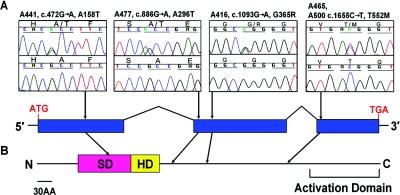
Figure  1.
Figure  1.
Four missense mutations in SIX5 identified in patients with BOR. A, A158T, A296T, and G365R mutations, present in heterozygous form in a single patient. The T552M mutation was detected in patients A465 and A500. Sequences from the affected individual are shown above sequences from healthy control individuals. Patient identifiers, nucleotide changes, and amino acid changes are shown above the traces. B, SIX5 has an SD and a homeodomain (HD) characteristic of the SIX family of proteins at the N-terminus. An activation domain has also been mapped to the C-terminus. The A158T mutation is located in the SIX domain; the remaining three mutations are located between the HD and the activation domain.
Figure  2.
Figure  2.
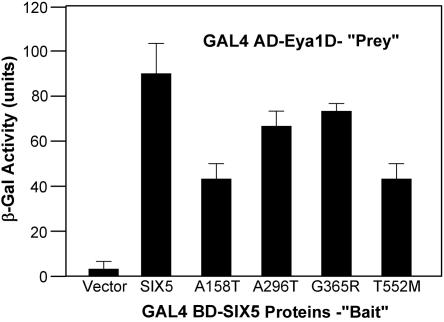
Mutations in SIX5 affect SIX5-Eya1 binding. Yeast two-hybrid assays were performed to test the effect of the mutations on the ability of SIX5 to bind to Eya1. Cotransformation of GAL4BD-SIX5 and GAL4AD-Eya1D leads to strong lacZ expression. An >2-fold reduction in LacZ expression is seen when SIX5 proteins containing an A158T or a T552M mutation are cotransformed with Eya1D fusion proteins.
Figure  3.
Figure  3.
Mutations in SIX5 reduce its ability to activate transcription of the MEF3 promoter. The myogenin luciferase reporter pGL3-6×MEF3 was cotransfected with pcDNA3 vector containing SIX5 or its mutants (A158T, A296T, G365R, and T552M), pFlag-Eya1, or both the SIX5 and Eya1 plasmids together in HEK293 cells. Luciferase activity in the cell lysate was normalized with β-galactosidase activity of pCMVβ-gal as an internal control. The activity at each data point is relative to that obtained by the control pCMV vector. The mean fold activation from three independent experiments (each performed in duplicate) is shown with the standard deviation. A filled circle (•) indicates P<.002, compared with SIX5; an asterisk (*) indicates P<.002, compared with SIX5/Eya1 (one-way analysis of variance [ANOVA]).

References

Web Resource

    1. Online Mendelian Inheritance in Man (OMIM), http://www.ncbi.nlm.nih.gov/Omim/ (for BOR, BOS2, and branchiootic syndrome-3 locus)

References

    1. Fraser FC, Sproule JR, Halal F (1980) Frequency of the branchio-oto-renal (BOR) syndrome in children with profound hearing loss. Am J Med Genet 7:341–34910.1002/ajmg.1320070316 - DOI - PubMed
    1. Weber KM, Kousseff BG (1999) “New” manifestations of BOR syndrome. Clin Genet 56:306–31210.1034/j.1399-0004.1999.560408.x - DOI - PubMed
    1. Izzedine H, Tankere F, Launay-Vacher V, Deray G (2004) Ear and kidney syndromes: molecular versus clinical approach. Kidney Int 65:369–38510.1111/j.1523-1755.2004.00390.x - DOI - PubMed
    1. Heimler A, Lieber E (1986) Branchio-oto-renal syndrome: reduced penetrance and variable expressivity in four generations of a large kindred. Am J Med Genet 25:15–2710.1002/ajmg.1320250104 - DOI - PubMed
    1. Kalatzis V, Abdelhak S, Compain S, Vincent C, Petit C (1996) Characterization of a translocation-associated deletion defines the candidate region for the gene responsible for branchio-oto-renal syndrome. Genomics 34:422–42510.1006/geno.1996.0307 - DOI - PubMed

Publication types

MeSH terms