Review
. 2007 Jul;22(7):926-36.
doi: 10.1007/s00467-007-0435-0. Epub 2007 Mar 15.

Bardet-Biedl syndrome: beyond the cilium

Affiliations
Review

Bardet-Biedl syndrome: beyond the cilium

Jonathan L Tobin et al. Pediatr Nephrol. 2007 Jul.

Abstract

The Bardet-Biedl syndrome (BBS) is a significant genetic cause of chronic and end-stage renal failure in children. Despite being a relatively rare recessive condition, BBS has come to prominence during the past few years owing to revelations of primary cilia dysfunction underlying pathogenesis. The study of this multi-system disorder, which includes obesity, cognitive impairment, genito-urinary tract malformations and limb deformities, is beginning to reveal insights into several aspects of mammalian development and organogenesis. Involvement of BBS proteins in disparate pathways such as the non-canonical Wnt and Sonic Hedgehog pathways is highlighting their interplay in disease pathogenesis. Here we review the recent developments in this emerging field, with the emphasis on the renal component of the syndrome and potential future directions.


Figures
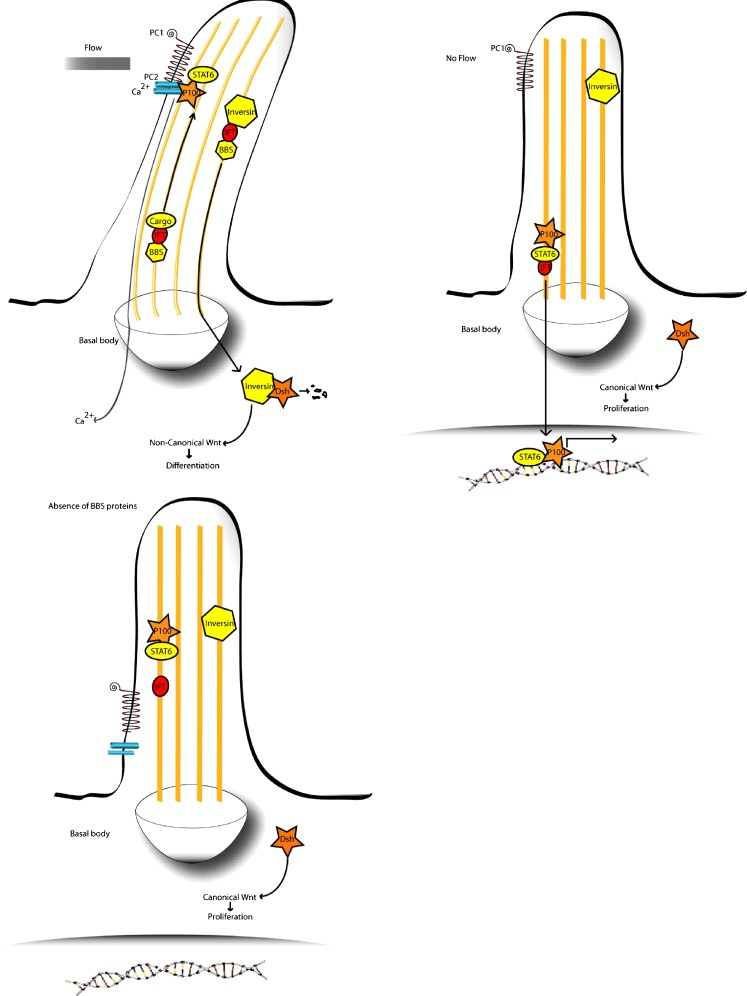
Fig. 1
Fig. 1
Putative pathomechanism for renal cystic hyperplasia in BBS. Top left Urine flow through the kidney tubule causes an influx of Ca2+ ions through polycystin 2 (PC2), while polycystin 1 (PC1) anchors the transcriptional complex of P100 and STAT6 in the cilium. Concurrently, inversin is translocated to the nucleus, where it targets cytoplasmic Dishevelled for destruction, activating the non-canonical pathway and causing cells to differentiate. The ciliary localisation of PC1/2 and inversin may be dependent on BBS proteins. Top right Absence of urine flow reduces Ca2+ influx and causes release of P100 and STAT6, allowing them to enter the nucleus to activate transcription. It also prevents translocation of inversin to the cytoplasm, maintaining the cytoplasmic pool of Dishevelled, which activates the canonical Wnt pathway and causes proliferation. Bottom left A lack of BBS protein function may inhibit proper transport of PC1/2 to the distal tip of the cilium and also prevent translocation of inversin to the cytoplasm. This would cause inappropriate activation of STAT6 target and maintenance of cytoplasmic Dishevelled, leading to unregulated cell proliferation. Additionally, lack of BBS protein function could disturb planar cell polarity (PCP). The combination of disorganised cell polarity and cell division could cause the various abnormalities seen in BBS
Fig. 2
Fig. 2
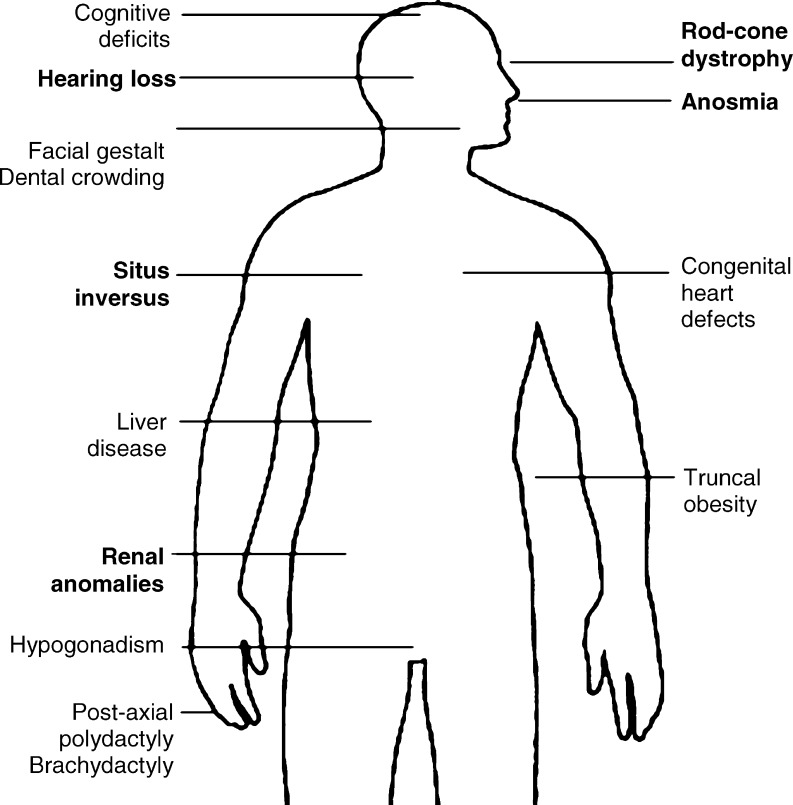
Summary diagram of the major features of BBS. Diagram of major features of BBS. Features directly attributable to defects in ciliary function are marked in bold
Fig. 3
Fig. 3
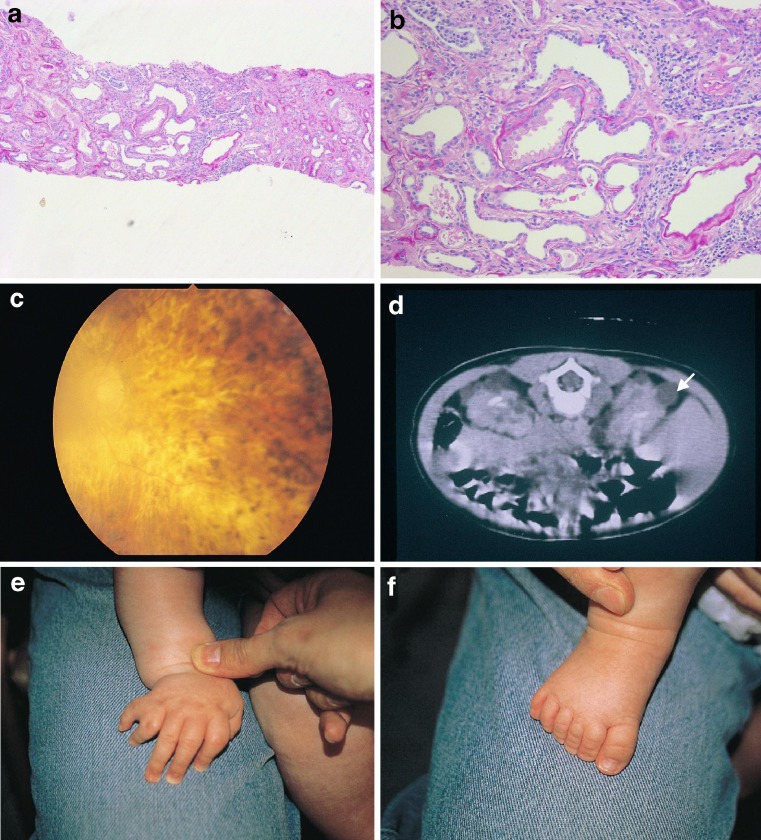
Examples of renal histopathology in BBS patients. a, b Low and high power micrographs showing tubular dilatation in a biopsy from a BBS patient’s kidney (Histopathological sections courtesy of Dr. Neil Sebire, Great Ormond Street Hospital). c Fundoscopy showing retinitis pigmentosa with cataract. d Abdominal CT scan documenting cystic kidneys (arrowed). e, f Post-axial polydactyly in a hand and foot from the same child with BBS

References

    1. Laurence JZ, Moon RC. Four cases of retinitis pigmentosa occurring in the same family accompanied by general imperfection of development. Ophthalmol Rev. 1866;2:32–41. - PubMed
    1. Bardet G (1920) Sur un syndrome d’obesite congenitale avec polydactylie et retinite pigmentaire (contribution a l’etude des formes cliniques de l’obesite hypophysaire) University of Paris
    1. Biedl A. Ein Geschwisterpaar mit adiposo-genitaler Dystrophie. Dtsch Med Wochenschr. 1922;48:1633.
    1. Beales PL, Elcioglu N, Woolf AS, Parker D, Flinter FA. New criteria for improved diagnosis of Bardet–Biedl syndrome: results of a population survey. J Med Genet. 1999;36(6):437–446. - PMC - PubMed
    1. Moore SJ, Green JS, Fan Y, Bhogal AK, Dicks E, Fernandez BA, Stefanelli M, Murphy C, Cramer BC, Dean JC, Beales PL, Katsanis N, Bassett AS, Davidson WS, Parfrey PS. Clinical and genetic epidemiology of Bardet–Biedl syndrome in Newfoundland: a 22-year prospective, population-based, cohort study. Am J Med Genet A. 2005;132(4):352–360. doi: 10.1002/ajmg.a.30406. - DOI - PMC - PubMed

Publication types