


Prevalence and impact of alcohol and other drug use disorders on sedation and mechanical ventilation: a retrospective study
- PMID: 17359534
- PMCID: PMC1838409
- DOI: 10.1186/1471-2253-7-3
Prevalence and impact of alcohol and other drug use disorders on sedation and mechanical ventilation: a retrospective study
Abstract
Background: Experience suggests that patients with alcohol and other drug use disorders (AOD) are commonly cared for in our intensive care units (ICU's) and require more sedation. We sought to determine the impact of AOD on sedation requirement and mechanical ventilation (MV) duration.
Methods: Retrospective review of randomly selected records of adult patients undergoing MV in the medical ICU. Diagnoses of AOD were identified using strict criteria in Diagnostic and Statistical Manual of Mental Disorders, and through review of medical records and toxicology results.
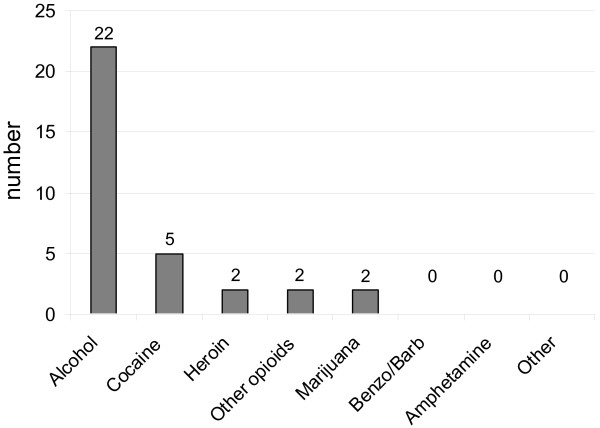
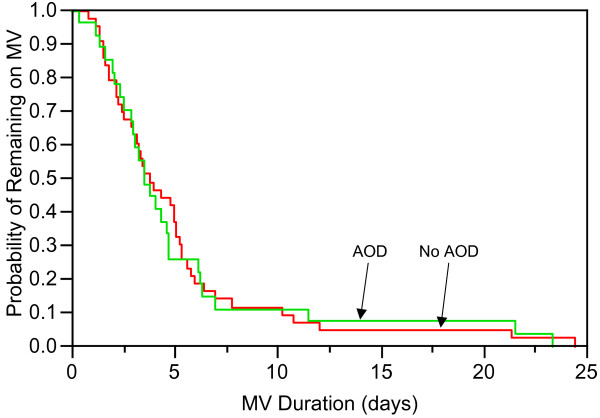
Results: Of the 70 MV patients reviewed, 27 had AOD (39%). Implicated substances were alcohol in 22 patients, cocaine in 5, heroin in 2, opioids in 2, marijuana in 2. There was no difference between AOD and non-AOD patients in age, race, or reason for MV, but patients with AOD were more likely to be male (21 versus 15, p < 0.0001) and had a lower mean Acute Physiology and Chronic Health Evaluation II (22 versus 26, p = 0.048). While AOD patients received more lorazepam equivalents (0.5 versus 0.2 mg/kg.day, p = 0.004), morphine equivalents (0.5 versus 0.1 mg/kg.day, p = 0.03) and longer duration of infusions (16 versus 10 hours/day. medication, p = 0.002), they had similar sedation levels (Richmond Agitation-Sedation Scale (RASS) -2 versus -2, p = 0.83), incidence of agitation (RASS > or = 3: 3.0% versus 2.4% of observations, p = 0.33), and duration of MV (3.6 versus 3.9 days, p = 0.89) as those without AOD.
Conclusion: The prevalence of AOD among medical ICU patients undergoing MV is high. Patients with AOD receive higher doses of sedation than their non-AOD counterparts to achieve similar RASS scores but do not undergo longer duration of MV.
Figures
References
-
- Arroliga A, Frutos-Vivar F, Hall J, Esteban A, Apezteguia C, Soto L, Anzueto A, International Mechanical Ventilation Study Group Use of sedatives and neuromuscular blockers in a cohort of patients receiving mechanical ventilation. Chest. 2005;128:496–506. doi: 10.1378/chest.128.2.496. - DOI - PubMed
-
- Woods JC, Mion LC, Connor JT, Viray F, Jahan L, Huber C, McHugh R, Gonzales JP, Stoller JK, Arroliga AC. Severe agitation among ventilated medical intensive care unit patients: Frequency, characteristics and outcomes. Intensive Care Med. 2004;30:1066–1072. doi: 10.1007/s00134-004-2193-9. - DOI - PubMed
-
- Kollef MH, Levy NT, Ahrens TS, Schaiff R, Prentice D, Sherman G. The use of continuous i.v. sedation is associated with prolongation of mechanical ventilation. Chest. 1998;114:541–548. - PubMed
Grants and funding
LinkOut - more resources
Full Text Sources
Medical
