. 2007 Mar 14:7:40.
doi: 10.1186/1471-2148-7-40.

Incorporating indel information into phylogeny estimation for rapidly emerging pathogens

Affiliations

Incorporating indel information into phylogeny estimation for rapidly emerging pathogens

Benjamin D Redelings et al. BMC Evol Biol. .

Abstract

Background: Phylogenies of rapidly evolving pathogens can be difficult to resolve because of the small number of substitutions that accumulate in the short times since divergence. To improve resolution of such phylogenies we propose using insertion and deletion (indel) information in addition to substitution information. We accomplish this through joint estimation of alignment and phylogeny in a Bayesian framework, drawing inference using Markov chain Monte Carlo. Joint estimation of alignment and phylogeny sidesteps biases that stem from conditioning on a single alignment by taking into account the ensemble of near-optimal alignments.

Results: We introduce a novel Markov chain transition kernel that improves computational efficiency by proposing non-local topology rearrangements and by block sampling alignment and topology parameters. In addition, we extend our previous indel model to increase biological realism by placing indels preferentially on longer branches. We demonstrate the ability of indel information to increase phylogenetic resolution in examples drawn from within-host viral sequence samples. We also demonstrate the importance of taking alignment uncertainty into account when using such information. Finally, we show that codon-based substitution models can significantly affect alignment quality and phylogenetic inference by unrealistically forcing indels to begin and end between codons.

Conclusion: These results indicate that indel information can improve phylogenetic resolution of recently diverged pathogens and that alignment uncertainty should be considered in such analyses.


Figures
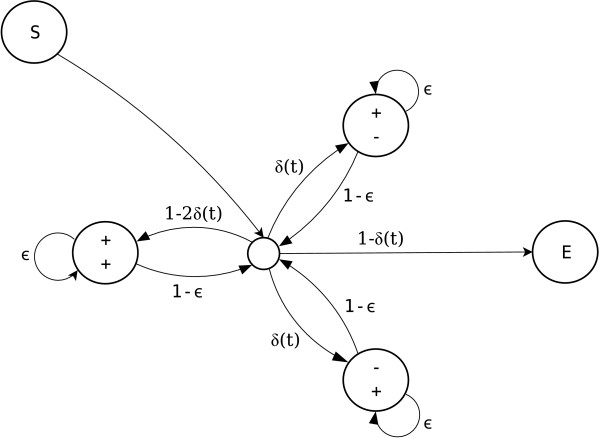
Figure 1
Figure 1
Pair-HMM representation of the fragment-based indel model. After the start state (S), the Markov chain transitions to the central silent state. From here it may terminate by transitioning to the end state (E), or it may enter a match (+/+), insert (-/+) or delete (+/-) fragment. Each fragment has probability δ(t) of being an insert or delete fragment. Fragment lengths are geometric with continuation probability ε. After the end of a fragment, the Markov chain returns to the central silent state where it may begin a new fragment. The silent state that indicates fragment boundaries can be removed, resulting in transitions only between non-silent states. The model is a fragment based model because the direct transition probability from (+/+) to (+/+) without going through the silent state is ε and not 0. The pair-HMM represents an improper distribution because the probabilities of outgoing edges of the central silent state do not sum to 1.
Figure 2
Figure 2
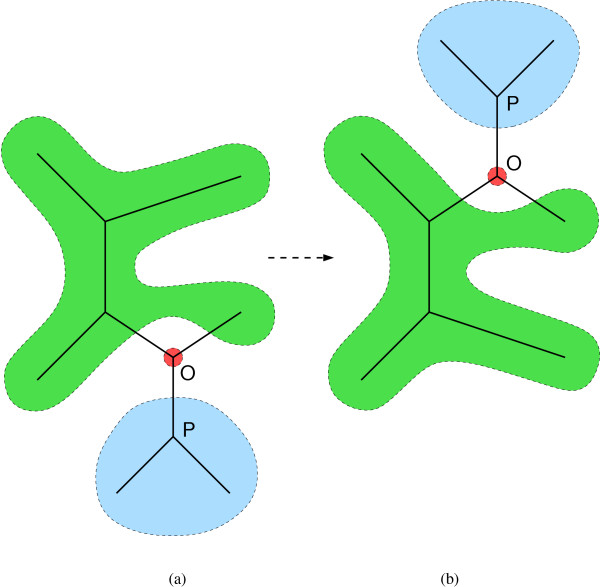
The subtree-prune-and-regraft operator. (a) First a subtree (blue) and its associated node O are detached from the rest of the tree (green). (b) The subtree is then regrafted along into a different branch through its node O. In both (a) and (b), three branches connect to node O. The phylogeny relating sequences at the pruned nodes (blue) and the phylogeny relating sequences at the remaining nodes (green) do not change. Therefore alignments within each of these sequence subsets can remain unchanged from (a) to (b).
Figure 3
Figure 3
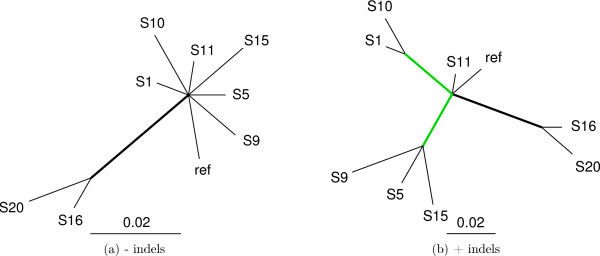
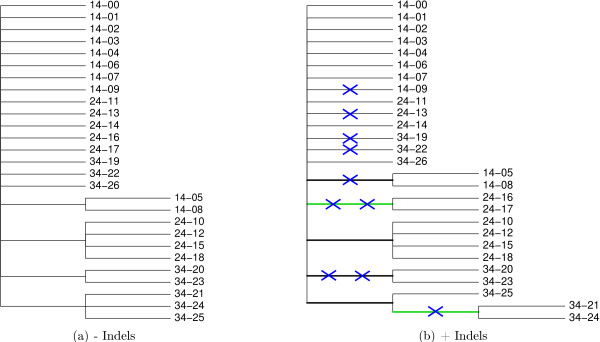
Indel information improves resolution of the SIV phylogeny. (a) At posterior probability > 0.99 the traditional sequential model supports only one branch, (b) When indel information is included, the number of supported branches rises to 3. The two green branches are supported only when indel information is used.
Figure 4
Figure 4
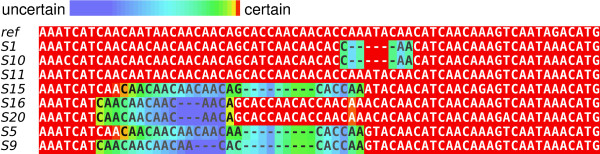
SIV Alignment uncertainty plot. We annotate the joint maximum a posteriori alignment estimate to indicate the approximate probability that each letter aligns to the root taxon in its column [24]. The 8 gaps in the alignment are a result of only 4 indel events under the joint model, whereas the Clustal W alignment requires at least 5 indel events. Colors other than red indicates that letters or gaps may shift to adjacent positions. The high frequency of the CAA triplet is partially responsible for the level of alignment uncertainty.
Figure 5
Figure 5
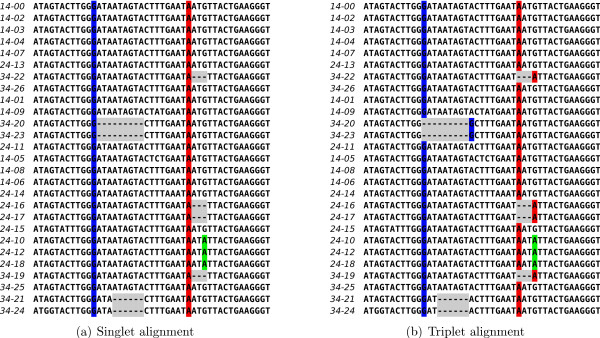
Triplet alignments may shift indels and cause misaligned residues. Triplet alignments may shift indels and cause misaligned residues. (a) Maximum a posteriori (MAP) alignment estimate under the singlet HKY model. (b) MAP alignment estimate under the triplet HKY × 3 model. In the triplet alignment, two G residues (blue) and four A residues (red) are forced into a different column to avoid breaking the alignment-wide reading frame. The displaced A residues join A residues from strains 10, 12, and 18 (green) which were previously the only A residues in that column. Under both models, the MAP alignment estimates display 8 gaps. The alignment of internal sequences (not shown) indicates that these gaps arose from 5 indel events on branches partitioning clades (20,23), (21,24), (16,17), (19), and (22). Thus, the gaps in sequences 19 and 22 arose independently of the gap in (16,17) even though they have the same length and position. Prefixes on sequence names indicate elapsed time in weeks between the initial infection and when the sequences were obtained.
Figure 6
Figure 6
Triplet alignments may shift indels and cause misaligned residues. (a) At posterior probability > 0.99 the traditional sequential model supports 4 internal branches. (b) When indel information is included, the number of supported branches increases to 6. Branches colored green are supported only when indel information is incorporated. Each blue cross denotes an indel event occurring on a particular branch. Prefixes on sequence names indicate elapsed time in weeks between the initial infection and when the sequences were obtained.
Figure 7
Figure 7
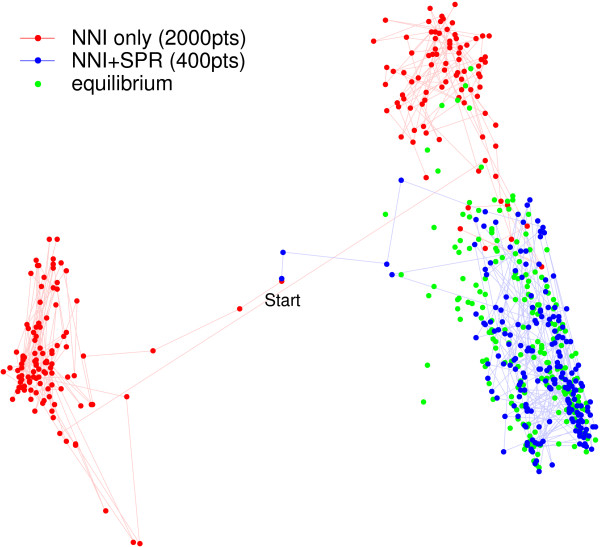
Alignment-aware SPR transition kernel decreases burn-in time. We consider the 27-sequence data set of HIV sequences described in the Results section as Example 2. Points represent 200 topologies sampled from a Markov chains with the alignment-aware SPR transition kernel disabled (red; NNI-only) or enabled (blue; NNI+SPR) or from the equilibrium distribution (green). While the convergence time for Markov chains varies widely, this example illustrates the median convergence time. The NNI-only chain takes 2112 iterations to converge versus only 66 iterations for the NNI+SPR chain. Because the convergence times are so different, the figure depicts every 10th tree for the first 2000 iterations, whereas for the NNI+SPR chain the figure depicts every 2nd tree for the first 400 iterations. Points represent trees projected onto the plane using multidimensional scaling based on the Robinson-Foulds distance. This distance depends only on the topology, not the branch lengths.

References

    1. Gao F, Bailes E, Robertson DL, Chen Y, Rodenburg CM, Michael SF, Cummins LB, Arthur LO, Peeters M, Shaw GM, Sharp PM, Hahn BH. Origin of HIV-1 in the chimpanzee Pan troglodytes troglodytes. Nature. 1999;397:436–441. doi: 10.1038/17130. - DOI - PubMed
    1. Rambaut A, Posada D, Crandall KA, Holmes EC. The causes and consequences of HIV evolution. Nature Reviews Genetics. 2004;5:52–61. doi: 10.1038/nrg1246. - DOI - PubMed
    1. Lutzoni F, Wagner P, Reeb V, Zoller S. Integrating ambiguously aligned regions of DNA sequences in phylogenetic analyses without violating positional homology. Systematic Biology. 2000;49:628–651. doi: 10.1080/106351500750049743. - DOI - PubMed
    1. Shankarappa R, Margolick JB, Gange SJ, Rodrigo AG, Upchurch D, Farzadegan h, Gupta P, Rinaldo CR, Learn GH, He X, Huang XL, Mullins JI. Consistent Viral Evolutionary Changes Associated with the Progression of Human Immunodeficiency Virus Type 1 Infection. Journal of Virology. 1999;73:10489–10502. - PMC - PubMed

    1. Forsman ZH, Lednicky JA, Fox GE, Willson RG, White ZS, Halvorson SJ, Wong C, Jr AML, Butel JS. Phylogenetic Analysis of Polyomavirus Simian Virus 40 from Monkeys and Humans Reveals Genetic Variation. J Virol. 2004;78:9306–9316. doi: 10.1128/JVI.78.17.9306-9316.2004. - DOI - PMC - PubMed

Publication types

Substances