


Stage, survival and delays in lung, colorectal, prostate and ovarian cancer: comparison between diagnostic routes
- PMID: 17359608
- PMCID: PMC2042569
Stage, survival and delays in lung, colorectal, prostate and ovarian cancer: comparison between diagnostic routes
Abstract
Background: Very few studies have reported cancer outcomes of patients referred through different routes, despite the prominence of current UK cancer urgent referral guidance.
Aim: This study aimed to compare outcomes of cancer patients referred through the urgent referral guidance with those who were not, with respect to stage at diagnosis, survival, and delays in diagnosis.
Design of study: Analysis of hospital records.
Setting: One hospital trust in England.
Method: The records of 889 patients diagnosed in 2000-2001 with one of four types of cancer were analysed: 409 with lung cancer; 239 with colorectal cancer; 146 with prostate cancer; and 95 with ovarian cancer. Outcome measures were diagnostic stage, survival, referral and secondary care delays.
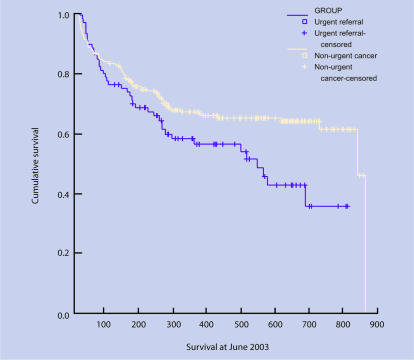
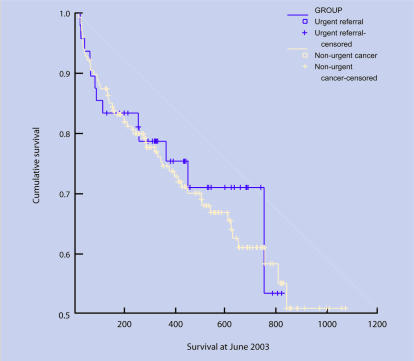
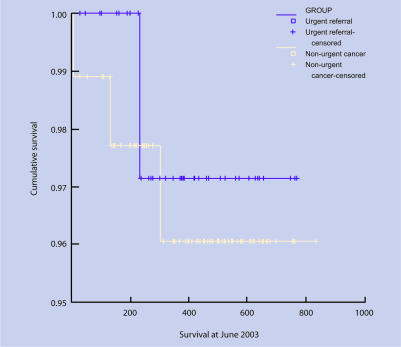
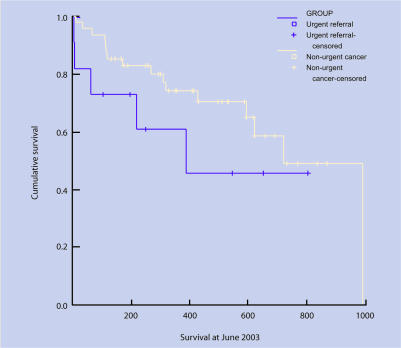
Results: For lung cancer, urgent referrals had more advanced TNM (tumor, node, metastasis) stage than patients diagnosed through other routes (P = 0.035) and poorer survival (P = 0.020). There was no difference in stage or survival for the other cancers. For each cancer, a higher proportion of urgent referrals was seen within 2 weeks. Secondary care delays for lung and colorectal cancer were shorter for inter-specialty referrals.
Conclusion: For patients with lung cancer, the guidance appears to be prioritising those in the more advanced stages of disease. This was not the case for the other three cancers. Referral delays were shorter for patients urgently referred, as is the intention of the guidance. The avoidance of delays in outpatient diagnostics probably accounts for shorter secondary care delays for inter-specialty referrals.
Figures
Comment in
-
Survival statistics.Br J Gen Pract. 2007 May;57(538):410; author reply 410-1. Br J Gen Pract. 2007. PMID: 17504596 Free PMC article. No abstract available.
References
-
- Berrino F, Gatta G, Sant M, Capocaccia R. The EUROCARE study of survival of cancer patients in Europe: aims, current status, strengths and weaknesses. Eur J Cancer. 2001;37(6):673–677. - PubMed
-
- Department of Health. Referral guidelines for suspected cancer. London: Department of Health; 2000.
-
- Department of Health. The NHS Cancer Plan. London: Department of Health; 2000.
Publication types
MeSH terms
LinkOut - more resources
Full Text Sources
Medical
