. 2007 May 11:1145:227-38.
doi: 10.1016/j.brainres.2007.01.144. Epub 2007 Feb 17.

Granulocyte-colony stimulating factor inhibits apoptotic neuron loss after neonatal hypoxia-ischemia in rats

Affiliations

Granulocyte-colony stimulating factor inhibits apoptotic neuron loss after neonatal hypoxia-ischemia in rats

Kenichiro Yata et al. Brain Res. .

Expression of concern in

Abstract

Neonatal hypoxia-ischemia (HI) is an important clinical problem with few effective treatments. Granulocyte-colony stimulating factor (G-CSF) is an endogenous peptide hormone of the hematopoietic system that has been shown to be neuroprotective in focal ischemia in vivo and is currently in phase I/II clinical trials for ischemic stroke in humans. We tested G-CSF in a rat model of neonatal hypoxia-ischemia in postnatal day 7 unsexed rat pups. Three groups of animals were used: hypoxia-ischemia (HI, n=67), hypoxia-ischemia with G-CSF treatment (HI+G, n=65), and healthy control (C, n=53). G-CSF (50 microg/kg, subcutaneous) was administered 1 h after HI and given on four subsequent days (five total injections). Animals were euthanized 24 h, 1, 2, and 3 weeks after HI. Assessment included brain weight, histology, immunohistochemistry, and Western blotting. G-CSF treatment was associated with improved quantitative brain weight and qualitative Nissl histology after hypoxia-ischemia. TUNEL demonstrated reduced apoptosis in group HI+G. Western blot demonstrated decreased expression of Bax and cleaved caspase-3 in group HI+G. G-CSF treatment was also associated with increased expression of STAT3, Bcl-2, and Pim-1, all of which may have participated in the anti-apoptotic effect of the drug. We conclude that G-CSF ameliorates hypoxic-ischemic brain injury and that this may occur in part by an inhibition of apoptotic cell death.


Figures
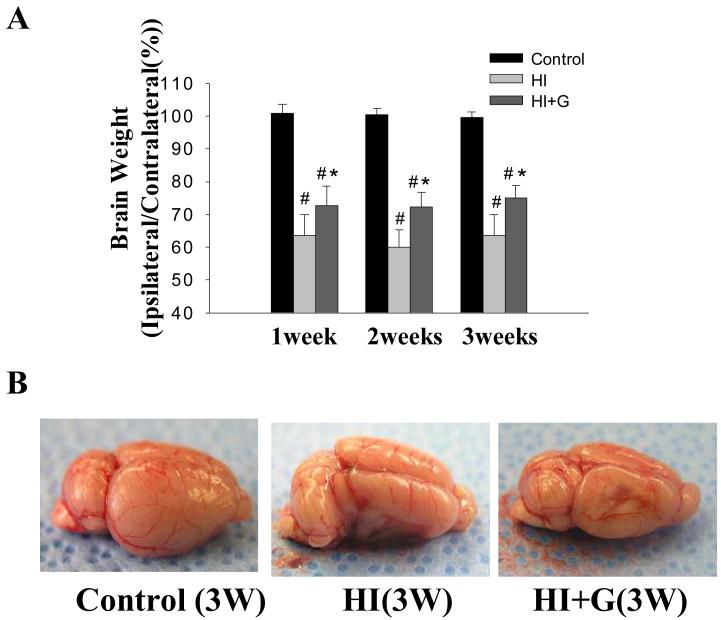
Figure 1
Figure 1
Brain weight. (A) brain weight expressed as a percentage (ipsilateral hemisphere/contralateral hemisphere) at 1, 2, and 3 weeks after HI. Data are mean ± SD of 12 or 13 pups in each group. On Analysis of Variance (ANOVA), p< 0.05 for both # and * when compared to Group C and HI respectively. (B) Representative pictures of brains taken from Groups C, HI and HI+G 3 weeks after hypoxia-ischemia. The lateral view of the ipsilateral hemisphere at 3 weeks shows that HI leads to a significant loss of brain tissue, and that G-CSF treatment is associated with statistically significant improvements in gross brain weight.
Figure 2
Figure 2
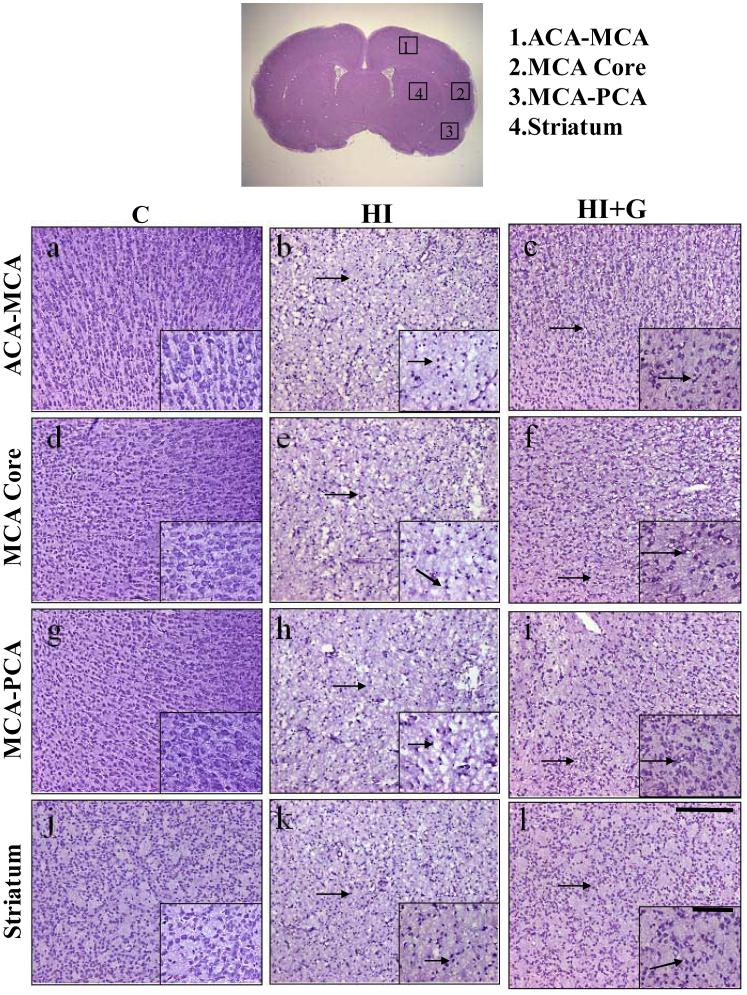
Photomicrographs of Nissl stained brain sections demonstrate qualitative reduction in damage in group HI+G in a variety of brain regions including the MCA supplied core area (panels d,e,f), ACA-MCA peri-infarct area (panels a,b,c), MCA-PCA peri-infarct area (panels g,h,i) and striatum (panels j,k,l) from C group (panels a,d,g,j), HI group (panels b,e,h,k), and HI+G (panels c,f,i,l) 24 hours after neonatal hypoxia-ischemia (Scale bar = 200μm). The topmost figure depicts the regions of interest. The insets in all panels depict brain tissue at higher magnification (Scale = 100μm). The arrows indicate shrunken and damaged neurons.
Figure 3
Figure 3
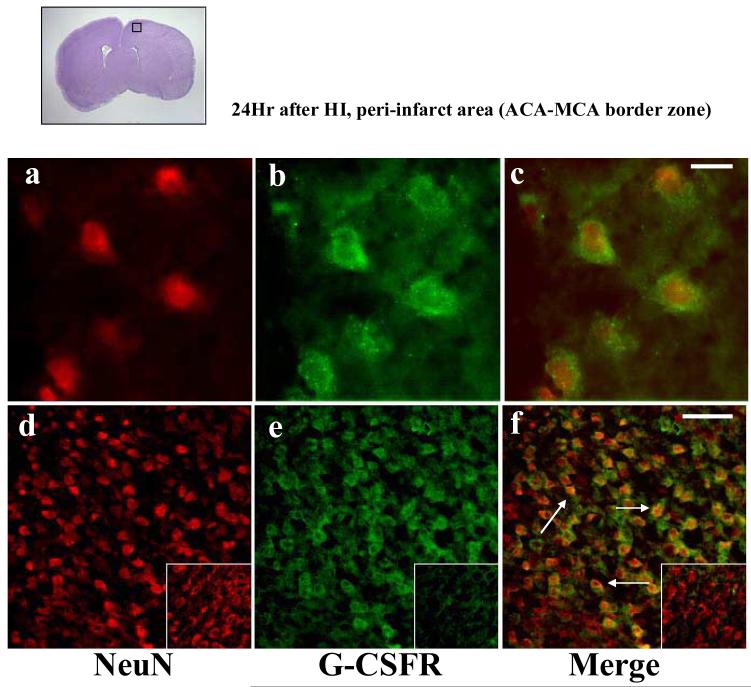
G-CSF receptor (G-CSFR) is expressed in the neonatal rat brain neurons after hypoxia-ischemia. Double immunofluorescence photomicrographs (n=4) of NeuN immunoreactivites (red, neuronal marker, panels a,d), G-CSFR immunoreactivites (green, panels b,e) and their merged images (panels c,f) from brain sections taken from the peri-infarct area at 24hr after hypoxia-ischemia at high magnification (x100, Scale bar 10μm, panels a,b,c) and low magnification (x20, Scale bar 20μm, panels d,e,f). The top left picture with denotes the region of interest. The insets show respective immunoreactivities from Group C.
Figure 4
Figure 4
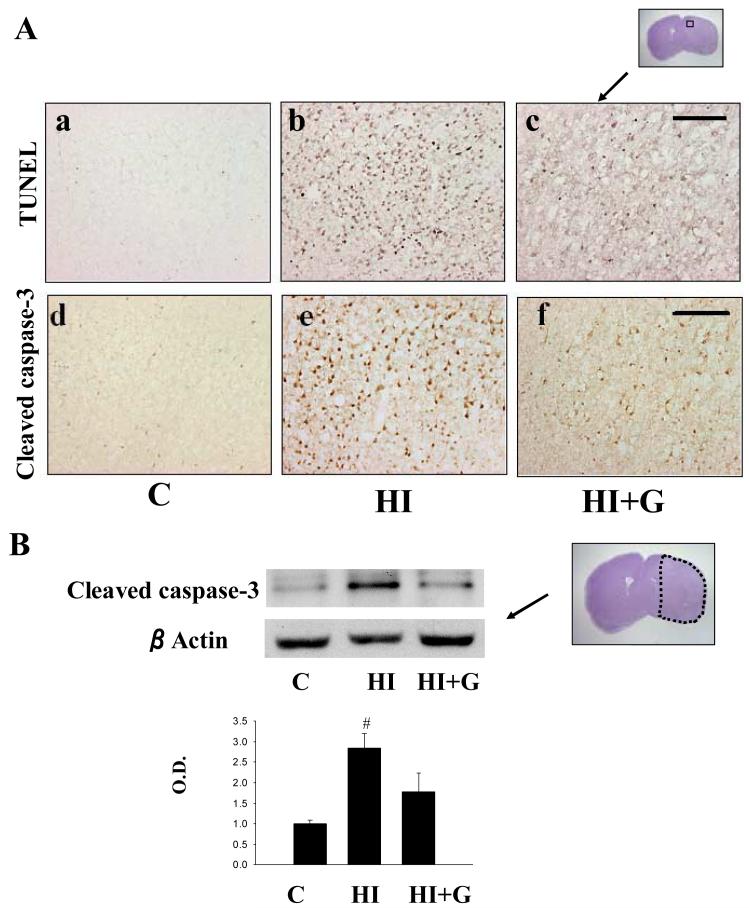
Apoptotic cell death after neonatal HI. A. representative photomicrographs of TUNEL stained brain sections and cleaved caspase-3 stained sections from the peri-infarct zone demonstrate fewer markers of apoptotic cell death in group HI+G compared to group HI 24 hours after hypoxia-ischemia. Scale bar = 200μm. B. Western blot for cleaved caspase-3 protein expression demonstrates less cleaved caspase-3 in group HI+G compared to group HI 24 hours after hypoxia-ischemia. The lower panel depicts cleaved caspase-3 protein expression measured by densitometry analysis. Values represent mean ± S.D. with 5 samples in C group and 8 samples in HI, HI+G group each, expressed as percent change over control group. On ANOVA, p< 0.05 for # when compared to Group C. O.D., optical density.
Figure 5
Figure 5
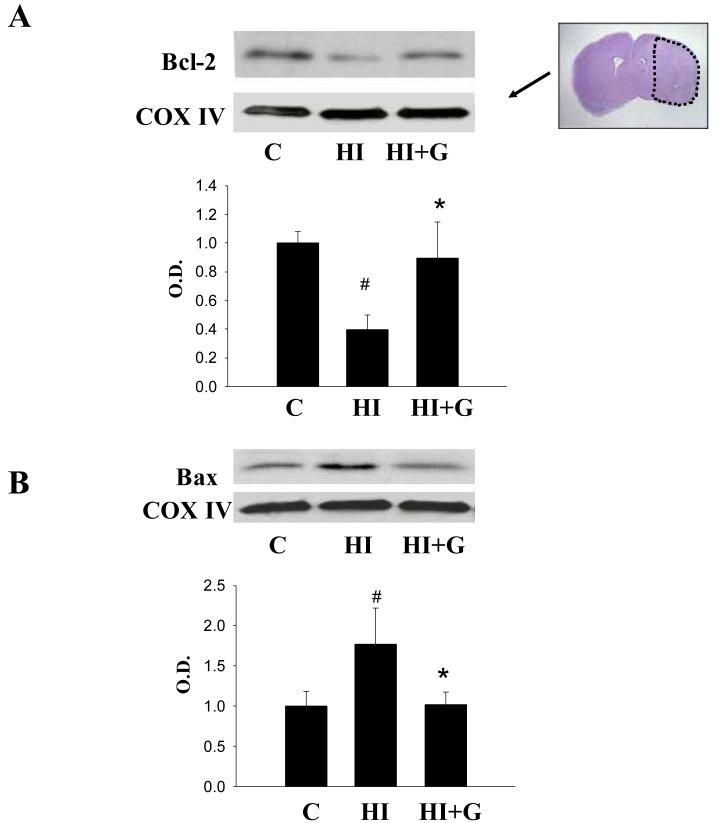
Bcl-2 and Bax expression. A. Group HI+G demonstrated increased levels of Bcl-2 in mitochondrial fractions compared to group HI 24 hours after hypoxia-ischemia. B. Group HI+G demonstrated reduced levels of Bax in mitochondrial fractions compared to group HI 24 hours after hypoxia-ischemia. For both A and B values represent mean ± S.D. with 5 samples in C group and 8 samples in HI, HI+G group each, expressed as percent change over control group. On ANOVA, p< 0.05 for both # and * when compared to Group C and HI, respectively (ANOVA). O.D., optical density. The Nissl stained photomicrograph depicts the area of interest.
Figure 6
Figure 6
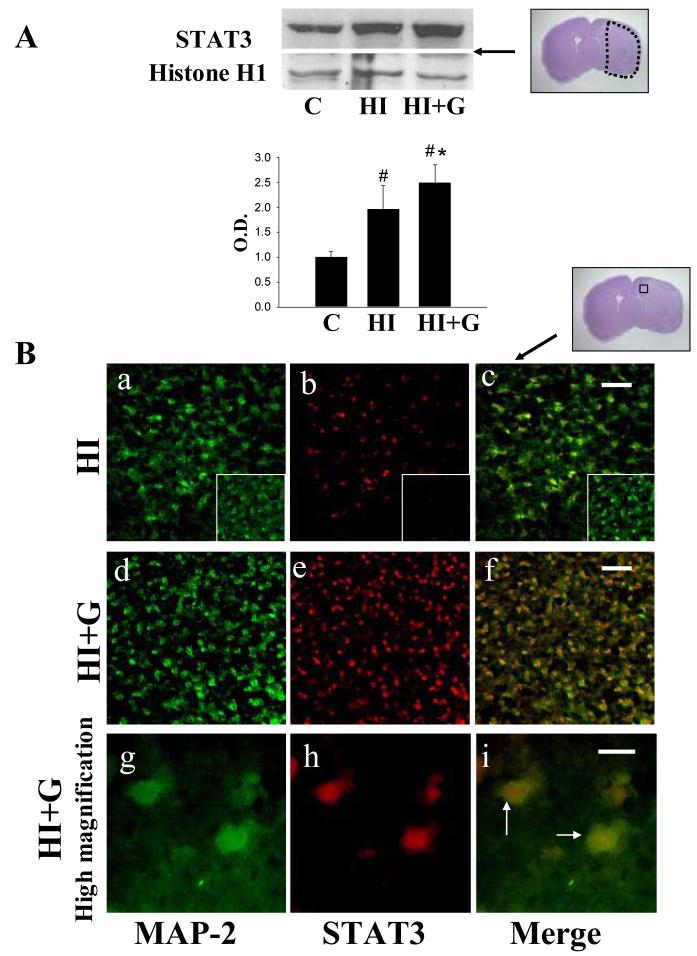
A. G-CSF treatment was associated with increased nuclear expression of STAT3 on Western blot analysis 24 hours after hypoxia-ischemia. Values represent mean ± S.D. with 5 samples in C group and 8 samples in HI, HI+G group each, expressed as percent change over control group. On ANOVA, p< 0.05 for both # and * when compared to Group C and HI, respectively (ANOVA). O.D., optical density. The Nissl stained photomicrograph depicts the area of interest. B. Double immunofluorescence for STAT3 and MAP-2 (a marker of neurons) demonstrated expression of STAT3 by neurons in the peri-infarct region 24 hours after hypoxia-ischemia. Panels a-f, low magnification ×20, Scale bar = 50μm. Panels g-i, high magnification, ×100, Scale bar = 10μm.
Figure 7
Figure 7
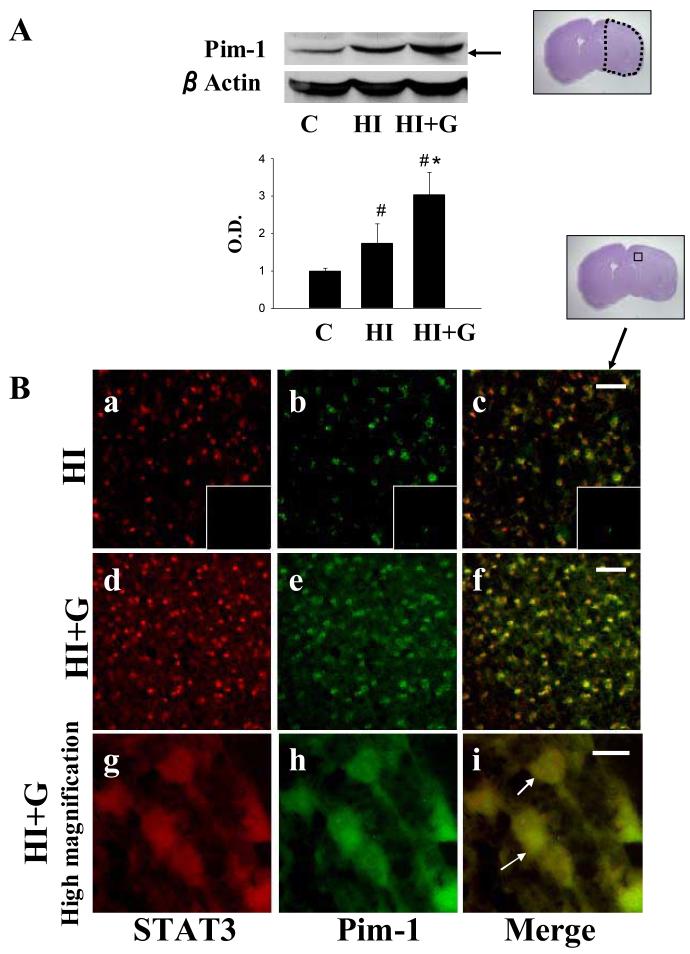
A. G-CSF treatment was associated with significantly increased expression of Pim-1 on Western blot analysis 24 hours after hypoxia-ischemia. values represent mean ± S.D. with 5 samples in C group and 8 samples in HI, HI+G group each, expressed as percent change over control group. On ANOVA, p< 0.05 for both # and * when compared to Group C and HI, respectively. O.D., optical density. The Nissl stained photomicrograph depicts the area of interest. B. Double immunofluorescence for STAT3 and Pim-1 demonstrated coexpression of these two proteins 24 hours after hypoxia-ischemia, with qualitative increased expression in group HI+G. Panels a-f, low magnification ×20, Scale bar 50μm. Panels g-i, high magnification ×100, Scale bar = 10μm.

References

    1. Abe-Dohmae S, Harada N, Yamada K, Tanaka R. Bcl-2 gene is highly expressed during neurogenesis in the central nervous system. Biochem Biophys Res Commun. 1993;191:915–21. - PubMed
    1. Akhtar RS, Ness JM, Roth KA. Bcl-2 family regulation of neuronal development and neurodegeneration. Biochim Biophys Acta. 2004;1644:189–203. - PubMed
    1. Bachmann M, Moroy T. The serine/threonine kinase Pim-1. Int J Biochem Cell Biol. 2005;37:726–730. - PubMed
    1. Calvert JW, Yin W, Patel M, Badr A, Mychaskiw G, Parent AD, Zhang JH. Hyperbaric oxygenation prevented brain injury induced by hypoxia-ischemia in neonatal rat model. Brain Res. 2002;951:1–8. - PubMed
    1. Chen Y, Ginis I, Hallenbeck JM. The protective effect of ceramide in immature rat brain hypoxia-ischemia involves up-regulation of bcl-2 and reduction of TUNEL-positive cells. J Cereb Blood Flow Metab. 2001;21:34–40. - PubMed

Publication types

MeSH terms

Substances