. 2007 Aug 22;4(15):727-34.
doi: 10.1098/rsif.2006.0204.

The impact of prophylaxis of healthcare workers on influenza pandemic burden

Affiliations

The impact of prophylaxis of healthcare workers on influenza pandemic burden

Michael Gardam et al. J R Soc Interface. .

Abstract

Several models have rationalized the use of antiviral drugs as an early control measure for delaying the progression and limiting the size of outbreaks during an influenza pandemic. However, the strategy for use of these drugs is still under debate. We evaluated the impact of prophylaxis of healthcare workers (HCWs) through a mathematical model that considers attack rates in a range of 25-35% in the general population and 25-50% among HCWs. Simulations and uncertainty analysis using the demographics of the province of Ontario, Canada show that increasing prophylaxis coverage of HCWs has little impact on reducing the reproduction number of disease transmission and may not prevent the occurrence of an outbreak if expected. However, it does enable a high level of treatment, which substantially reduces morbidity and mortality in the population as a whole. Therefore, prophylaxis of HCWs should be considered an important part of public health efforts for minimizing influenza pandemic burden and its socio-economic disruption.


Figures

Figure 1
Figure 1
A model diagram with treatment strategy.
Figure 2
Figure 2
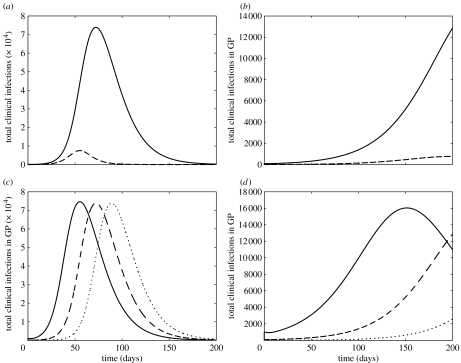
The time courses of the total clinical infections in the GP (solid curves) and HCWs (dashed curves) with 30 and 45% attack rates, respectively, are illustrated in the following: (a) without prophylaxis of HCWs and (b) with 100% prophylaxis coverage of HCWs and 30% reduction in susceptibility due to prophylaxis (αS=0.3). An initial number of I(0)=100 infectives in the GP was assumed in (a) and (b). The time courses of the total clinical infections in the GP with different initial values of infectives are illustrated in the following: (c) without prophylaxis and (d) with 100% prophylaxis coverage of HCWs. The initial values of infectives are as follows: dotted curves, I(0)=10; dashed curves, I(0)=100; solid curves, I(0)=1000.
Figure 3
Figure 3
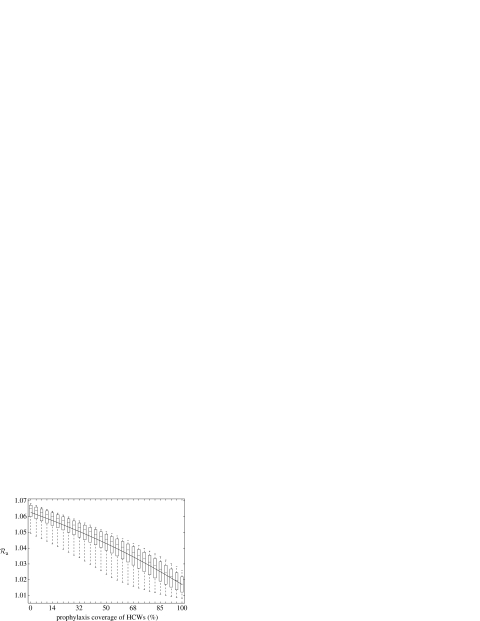
Sensitivity analysis: box plots for the variations of Ra as prophylaxis coverage increases, with a curve passing through the mean values. Using 25% clinical attack rate in the GP, samples of size n=1000 were generated by the LHS technique for the changes in susceptibility to the disease due to prophylaxis (αs : 25–35%) and a range of attack rate among HCWs (c2 : 25–40%).
Figure 4
Figure 4
Sensitivity analysis: box plots for the variations of (a) the total number of recovered clinical infections and (b) the total number of deaths, as prophylaxis coverage increases. Using 25% clinical attack rate in the GP, samples of size n=1000 were generated by the LHS technique for the changes in susceptibility to the disease due to prophylaxis (αS : 25–35%) and a range of attack rate among HCWs (c2 : 25–40%).

References

    1. Arino J, Brauer F, van den Driessche P, Watmough J, Wu J. Simple models for containment of a pandemic. J. R. Soc. Interface. 2006;3:453–457. doi: 10.1098/rsif.2006.0112. - DOI - PMC - PubMed
    1. Balicer R.D, Huerta M, Davidovitch N, Grotto I. Cost-benefit of stockpiling drugs for influenza pandemic. Emerg. Infect. Dis. 2005;11:1280–1282. - PMC - PubMed
    1. Bridges C.B, Kuehnert M.J, Hall C.B. Transmission of influenza: implications for control in health care settings. Clin. Infect. Dis. 2003;37:1094–1101. doi: 10.1086/378292. - DOI - PubMed
    1. Cinti S, Chenoweth C, Monto A.S. Preparing for pandemic influenza: should hospitals stockpile oseltamivir? Infect. Cont. Hosp. Epidemiol. 2005;26:852–854. doi: 10.1086/502507. - DOI - PubMed
    1. Cox N.J, Tamblyn S.E, Tam T. Influenza pandemic planning. Vaccine. 2003;21:1801–1803. doi: 10.1016/S0264-410X(03)00076-8. - DOI - PubMed

Publication types

Substances