


WNK4 regulates activity of the epithelial Na+ channel in vitro and in vivo
- PMID: 17360470
- PMCID: PMC1805455
- DOI: 10.1073/pnas.0611727104
WNK4 regulates activity of the epithelial Na+ channel in vitro and in vivo
Abstract
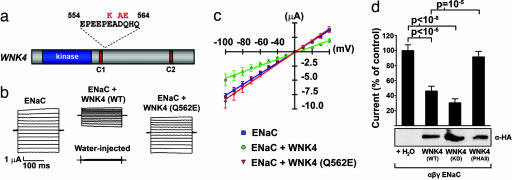
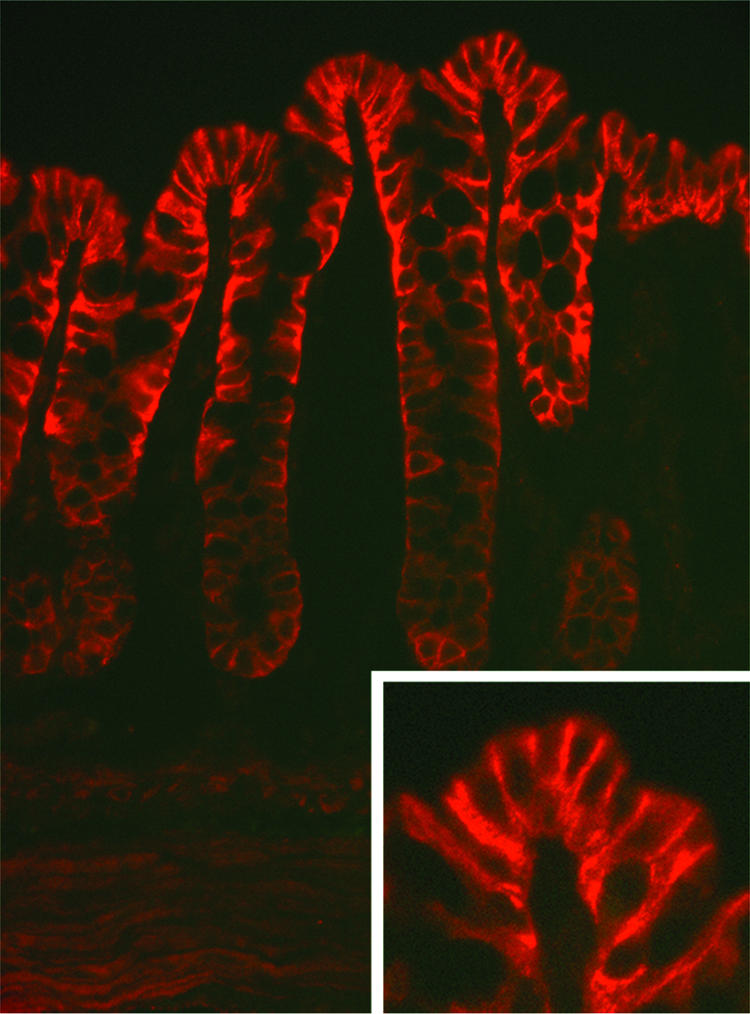
Homeostasis of intravascular volume, Na(+), Cl(-), and K(+) is interdependent and determined by the coordinated activities of structurally diverse mediators in the distal nephron and the distal colon. The behavior of these flux pathways is regulated by the renin-angiotensin-aldosterone system; however, the mechanisms that allow independent modulation of individual elements have been obscure. Previous work has shown that mutations in WNK4 cause pseudohypoaldosteronism type II (PHAII), a disease featuring hypertension with hyperkalemia, due to altered activity of specific Na-Cl cotransporters, K(+) channels, and paracellular Cl(-) flux mediators of the distal nephron. By coexpression studies in Xenopus oocytes, we now demonstrate that WNK4 also inhibits the epithelial Na(+) channel (ENaC), the major mediator of aldosterone-sensitive Na(+) (re)absorption, via a mechanism that is independent of WNK4's kinase activity. This inhibition requires intact C termini in ENaC beta- and gamma-subunits, which contain PY motifs used to target ENaC for clearance from the plasma membrane. Importantly, PHAII-causing mutations eliminate WNK4's inhibition of ENaC, thereby paralleling other effects of PHAII to increase sodium balance. The relevance of these findings in vivo was studied in mice harboring PHAII-mutant WNK4. The colonic epithelium of these mice demonstrates markedly increased amiloride-sensitive Na(+) flux compared with wild-type littermates. These studies identify ENaC as a previously unrecognized downstream target of WNK4 and demonstrate a functional role for WNK4 in the regulation of colonic Na(+) absorption. These findings support a key role for WNK4 in coordinating the activities of diverse flux pathways to achieve integrated fluid and electrolyte homeostasis.
Conflict of interest statement
The authors declare no conflict of interest.
Figures


References
-
- Schultheis PJ, Clarke LL, Meneton P, Miller ML, Soleimani M, Gawenis LR, Riddle TM, Duffy JJ, Doetschman T, Wang T, et al. Nat Genet. 1998;19:282–285. - PubMed
-
- Kunzelmann K, Mall M. Physiol Rev. 2002;82:245–289. - PubMed
-
- Lifton RP, Gharavi AG, Geller DS. Cell. 2001;104:545–556. - PubMed
-
- Pearce D. Trends Endocrinol Metab. 2001;12:341–347. - PubMed
-
- Kamynina E, Debonneville C, Bens M, Vandewalle A, Staub O. FASEB J. 2001;15:204–214. - PubMed
Publication types
MeSH terms
Substances
LinkOut - more resources
Full Text Sources
Other Literature Sources
Medical
Molecular Biology Databases
