. 2007 Mar 13;104(11):4700-5.
doi: 10.1073/pnas.0607524104. Epub 2007 Mar 6.

TORC1 is a calcium- and cAMP-sensitive coincidence detector involved in hippocampal long-term synaptic plasticity

Affiliations

TORC1 is a calcium- and cAMP-sensitive coincidence detector involved in hippocampal long-term synaptic plasticity

Krisztián A Kovács et al. Proc Natl Acad Sci U S A. .

Abstract

A key feature of memory processes is to link different input signals by association and to preserve this coupling at the level of synaptic connections. Late-phase long-term potentiation (L-LTP), a form of synaptic plasticity thought to encode long-term memory, requires gene transcription and protein synthesis. In this study, we report that a recently cloned coactivator of cAMP-response element-binding protein (CREB), called transducer of regulated CREB activity 1 (TORC1), contributes to this process by sensing the coincidence of calcium and cAMP signals in neurons and by converting it into a transcriptional response that leads to the synthesis of factors required for enhanced synaptic transmission. We provide evidence that TORC1 is involved in L-LTP maintenance at the Schaffer collateral-CA1 synapses in the hippocampus.


Conflict of interest statement

The authors declare no conflict of interest.

Figures
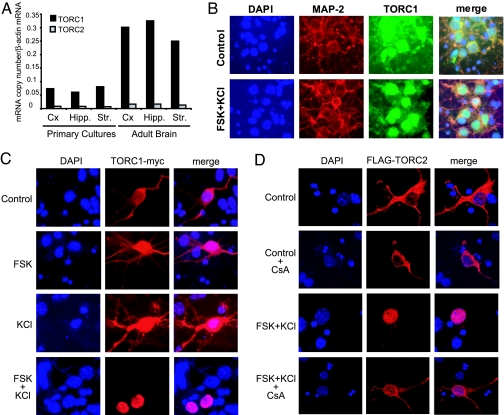
Fig. 1.
Fig. 1.
TORC1 and TORC2 are expressed in adult mouse brain and translocate to the nucleus of cultured neurons upon activation of calcium and cAMP pathways. (A) TORC1 and TORC2 mRNA levels in mouse neuronal cultures and adult brain as measured by real-time RT-PCR. Cx, cortex; Hipp., hippocampus; Str., striatum. (B) Nuclear translocation of endogenous TORCs in mouse cortical neurons exposed to FSK and KCl (preincubation with LMB). Microtubule-associated protein 2 (MAP-2) and DAPI stain neuronal processes and nuclei, respectively, are shown. (C) Immunofluorescence of neurons transfected with mouse TORC1-myc showing its nuclear translocation only in the presence of FSK and KCl (preincubation with LMB). (D) Immunofluorescence of neurons transfected with mouse Flag-TORC2 showing its nuclear translocation in the presence of FSK and KCl (no preincubation with LMB). Inhibition of calcineurin by CsA blocks the nuclear accumulation of TORC2 triggered by FSK and KCl. DAPI staining is shown to localize nuclei.
Fig. 2.
Fig. 2.
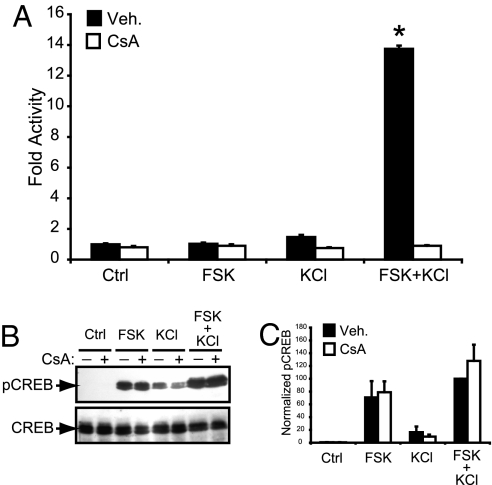
Calcium and cAMP pathways activate CREB synergistically in a calcineurin-dependent manner. (A) Effect of FSK and KCl on mouse cortical neurons transfected with a CRE-luciferase reporter in the absence (Veh.) or in the presence of CsA. Results are displayed as the mean (±SEM) of fold luciferase activity (n = 3) relative to control. ∗, Significantly different from all of the other conditions (two-way ANOVA followed by Bonferroni's post hoc test; P < 0.05). (B) Western blot of phospho-(Ser-133) CREB (pCREB) and total CREB levels in cortical neurons exposed for 30 min to FSK and/or KCl. (C) Mean densitometric band analysis of the Western blots shown in B. Data are representative of triplicate determinations. Intensity values were normalized to the FSK plus KCl condition, which was set equal to 100%.
Fig. 3.
Fig. 3.
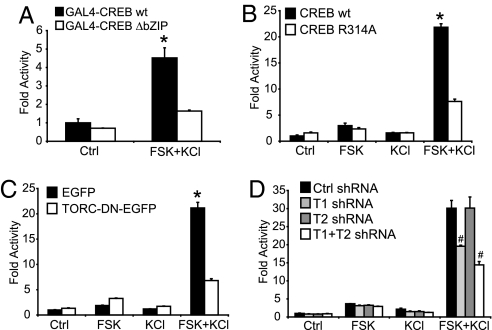
TORC1 mediates the synergistic activation of CREB-mediated transcription by calcium and cAMP in neurons. (A) Stimulation of CREB activity by calcium and cAMP requires its bZIP domain. Cortical neurons were transfected with a GAL4-luciferase reporter, and either full-length GAL4-CREB [wild-type (wt)] or truncated GAL4-CREB ΔbZIP (amino acids 4–283). (B) A CREB mutant defective in TORC binding is not activated synergistically by calcium and cAMP. Cortical neurons were transfected with a CRE-luciferase reporter in combination with either wild-type CREB or a CREB mutant with an arginine-to-alanine substitution at position 314 within the bZIP domain (R314A). (C) Effect of a TORC dominant-negative (TORC-DN-EGFP) on the synergistic activation of CREB-mediated transcription by FSK and KCl. Expression of EGFP was used as a control. (D) Silencing of TORC1 inhibits the synergistic effects of calcium and cAMP signals on CREB activation. Cortical neurons were transfected with a CRE-luciferase reporter gene and shRNA producing plasmids against TORC1 (T1) and TORC2 (T2) or a nonsilencing negative control (Ctrl). Results are displayed as the mean (±SEM) of fold luciferase activity (n = 3) relative to control. ∗, Significantly different from all of the other conditions (two-way ANOVA followed by Bonferroni's post hoc test; P < 0.05). #, Significantly different from the Ctrl shRNA FSK plus KCl condition (four-way ANOVA followed by Bonferroni's post hoc test; P < 0.05).
Fig. 4.
Fig. 4.
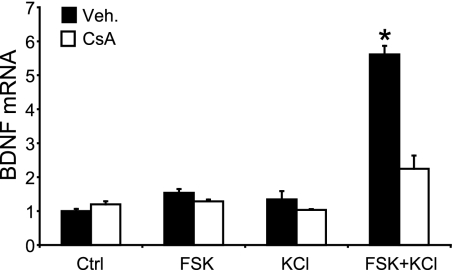
The CREB target gene bdnf is synergistically activated by calcium and cAMP in a calcineurin-dependent manner. BDNF mRNA levels in mouse cortical neurons exposed to FSK and/or KCl for 90 min, in the absence (Veh.) or presence of CsA (measured by real-time RT-PCR). Levels of BDNF mRNA are normalized to β-actin and represented in fold increase relative to control. Results are displayed as the mean ± SEM (n = 3). ∗, Significantly different from all of the other conditions (two-way ANOVA followed by Bonferroni's post hoc test; P < 0.05).
Fig. 5.
Fig. 5.
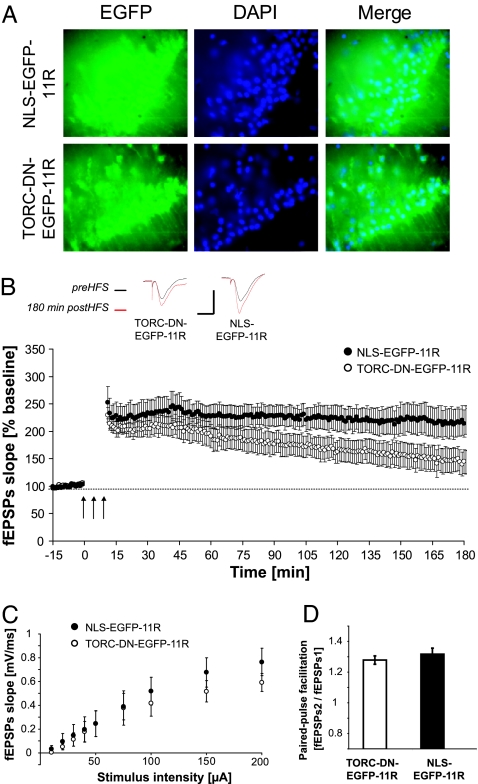
TORC1 is involved in L-LTP maintenance in the Schaffer collateral–CA1 pathway. (A) Transduction of the recombinant TORC dominant-negative protein (TORC-DN-EGFP-11R) or the control recombinant protein (NLS-EGFP-11R) in hippocampal slices. Many cells contain recombinant protein in the nucleus, as evidenced by the colocalization of EGFP and DAPI staining. (B) Effect of TORC-DN-EGFP-11R on L-LTP induced by three trains of 100-Hz pulses (1-s duration) separated by 5-min intervals (HFS). Seventy-five minutes after the tetanic stimulation, LTP became significantly smaller in slices treated with TORC- DN-EGFP-11R (n = 7, 7 rats) than in control slices (n = 9, 9 rats) treated with NLS-EGFP-11R (t test; P < 0.05). An arrow indicates a stimulation of a 1-s train at 100 Hz. Traces show examples of postsynaptic responses before (preHFS; black) and 180 min after (180 min postHFS; red) the tetanic stimulation. [Scales for these traces: 1 mV (vertical), 10 ms (horizontal).] HFS was applied ≈1.5 h after the end of the incubation with the recombinant proteins. (C) Transduction of TORC-DN-EGFP-11R did not have any significant effect on the input/output curve. There was no significant effect of treatment after a two-way ANOVA on postsynaptic responses with treatment as an independent variable and concentration as a repeated measure (P > 0.05). N as in B. (D) Transduction of TORC-DN-EGFP-11R did not interfere with the presynaptic function as evidenced by unchanged paired-pulse facilitation (t test; P > 0.05). N as in B.

References

    1. Conkright MD, Canettieri G, Screaton R, Guzman E, Miraglia L, Hogenesch JB, Montminy M. Mol Cell. 2003;12:413–423. - PubMed
    1. Iourgenko V, Zhang W, Mickanin C, Daly I, Jiang C, Hexham JM, Orth AP, Miraglia L, Meltzer J, Garza D, et al. Proc Natl Acad Sci USA. 2003;100:12147–12152. - PMC - PubMed
    1. Screaton RA, Conkright MD, Katoh Y, Best JL, Canettieri G, Jeffries S, Guzman E, Niessen S, Yates JR, III, Takemori H, et al. Cell. 2004;119:61–74. - PubMed
    1. Kandel ER. Science. 2001;294:1030–1038. - PubMed
    1. Lonze BE, Ginty DD. Neuron. 2002;35:605–623. - PubMed

Publication types