


Comparative Study
doi: 10.1073/pnas.0611377104.
Epub 2007 Feb 21.
Genetic evidence for a second domestication of barley (Hordeum vulgare) east of the Fertile Crescent
Affiliations
- PMID: 17360640
- PMCID: PMC1805597
- DOI: 10.1073/pnas.0611377104
Item in Clipboard
Comparative Study
Genetic evidence for a second domestication of barley (Hordeum vulgare) east of the Fertile Crescent
Proc Natl Acad Sci U S A.
.
Abstract
Cereal agriculture originated with the domestication of barley and early forms of wheat in the Fertile Crescent. There has long been speculation that barley was domesticated more than once. We use differences in haplotype frequency among geographic regions at multiple loci to infer at least two domestications of barley; one within the Fertile Crescent and a second 1,500-3,000 km farther east. The Fertile Crescent domestication contributed the majority of diversity in European and American cultivars, whereas the second domestication contributed most of the diversity in barley from Central Asia to the Far East.
Conflict of interest statement
The authors declare no conflict of interest.
Figures
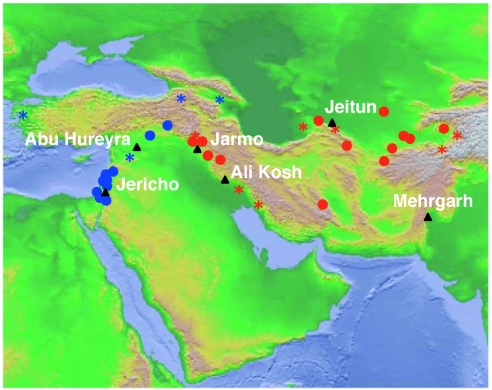
The geographic distribution of sampled wild barley accessions and the locations of the human Neolithic sites mentioned in the text that contain early evidence of domesticated barley. The 25 wild barley accessions where all 18 loci were sequenced are indicated by filled circles. An additional 20 accessions (see Materials and Methods) were sequenced at four loci and are indicated by asterisks. Samples with majority assignment to the eastern cluster are shown in red, and samples with majority assignment to western cluster are shown in blue. The Neolithic sites indicated include Jericho (Palestine), Abu Hureyra (Syria), Jarmo (Iraq), Ali Kosh (Iran), Jeitun (Turkmenistan), and Mehrgarh (Pakistan).
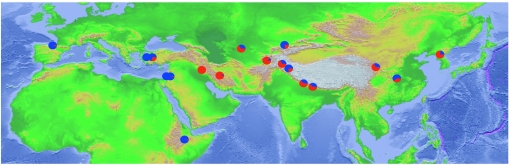
The geographic distribution of sampled barley landraces. The estimated probabilities of eastern and western wild barley origin for each sample are shown in red and blue, respectively. A landrace sample from Peru is not depicted.
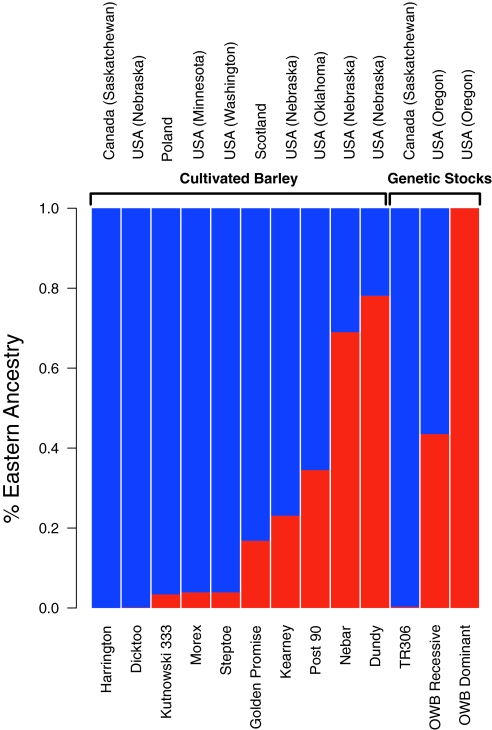
Assignment of cultivated barley samples and barley genetic stocks relative to the eastern and western wild barley clusters. Each column represents a single individual, with the probability of assignment to eastern wild barley shown in red and the probability of assignment to western wild barley shown in blue. Samples are sorted based on decreasing probability of assignment to eastern wild barley.
References
-
- Harlan JR, Zohary D. Science. 1966;153:1074–1079. - PubMed
-
- Diamond J. Nature. 2002;418:700–707. - PubMed
-
- Willcox G. Vegetat Hist Archaeobot. 2005;14:534–541.
-
- Zohary D, Hopf M. Domestication of Plants in the Old World: The Origin and Spread of Cultivated Plants in West Asia, Europe, and the Nile Valley. Oxford: Oxford Univ Press; 2000.
-
- Harris DR, Gosden C. In: The Beginnings of Agriculture in Central Asia. Harris DR, editor. Washington, DC: Smithsonian Inst Press; 1996. pp. 370–389.
Publication types
MeSH terms
Associated data
- Actions
- Actions
- Actions
- Actions
- Actions
- Actions
- Actions
- Actions
- Actions
- Actions
- Actions
- Actions
- Actions
- Actions
- Actions
- Actions
- Actions
- Actions
- Actions
- Actions
- Actions
- Actions
- Actions
- Actions
- Actions
- Actions
- Actions
- Actions
- Actions
- Actions
- Actions
- Actions
- Actions
- Actions
- Actions
- Actions
- Actions
- Actions
- Actions
- Actions
- Actions
- Actions
- Actions
- Actions
- Actions
- Actions
- Actions
- Actions
- Actions
- Actions
- Actions
- Actions
- Actions
- Actions
- Actions
- Actions
- Actions
- Actions
- Actions
- Actions
- Actions
- Actions
- Actions
- Actions
- Actions
- Actions
- Actions
- Actions
- Actions
- Actions
- Actions
- Actions
- Actions
- Actions
- Actions
- Actions
- Actions
- Actions
- Actions
- Actions
- Actions
- Actions
- Actions
- Actions
- Actions
- Actions
- Actions
- Actions
- Actions
- Actions
- Actions
- Actions
- Actions
- Actions
- Actions
- Actions
- Actions
- Actions
- Actions
- Actions
- Actions
- Actions
- Actions
- Actions
- Actions
- Actions
- Actions
- Actions
- Actions
- Actions
- Actions
- Actions
- Actions
- Actions
- Actions
- Actions
- Actions
- Actions
- Actions
- Actions
- Actions
- Actions
- Actions
- Actions
- Actions
- Actions
- Actions
- Actions
- Actions
- Actions
- Actions
- Actions
- Actions
- Actions
- Actions
- Actions
- Actions
- Actions
- Actions
- Actions
- Actions
- Actions
- Actions
- Actions
- Actions
- Actions
- Actions
- Actions
- Actions
- Actions
- Actions
- Actions
- Actions
- Actions
- Actions
- Actions
- Actions
- Actions
- Actions
- Actions
- Actions
- Actions
- Actions
- Actions
- Actions
- Actions
- Actions
- Actions
- Actions
- Actions
- Actions
- Actions
- Actions
- Actions
- Actions
- Actions
- Actions
- Actions
- Actions
- Actions
- Actions
- Actions
- Actions
- Actions
- Actions
- Actions
- Actions
- Actions
- Actions
- Actions
- Actions
- Actions
- Actions
- Actions
- Actions
- Actions
- Actions
- Actions
- Actions
- Actions
- Actions
- Actions
- Actions
- Actions
- Actions
- Actions
- Actions
- Actions
- Actions
- Actions
- Actions
- Actions
- Actions
- Actions
- Actions
- Actions
- Actions
- Actions
- Actions
- Actions
- Actions
- Actions
- Actions
- Actions
- Actions
- Actions
- Actions
- Actions
- Actions
- Actions
- Actions
- Actions
- Actions
- Actions
- Actions
- Actions
- Actions
- Actions
- Actions
- Actions
- Actions
- Actions
- Actions
- Actions
- Actions
- Actions
- Actions
- Actions
- Actions
- Actions
- Actions
- Actions
- Actions
- Actions
- Actions
- Actions
- Actions
- Actions
- Actions
- Actions
- Actions
- Actions
- Actions
- Actions
- Actions
- Actions
- Actions
- Actions
- Actions
- Actions
- Actions
- Actions
- Actions
- Actions
- Actions
- Actions
- Actions
- Actions
- Actions
- Actions
- Actions
- Actions
- Actions
- Actions
- Actions
- Actions
- Actions
- Actions
LinkOut - more resources
Full Text Sources
Other Literature Sources
