


Multigene phylogeny reveals eusociality evolved twice in vespid wasps
- PMID: 17360641
- PMCID: PMC1805554
- DOI: 10.1073/pnas.0610140104
Multigene phylogeny reveals eusociality evolved twice in vespid wasps
Abstract
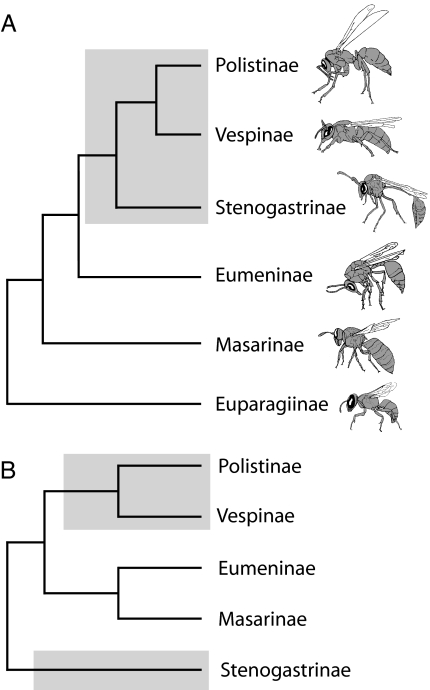
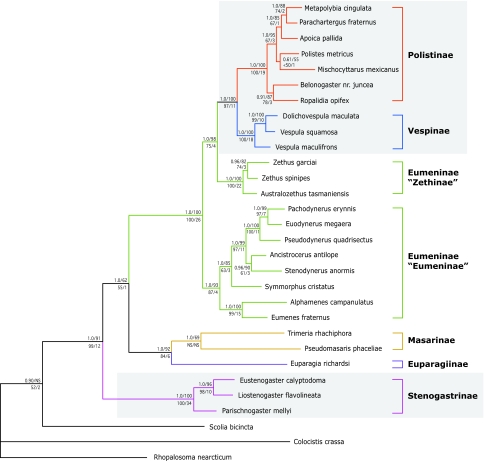
Eusocial wasps of the family Vespidae are thought to have derived their social behavior from a common ancestor that had a rudimentary caste-containing social system. In support of this behavioral scenario, the leading phylogenetic hypothesis of Vespidae places the eusocial wasps (subfamilies Stenogastrinae, Polistinae, and Vespinae) as a derived monophyletic clade, thus implying a single origin of eusocial behavior. This perspective has shaped the investigation and interpretation of vespid social evolution for more than two decades. Here we report a phylogeny of Vespidae based on data from four nuclear gene fragments (18S and 28S ribosomal DNA, abdominal-A and RNA polymerase II) and representatives from all six extant subfamilies. In contrast to the current phylogenetic perspective, our results indicate two independent origins of vespid eusociality, once in the clade Polistinae+Vespinae and once in the Stenogastrinae. The stenogastrines appear as an early diverging clade distantly related to the vespines and polistines and thus evolved their distinctive form of social behavior from a different ancestor than that of Polistinae+Vespinae. These results support earlier views based on life history and behavior and have important implications for interpreting transitional stages in vespid social evolution.
Conflict of interest statement
The authors declare no conflict of interest.
Figures
References
-
- Michener CD. Annu Rev Entomol. 1969;14:299–342.
-
- Moreau CS, Bell CD, Vila R, Archibald SB, Pierce NE. Science. 2006;321:101–104. - PubMed
-
- Matthews RW. In: The Social Biology of Wasps. Ross KG, Matthews RW, editors. Ithaca, NY: Comstock, Cornell Univ Press; 1991. pp. 570–602.
-
- Carpenter JM. Syst Entomol. 1982;7:11–38.
-
- Carpenter JM. In: The Social Biology of Wasps. Ross KG, Matthews RW, editors. Ithaca, NY: Comstock, Cornell Univ Press; 1991. pp. 7–32.
Publication types
MeSH terms
Substances
Associated data
- Actions
- Actions
- Actions
- Actions
- Actions
- Actions
- Actions
- Actions
- Actions
- Actions
- Actions
- Actions
- Actions
- Actions
- Actions
- Actions
- Actions
- Actions
- Actions
- Actions
- Actions
- Actions
- Actions
- Actions
- Actions
- Actions
- Actions
- Actions
- Actions
- Actions
- Actions
- Actions
- Actions
- Actions
- Actions
- Actions
- Actions
- Actions
- Actions
- Actions
- Actions
- Actions
- Actions
- Actions
- Actions
- Actions
- Actions
- Actions
- Actions
- Actions
- Actions
- Actions
- Actions
- Actions
- Actions
- Actions
- Actions
- Actions
- Actions
- Actions
- Actions
- Actions
- Actions
- Actions
- Actions
- Actions
- Actions
- Actions
- Actions
- Actions
- Actions
- Actions
- Actions
- Actions
- Actions
- Actions
- Actions
- Actions
- Actions
- Actions
- Actions
- Actions
- Actions
- Actions
- Actions
- Actions
- Actions
- Actions
- Actions
- Actions
- Actions
- Actions
- Actions
- Actions
- Actions
- Actions
- Actions
- Actions
- Actions
- Actions
- Actions
- Actions
- Actions
- Actions
- Actions
- Actions
- Actions
- Actions
- Actions
- Actions
- Actions
- Actions
- Actions
- Actions
- Actions
- Actions
Grants and funding
LinkOut - more resources
Full Text Sources
Molecular Biology Databases
