


Cellular scaling rules for primate brains
- PMID: 17360682
- PMCID: PMC1805542
- DOI: 10.1073/pnas.0611396104
Cellular scaling rules for primate brains
Abstract
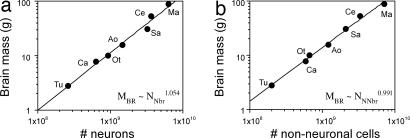
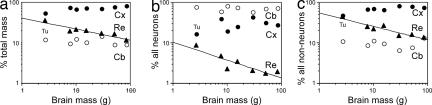
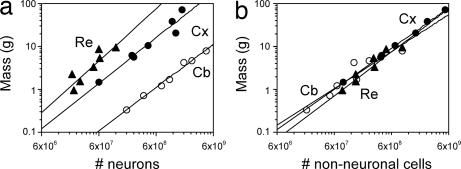
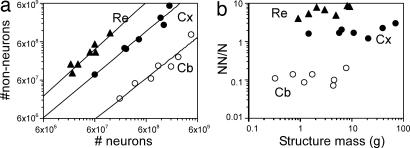
Primates are usually found to have richer behavioral repertoires and better cognitive abilities than rodents of similar brain size. This finding raises the possibility that primate brains differ from rodent brains in their cellular composition. Here we examine the cellular scaling rules for primate brains and show that brain size increases approximately isometrically as a function of cell numbers, such that an 11x larger brain is built with 10x more neurons and approximately 12x more nonneuronal cells of relatively constant average size. This isometric function is in contrast to rodent brains, which increase faster in size than in numbers of neurons. As a consequence of the linear cellular scaling rules, primate brains have a larger number of neurons than rodent brains of similar size, presumably endowing them with greater computational power and cognitive abilities.
Conflict of interest statement
The authors declare no conflict of interest.
Figures
References
-
- Stolzenburg JU, Reichenbach A, Neumann M. Glia. 1989;2:78–84. - PubMed
-
- Tower DB. J Comp Neurol. 1954;101:19–51. - PubMed
-
- Haug H. Am J Anat. 1987;180:126–142. - PubMed
-
- Frahm HD, Stephan H, Stephan M. J Hirnforsch. 1982;23:375–389. - PubMed
-
- Williams RW, Herrup K. Annu Rev Neurosci. 1988;11:423–453. - PubMed
Publication types
MeSH terms
Substances
Grants and funding
LinkOut - more resources
Full Text Sources
