


Interaction between transcellular and paracellular water transport pathways through Aquaporin 5 and the tight junction complex
- PMID: 17360692
- PMCID: PMC1802728
- DOI: 10.1073/pnas.0608384104
Interaction between transcellular and paracellular water transport pathways through Aquaporin 5 and the tight junction complex
Abstract
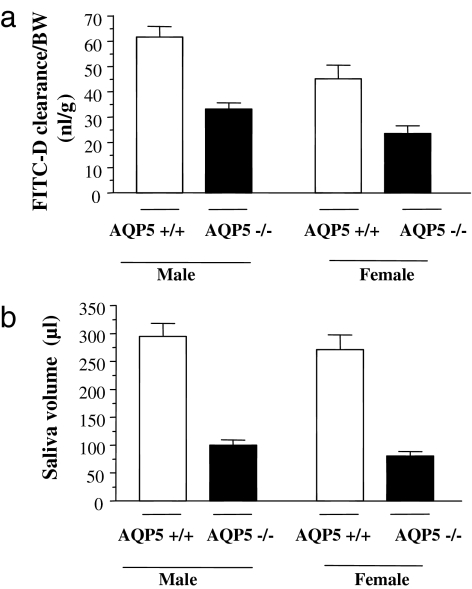
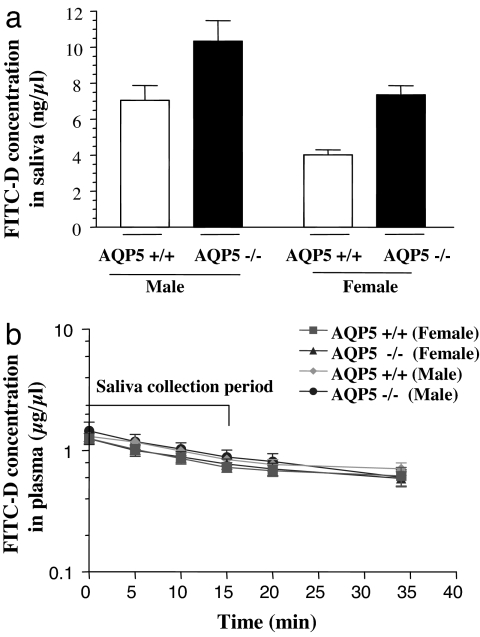
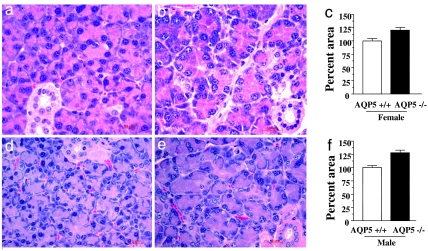
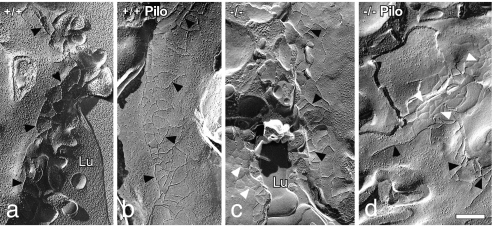
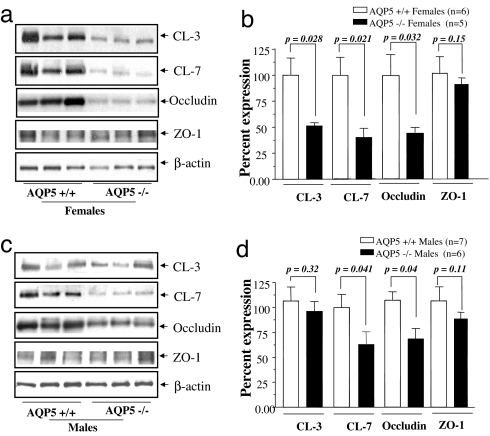
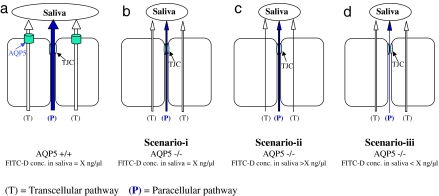
To investigate potential physiological interactions between the transcellular and paracellular pathways of water transport, we asked whether targeted deletion of Aquaporin 5 (AQP5), the major transcellular water transporter in salivary acinar cells, affected paracellular transport of 4-kDa FITC-labeled dextran (FITC-D), which is transported through the paracellular but not the transcellular route. After i.v. injection of FITC-D into either AQP5 wild-type or AQP5-/- mice and saliva collection for fixed time intervals, we show that the relative amount of FITC-D transported in the saliva of AQP5-/- mice is half that in matched AQP5+/+ mice, indicating a 2-fold decrease in permeability of the paracellular barrier in mice lacking AQP5. We also found a significant difference in the proportion of transcellular vs. paracellular transport between male and female mice. Freeze-fracture electron microscopy revealed an increase in the number of tight junction strands of both AQP5+/+ and AQP5-/- male mice after pilocarpine stimulation but no change in strand number in female mice. Average acinar cell volume was increased by approximately 1.4-fold in glands from AQP5-/- mice, suggesting an alteration in the volume-sensing machinery of the cell. Western blots revealed that expression of Claudin-7, Claudin-3, and Occludin, critical proteins that regulate the permeability of the tight junction barrier, were significantly decreased in AQP5-/- compared with AQP5+/+ salivary glands. These findings reveal the existence of a gender-influenced molecular mechanism involving AQP5 that allows transcellular and paracellular routes of water transport to act in conjunction.
Conflict of interest statement
The authors declare no conflict of interest.
Figures
References
-
- Zeuthen T. Int Rev Cytol. 2002;215:285–317. - PubMed
-
- Tripathi S, Boulpaep EL. Q J Exp Physiol. 1989;74:385–417. - PubMed
-
- Guyton AC, Hall JE. In: Textbook of Medical Physiology. Hall JE, editor. Philadelphia: Saunders; 2000. pp. 295–312.
-
- Robben JH, Knoers NV, Deen PM. Am J Physiol. 2006;291:F257–F270. - PubMed
Publication types
MeSH terms
Substances
Grants and funding
LinkOut - more resources
Full Text Sources
Other Literature Sources
Molecular Biology Databases
