


Reduced penetrance alleles for Huntington's disease: a multi-centre direct observational study
- PMID: 17361007
- PMCID: PMC2598018
- DOI: 10.1136/jmg.2006.045120
Reduced penetrance alleles for Huntington's disease: a multi-centre direct observational study
Abstract
Objective: To obtain penetrance data for Huntington's disease when DNA results are in the range of 36-39 CAG repeats and assess the consistency of reporting the upper allele from two reference centres.
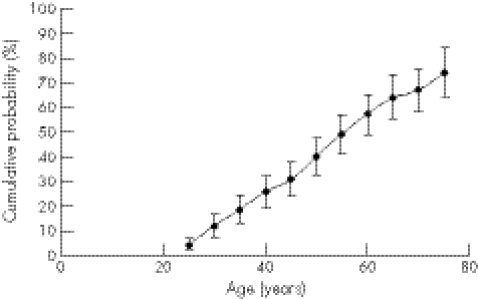
Method: Data were collected anonymously on age of onset or age last known to be unaffected from a cohort of individuals with results in this range. DNA samples were re-analysed in two reference centres. Kaplan-Meier analysis was used to construct an age of onset curve and penetrance figures.
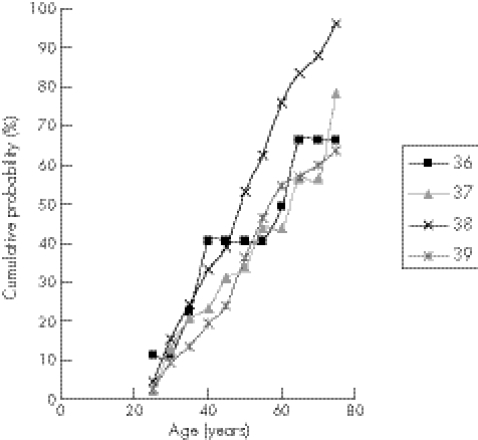
Results: Clinical data and concordant DNA results from both reference centres were available for 176 samples; penetrance figures (and 95% confidence intervals) for this cohort, at age 65 and 75 years, were 63.9% (55.5% to 73.2%) and 74.2% (64.2% to 84.2%), respectively. Inclusion of 28 additional subjects for whom repeat DNA results were unavailable, obtained from only one reference centre, or discrepant by one repeat within this range, gave penetrance data (including 95% confidence intervals) at ages 65 and 75 years of 62.4% (54.4% to 70.4%) and 72.7.% (63.3% to 82.1%), respectively. 238 duplicate results were available from the reference centres; 10 (4.2%) differed by one CAG repeat in the reporting of the upper allele and in two (0.84%) of these cases the discrepancy was between 39 and 40 repeats.
Conclusion: When DNA results are in this range, a conservative approach is to say that there is at least a 40% chance the person will be asymptomatic at age 65 years and at least a 30% chance the person will be asymptomatic at age 75 years.
Conflict of interest statement
Competing interests: None declared.
References
-
- Huntington's Disease Collaborative Research Group A novel gene containing a trinucleotide repeat that is expanded and unstable on Huntington's disease chromosomes. Cell 199372971–983. - PubMed
-
- Harper P S, Jones L. Huntington's disease: genetic and molecular studies. In: Bates G, Harper P, Jones L, eds. Huntingtons disease, 3rd edn. Oxford: Oxford University Press, 2002123–124.
-
- Gusella J F, MacDonald M E. Molecular genetics: unmasking polyglutamine triggers in neurodegenerative disease. Nat Rev Neurosci 20001109–115. - PubMed
-
- Legius E, Cuppens H, Dierick H, Van Zandt K, Dom R, Fryns J ‐ P, Evers‐Kiebooms G, Decruyenaere M, Demyttenaere K, Marynen P, Cassiman J J. Limited expansion of the (CAG)n repeat of the Huntington gene: a premutation (?). Eur J Hum Genet 1994244–50. - PubMed
-
- Rubinsztein D C, Leggo J, Coles R, Almqvist E, Biancalana V, Cassiman J ‐ J, Chotai K, Connarty M, Craufurd D, Curtis A, Curtis D, Davidson M J, Differ A ‐ M, Dode C, Dodge A, Frontali M, Ranen N G, Stine O C, Sherr M, Abbott M H, Franz M L, Graham C A, Harper P S, Hedreen J C, Jackson A, Kaplan J ‐ C, Losekoot M, MacMillan J C, Morrison P, Trottier Y, Novelletto A, Simpson S A, Thielmann J, Whittaker J L, Folstein S E, Ross C A, Hayden M R. Phenotypic characterization of individuals with 30–40 CAG repeats in the Huntington disease (HD) gene reveals HD cases with 36 repeats and apparently normal elderly individuals with 36–39 repeats. Am J Hum Genet 19965916–22. - PMC - PubMed
Publication types
MeSH terms
LinkOut - more resources
Full Text Sources
Other Literature Sources
Medical
