


A cytochrome C oxidase model catalyzes oxygen to water reduction under rate-limiting electron flux
- PMID: 17363671
- PMCID: PMC3064436
- DOI: 10.1126/science.1135844
A cytochrome C oxidase model catalyzes oxygen to water reduction under rate-limiting electron flux
Abstract
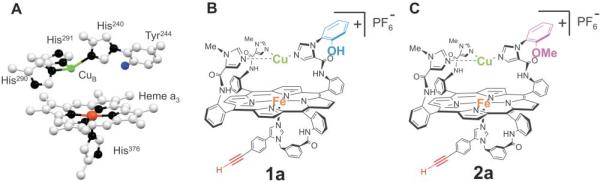
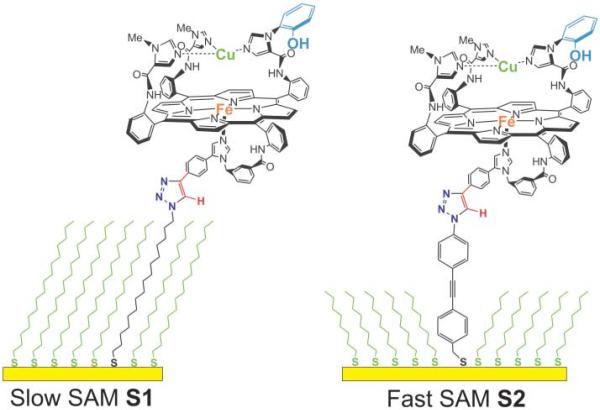
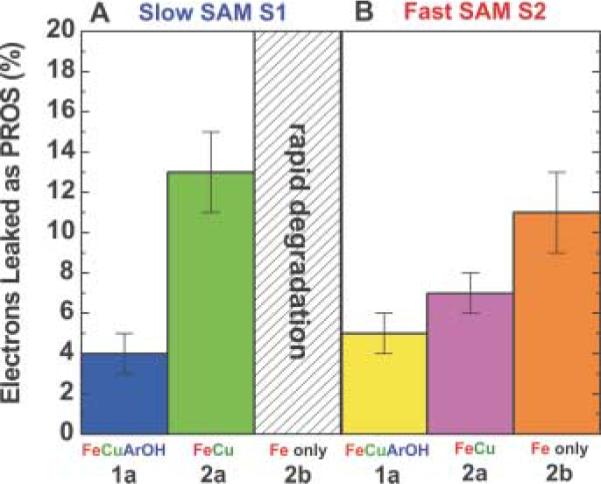
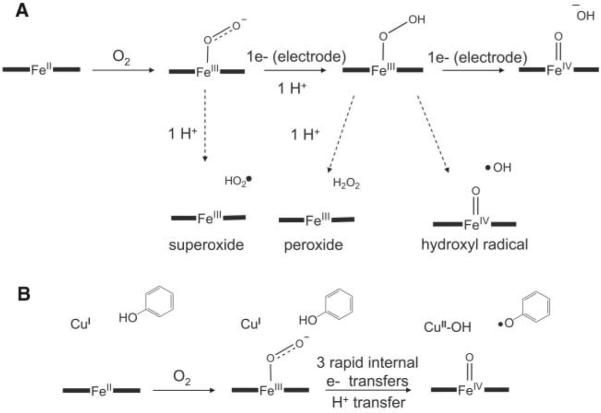
We studied the selectivity of a functional model of cytochrome c oxidase's active site that mimics the coordination environment and relative locations of Fe(a3), Cu(B), and Tyr(244). To control electron flux, we covalently attached this model and analogs lacking copper and phenol onto self-assembled monolayer-coated gold electrodes. When the electron transfer rate was made rate limiting, both copper and phenol were required to enhance selective reduction of oxygen to water. This finding supports the hypothesis that, during steady-state turnover, the primary role of these redox centers is to rapidly provide all the electrons needed to reduce oxygen by four electrons, thus preventing the release of toxic partially reduced oxygen species.
Figures

References
-
- Brunori M, Giuffre A, Sarti P. J. Inorg. Biochem. 2005;99:324. - PubMed
-
- Morgan JE, Verkhovsky MI, Palmer G, Wikstrom M. Biochemistry. 2001;40:6882. - PubMed
-
- Proshlyakov DA, et al. Science. 2000;290:1588. - PubMed
-
- Chazotte B, Hackenbrock CR. J. Biol. Chem. 1989;264:4978. - PubMed
-
- Gupte SS, Hackenbrock CR. J. Biol. Chem. 1988;263:5248. - PubMed
Publication types
MeSH terms
Substances
Grants and funding
LinkOut - more resources
Full Text Sources
Other Literature Sources
