Measures of clade confidence do not correlate with accuracy of phylogenetic trees
- PMID: 17367204
- PMCID: PMC1828704
- DOI: 10.1371/journal.pcbi.0030051
Measures of clade confidence do not correlate with accuracy of phylogenetic trees
Retraction in
-
Retraction: Measures of clade confidence do not correlate with accuracy of phylogenetic trees.PLoS Comput Biol. 2007 Jul;3(7):e158. doi: 10.1371/journal.pcbi.0030158. PLoS Comput Biol. 2007. PMID: 17658946 Free PMC article. No abstract available.
Abstract
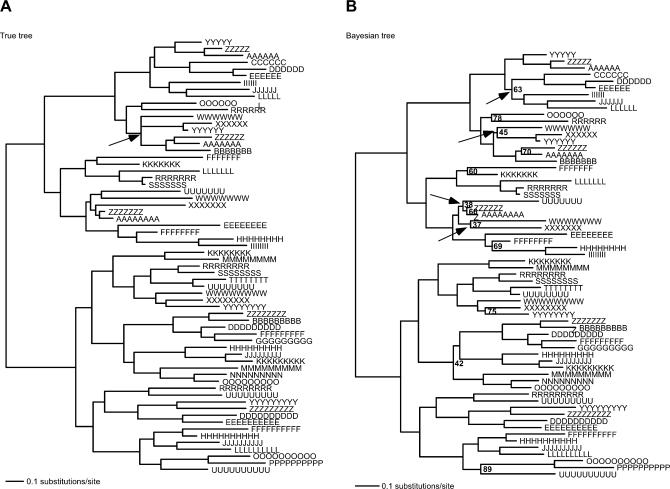
Metrics of phylogenetic tree reliability, such as parametric bootstrap percentages or Bayesian posterior probabilities, represent internal measures of the topological reproducibility of a phylogenetic tree, while the recently introduced aLRT (approximate likelihood ratio test) assesses the likelihood that a branch exists on a maximum-likelihood tree. Although those values are often equated with phylogenetic tree accuracy, they do not necessarily estimate how well a reconstructed phylogeny represents cladistic relationships that actually exist in nature. The authors have therefore attempted to quantify how well bootstrap percentages, posterior probabilities, and aLRT measures reflect the probability that a deduced phylogenetic clade is present in a known phylogeny. The authors simulated the evolution of bacterial genes of varying lengths under biologically realistic conditions, and reconstructed those known phylogenies using both maximum likelihood and Bayesian methods. Then, they measured how frequently clades in the reconstructed trees exhibiting particular bootstrap percentages, aLRT values, or posterior probabilities were found in the true trees. The authors have observed that none of these values correlate with the probability that a given clade is present in the known phylogeny. The major conclusion is that none of the measures provide any information about the likelihood that an individual clade actually exists. It is also found that the mean of all clade support values on a tree closely reflects the average proportion of all clades that have been assigned correctly, and is thus a good representation of the overall accuracy of a phylogenetic tree.
Conflict of interest statement
Figures

References
-
- Felsenstein J. Confidence limits on phylogenies: An approach using the bootstrap. Evolution. 1985;39:783–791. - PubMed
-
- Anisimova M, Gascuel O. Approximate likelihood-ratio test for branches: A fast, accurate, and powerful alternative. Syst Biol. 2006;55:539–552. - PubMed
-
- Guindon S, Gascuel O. A simple, fast, and accurate algorithm to estimate large phylogenies by maximum likelihood. Syst Biol. 2003;52:696–704. - PubMed
-
- Hall BG. Phylogenetic trees made easy: A how-to manual. Sunderland (Massachusetts): Sinauer Associates; 2004. 221
-
- Huelsenbeck JP, Larget B, Miller RE, Ronquist F. Potential applications and pitfalls of Bayesian inference of phylogeny. Syst Biol. 2002;51:673–688. - PubMed
Publication types
MeSH terms
LinkOut - more resources
Full Text Sources