


The evolution of amphibian metamorphosis: insights based on the transformation of the aortic arches of Pelobates fuscus (Anura)
- PMID: 17367494
- PMCID: PMC2100297
- DOI: 10.1111/j.1469-7580.2007.00710.x
The evolution of amphibian metamorphosis: insights based on the transformation of the aortic arches of Pelobates fuscus (Anura)
Abstract
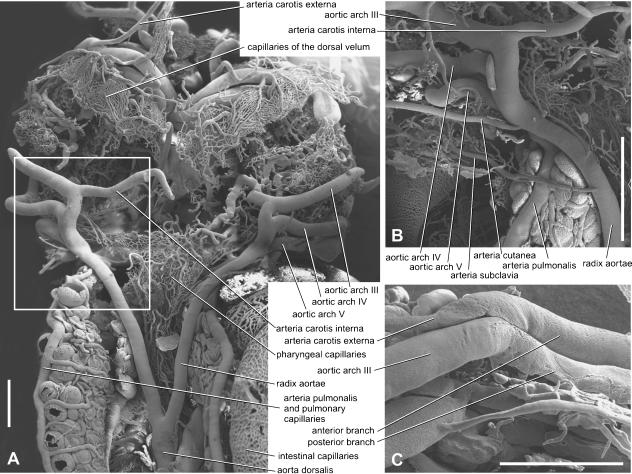
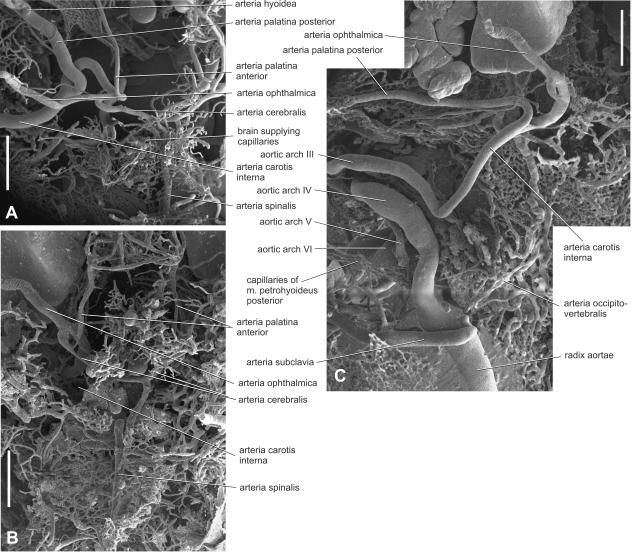
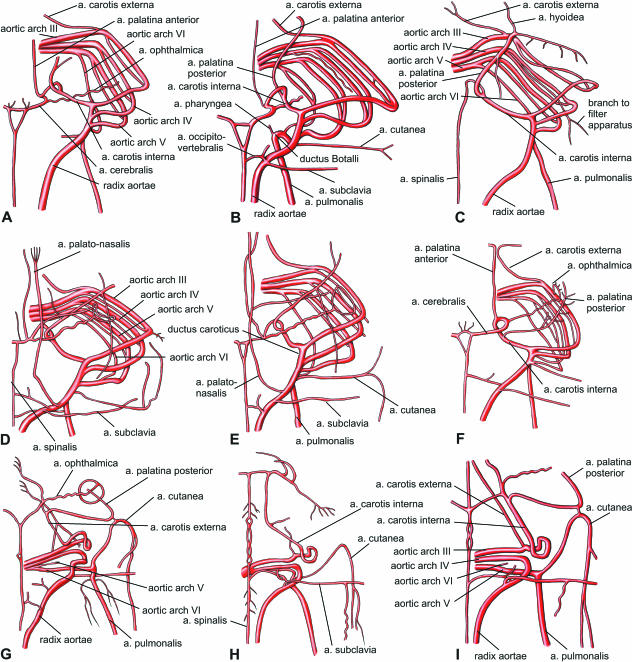
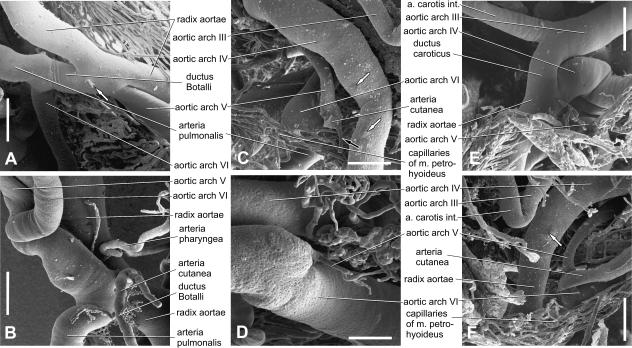
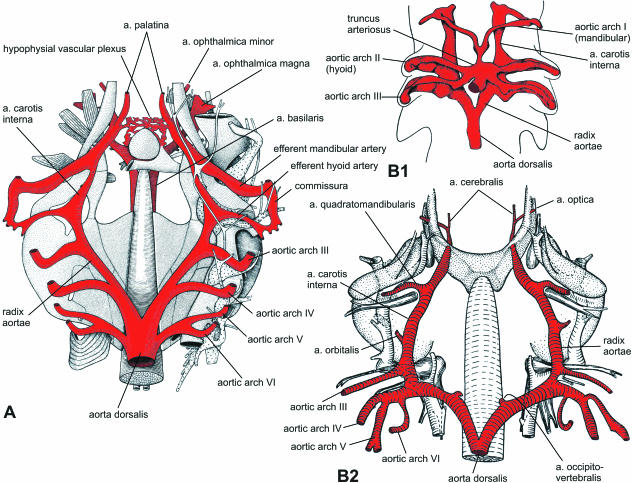
In order to gain insights into how the aortic arches changed during the transition of vertebrates to land, transformations of the aortic arches during the metamorphosis of Pelobates fuscus were investigated and compared with data from the early development of a recent ganoid fish Amia calva and a primitive caudate amphibian Salamandrella keyserlingi. Although in larval Pelobates, as in other non-pipid anurans, the gill arches serve partly as a filter-feeding device, their aortic arches maintain the original piscine-like arrangement, except for the mandibular and hyoid aortic arches which were lost. As important pre-adaptations for breathing of atmospheric oxygen occur in larval Pelobates (which have well-developed, though non-respiratory lungs and pulmonary artery), transformation of aortic arches during metamorphosis is fast. The transformation involves disappearance of the ductus Botalli, which results in a complete shunting of blood into the lungs and skin, disappearance of the ductus caroticus, which results in shunting of blood into the head through the arteria carotis interna, and disappearance of arch V, which results in shunting blood to the body through arch IV (systemic arch). It is supposed that the branching pattern of the aortic arches of permanently water-dwelling piscine ancestors, of intermediate forms which occasionally left the water and of primitive tetrapods capable of spending longer periods of time on land had been the same as in the prematamorphic anuran larvae or in some metamorphosed caudates in which the ductus caroticus and ductus Botalli were not interrupted, and arch V was still complete.
Figures
References
-
- Aichhorn H, Lametschwandtner A. Vascular regression during the amphibian metamorphosis – a scanning electron microscope study of vascular corrosion cast of the ventral velum in tadpoles of Xenopus laevis Daudin. Scanning. 1996;18:447–455. - PubMed
-
- Baker CL. The comparative anatomy of the aortic arches of the urodeles and their relation to respiration and degree of metamorphosis. J Tennessee Acad Sci. 1949;24:12–40.
-
- Balinsky BI. An Introduction to Embryology. 5. Philadelphia: Saunders College Publishing; 1981.
-
- Bartel H, Lametschwandtner A. Intussusceptive microvasculant growth in the lung of larval Xenopus laevis. A light microscope, transmission electron microscope and SEM study of microvascular corrosion casts. Anat Embryol. 2000;202:55–66. - PubMed
-
- Bjerring HC. Does a homology exist between the basicranial muscle and the polar cartilage? Colloques int Cent Natn Rech Scient. 1967;163:223–267.
Publication types
MeSH terms
LinkOut - more resources
Full Text Sources
Research Materials
