Review
. 2007 Apr;29(4):334-43.
doi: 10.1002/bies.20549.

The making of a social insect: developmental architectures of social design

Affiliations
Review

The making of a social insect: developmental architectures of social design

Robert E Page Jr et al. Bioessays. 2007 Apr.

Abstract

We marvel at the social complexity of insects, marked by anatomically and behaviorally distinguishable castes, division of labor and specialization--but how do such systems evolve? Insect societies are composed of individuals, each undergoing its own developmental process and each containing its own genetic information and experiencing its own developmental and experiential environment. Yet societies appear to function as if the colonies themselves are individuals with novel "social genes" and novel social developmental processes. We propose an alternative hypothesis. The origins of complex social behavior, from which insect societies emerge, are derived from ancestral developmental programs. These programs originated in ancient solitary insects and required little evolutionary remodeling. We present evidence from behavioral assays, selective breeding, genetic mapping, functional genomics and endocrinology, and comparative anatomy and physiology. These insights explain how complex social behavior can evolve from heterochronic changes in reproductive signaling systems that govern ubiquitous and ancient relationships between behavior and ovarian development.


Figures

Figure 1
Figure 1
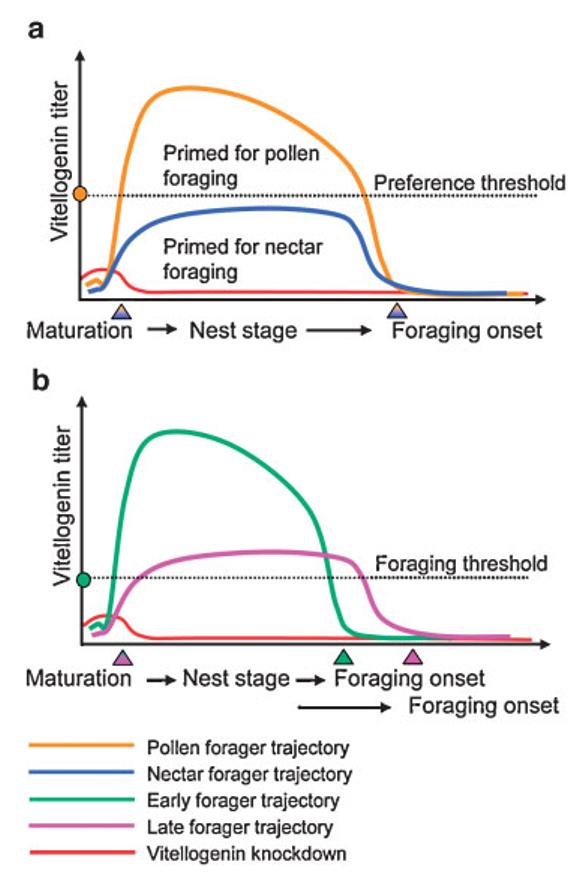
The ancestral yolk protein vitellogenin has a dual role in regulation of honey bee social behavior.(16) After a maturation phase of about 4 days when young bees are unable to forage, the hemolymph vitellogenin level acts as a primer of foraging preference. a: Bees with vitellogenin titers over a Preference threshold will primarily collect pollen later in life. Bees with vitellogenin levels under this same threshold are primed to collect nectar as foragers. In addition, vitellogenin is a suppressor of the transition from nest tasks to foraging activity. b: Bees that early in life experience a drop in the vitellogenin level below the Foraging threshold, also will initiate foraging at younger ages. In sum, this model (a,b) explains the behavior of workers with a vitellogenin gene knockdown phenotype, which forage precociously and preferentially collect nectar.(16) It also explains the behavior of selected pollen-hoarding strains. High-strain bees have high levels of vitellogenin soon after emergence but titers drop rapidly early in life. Low-strain bees, conversely, have lower vitellogenin levels that stay constant for a longer time (Amdam and Hartfelder, unpublished data). Accordingly, high-strain bees forage early and primarily collect pollen, while low-strain bees forage late and preferentially collect nectar.
Figure 2
Figure 2
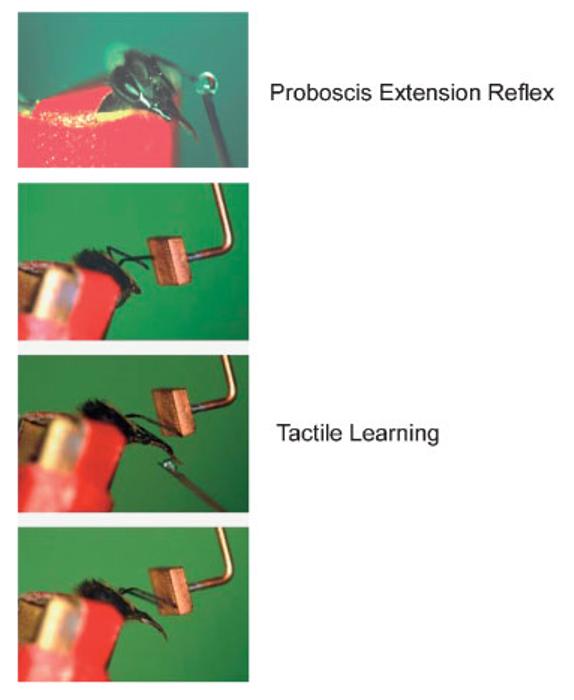
The top panel demonstrates the proboscis extension reflex of a restrained worker honey bee. A droplet of sucrose is touched to the antenna eliciting the extension of the proboscis. The bottom three panels demonstrate conditioning a worker honey bee to a tactile stimulus. The bee's eyes are occluded with paint. A droplet of sucrose was applied to the antenna eliciting the extension of the proboscis. A droplet of sucrose was presented to the tip of the proboscis as a reward. After conditioning, the bee responds to the tactile stimulus by extending the proboscis (photos by J. Erber).
Figure 3
Figure 3
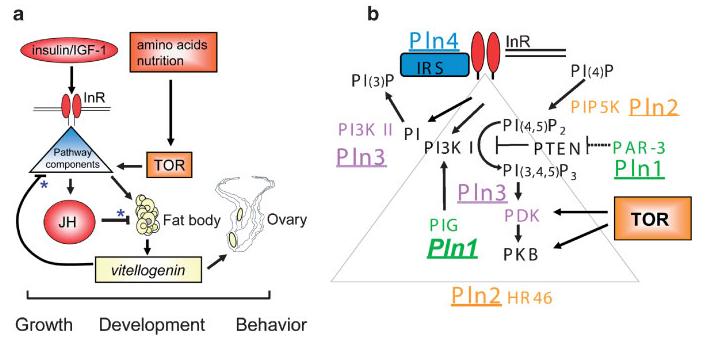
Variation the insulin/insulin-like (IIS) pathway, including cross talk with target of rapamycin (TOR) signaling, is a possible explanation for the different life history syndromes of high and low pollen-hoarding strain bees. a: In general, insulin-like peptides (insulin/IGF-1) bind to the insulin receptor (InR). The resulting signal is transmitted via components of second messenger pathways, and effects on fat body synthesis of yolk peptides/protein (vitellogenin), ovarian maturation state, organismal growth, development, and behavior emerge via pleiotropic cascades that involve systemic hormones (e.g. juvenile hormone, JH). Note that the feedback relationship(10) between vitellogenin and JH (blue asterisks) in honey bees is uncommon in insects,(12) and may emerge via vitellogenin-mediated regulation of IIS(63) Signal transmission can be conditional on nutrients (amino acids) and/or energy status, through cross talk with the nutrient sensing TOR pathway. b: Explicitly, the genomic regions associated with the pollen-hoarding behavioral and physiological syndrome (QTL Pln1–4) are characterized by a density of IIS/TOR pathway components that is much higher than expected by chance alone (see Hunt et al.63). Abbreviations: PI, phosphoinositol; PIP, phosphoinositol phosphate; IRS, insulin receptor substrate; PI3K, phosphoinositide-3 kinase (class I or II); PIP5K, 1-phosphatydylinositol-4-phosphate 5-kinase; PIG-P, phosphatidyl-inositolglycan-peptide; PDK1, 3-phosphoinositide-dependent kinase 1; PKB, protein kinase B; HR46, honeybee ortholog of Dmel/HR46; PTEN, phosphatidylinositol-3,4,5-trisphosphate 3-phosphatase.
Figure 4
Figure 4
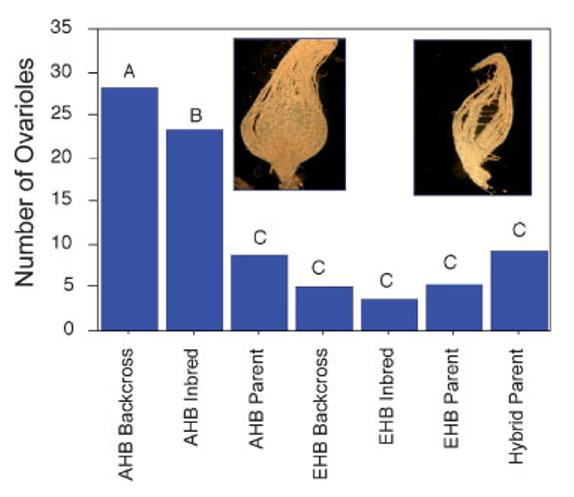
Queens were raised from the AHB parent and mated to drones from the AHB parent to produce four AHB inbred colonies. EHB parent queens were raised and mated to EHB parent drones to produce four EHB inbred colonies. An EHB queen was raised from the EHB parent colony and mated to a drone from the AHB parent colony to produce the hybrid parent colony. Queens were raised from the hybrid parent colony and mated to drones from the AHB parent to produce seven AHB backcross colonies and the EHB parent to produce 5 EHB backcross colonies. 25 workers were sampled from each colony, dissected and ovarioles counted. Data from different colonies within genetic crosses were pooled for analyses. Bars with different letters are statistically different at P < 0.0001, except for A and B P = 0.0125.
Figure 5
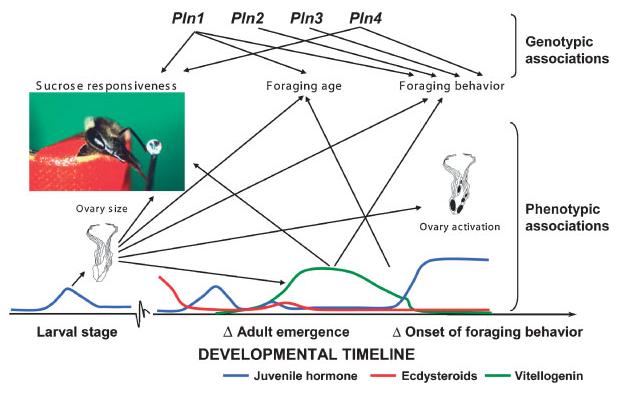
Figure 5
Two-way selection for pollen hoarding revealed a complex phenotypic, hormonal and genetic architecture affecting division of labor and foraging specialization in honey bees. Four pollen-hoarding QTLs were mapped that affected sensory response systems, behavioral development (age of foraging onset) and foraging behavior. High- and low-strain bees differed also in the size of their ovaries, and titres of vitellogenin and juvenile hormone soon after emerging as adults. Sucrose responsiveness correlates with vitellogenin titres and ovary size, while ovary size correlates with foraging onset, and foraging behavior, etc.

References

    1. Winston ML. The Biology of the Honey Bee. Harvard University Press; Cambridge MA: 1987.
    1. Snodgrass RE. Anatomy of the Honey Bee. Comstock Publishing Associates; New York: 1956.
    1. Evans JD, Wheeler DE. Differential gene expression between developing queens and workers in the honey bee, Apis mellifera. Proc Natl Acad Sci USA. 1999;96:5575–5580. - PMC - PubMed
    1. Evans JD, Wheeler DE. Gene expression and the evolution of insect polyphenisms. Bioessays. 2001;23:62–68. - PubMed
    1. Bishop GH. Fertilization in the honeybee. J Exp Zool. 1920;31:225–286.

Publication types