F15063, a compound with D2/D3 antagonist, 5-HT 1A agonist and D4 partial agonist properties. III. Activity in models of cognition and negative symptoms
- PMID: 17375085
- PMCID: PMC2013949
- DOI: 10.1038/sj.bjp.0707160
F15063, a compound with D2/D3 antagonist, 5-HT 1A agonist and D4 partial agonist properties. III. Activity in models of cognition and negative symptoms
Abstract
Background and purpose: The D(2)/D(3) receptor antagonist, D(4) receptor partial agonist, and high efficacy 5-HT(1A) receptor agonist F15063 was shown to be highly efficacious and potent in rodent models of activity against positive symptoms of schizophrenia. However F15063 induced neither catalepsy nor the 'serotonin syndrome'. Here, we evaluated its profile in rat models predictive of efficacy against negative symptoms/cognitive deficits of schizophrenia.
Experimental approach: F15063, given i.p., was assessed in models of behavioural deficits induced by interference with the NMDA/glutamatergic (phencyclidine: PCP) or cholinergic (scopolamine) systems.
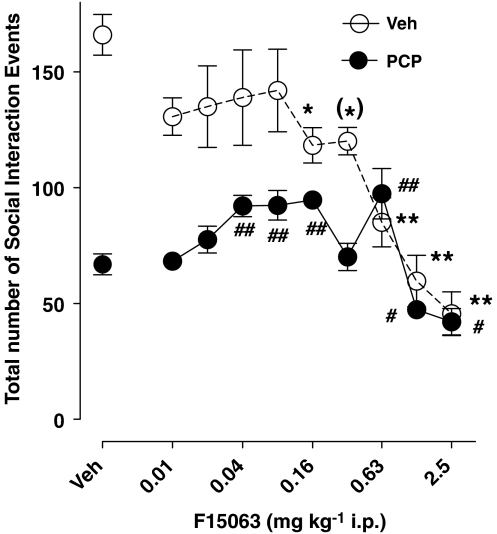
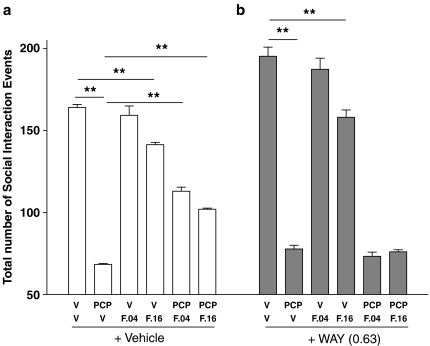
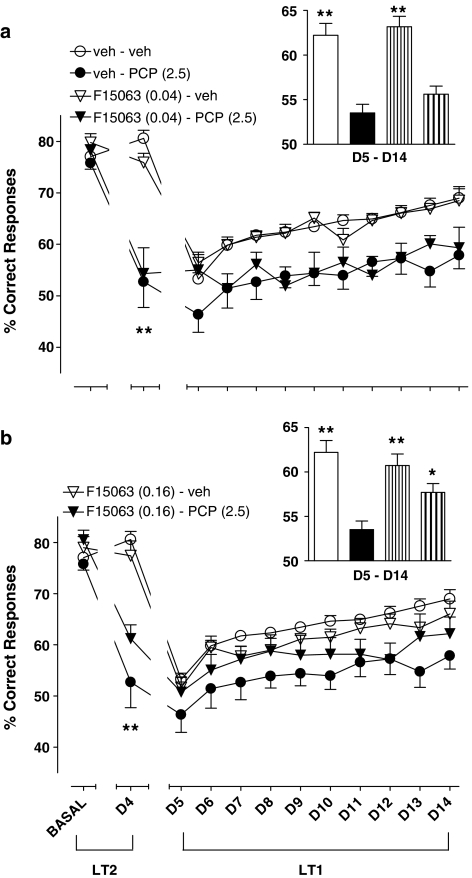
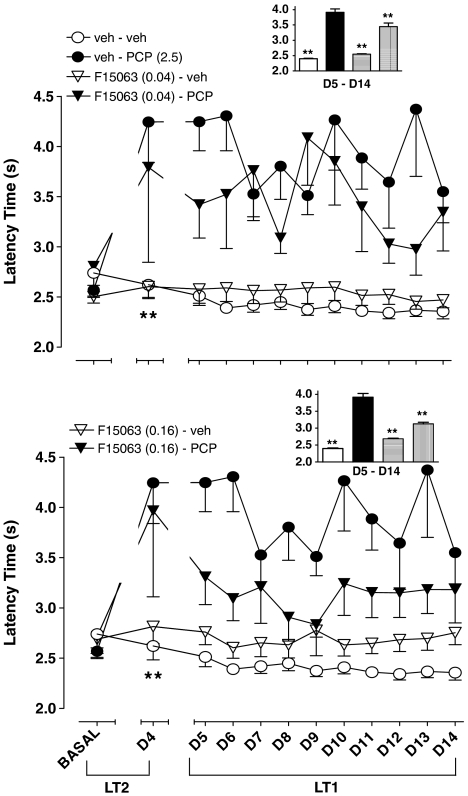
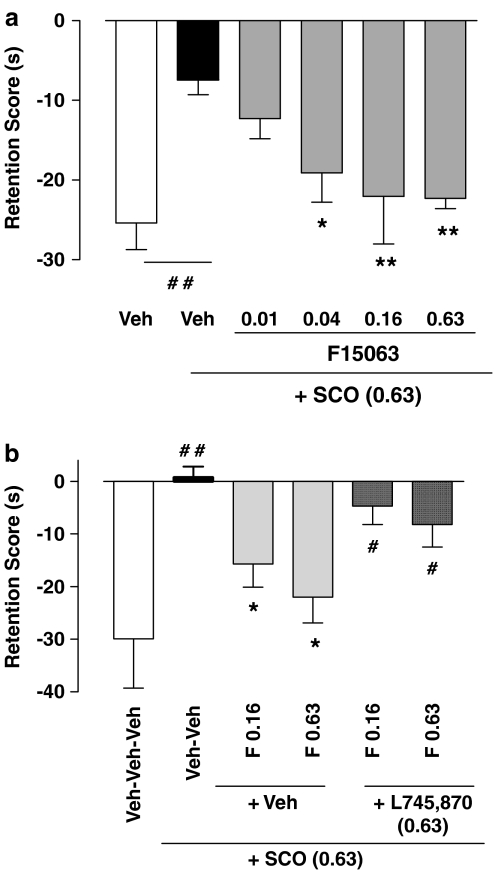
Key results: Through 5-HT(1A) activation, F15063 partially alleviated (MED: 0.04 mg kg(-1)) PCP-induced social interaction deficit between two adult rats, without effect by itself, underlining its potential to combat negative symptoms. At doses above 0.16 mg kg(-1), F15063 reduced interaction by itself. F15063 (0.16 mg kg(-1)) selectively re-established PCP-impaired 'cognitive flexibility' in a reversal learning task, suggesting potential against adaptability deficits. F15063 (0.04-0.63 mg kg(-1)) also reversed scopolamine-induced amnesia in a juvenile-adult rat social recognition test, indicative of a pro-cholinergic influence. Activity in this latter test is consistent with its D(4) partial agonism, as it was blocked by the D(4) antagonist L745,870. Finally, F15063 up to 40 mg kg(-1) did not disrupt basal prepulse inhibition of startle reflex in rats, a marker of sensorimotor gating.
Conclusions and implications: The balance of D(2)/D(3), D(4) and 5-HT(1A) receptor interactions of F15063 yields a promising profile of activity in models of cognitive deficits and negative symptoms of schizophrenia.
Figures
Comment in
-
Optimisation of anti-psychotic therapeutics: a balancing act?Br J Pharmacol. 2007 May;151(2):161-2. doi: 10.1038/sj.bjp.0707164. Epub 2007 Mar 20. Br J Pharmacol. 2007. PMID: 17375084 Free PMC article.
References
-
- Abdul-Monim Z, Reynolds GP, Neill JC. The atypical antipsychotic ziprasidone, but not haloperidol, improves phencyclidine-induced cognitive deficits in a reversal learning task in the rat. J Psychopharmacol. 2003;17:57–65. - PubMed
-
- Auclair A, Kleven MS, Besnard J, Depoortère R, Newman-Tancredi A. Actions of novel antipsychotic agents on apomorphine-induced PPI disruption: influence of combined serotonin 5-HT1A receptor activation and dopamine D2 receptor blockade. Neuropsychopharmacology. 2006a;31:1900–1909. - PubMed
-
- Auclair A, Newman-Tancredi A, Depoortère R.Comparative analysis of typical, atypical, and novel antipsychotics with preferential D2/D3 and 5-HT1A affinity in rodent models of cognitive flexibility and sensory gating: (II) The reversal learning task and PPI of the startle reflex Int J Neuropsychopharmacol 2006b9Supp 1P01167
-
- Bantick RA, Deakin JF, Grasby PM. The 5-HT1A receptor in schizophrenia: a promising target for novel atypical neuroleptics. J Psychopharmacol. 2001;15:37–46. - PubMed
-
- Bardin L, Kleven MS, Barret-Grevoz C, Depoortère R, Newman-Tancredi A. Antipsychotic-like vs cataleptogenic actions in mice of novel antipsychotics having D2 antagonist and 5-HT1A agonist properties. Neuropsychopharmacology. 2006a;31:1869–1879. - PubMed
Publication types
MeSH terms
Substances
LinkOut - more resources
Full Text Sources