


Poly(I:C) and lipopolysaccharide innate sensing functions of circulating human myeloid dendritic cells are affected in vivo in hepatitis C virus-infected patients
- PMID: 17376921
- PMCID: PMC1900294
- DOI: 10.1128/JVI.01741-06
Poly(I:C) and lipopolysaccharide innate sensing functions of circulating human myeloid dendritic cells are affected in vivo in hepatitis C virus-infected patients
Abstract
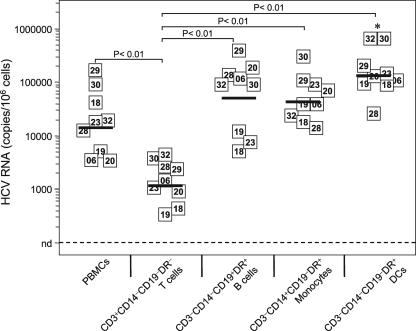
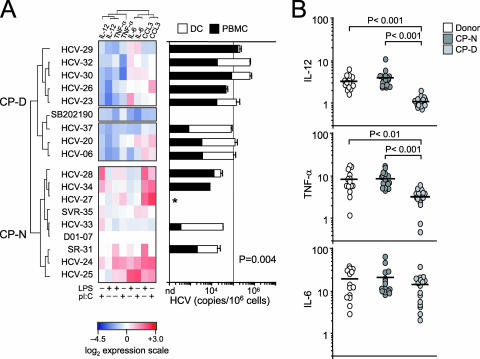
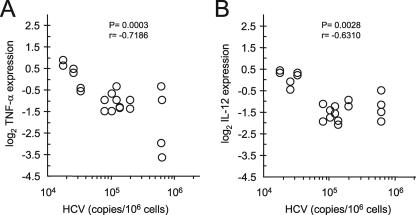
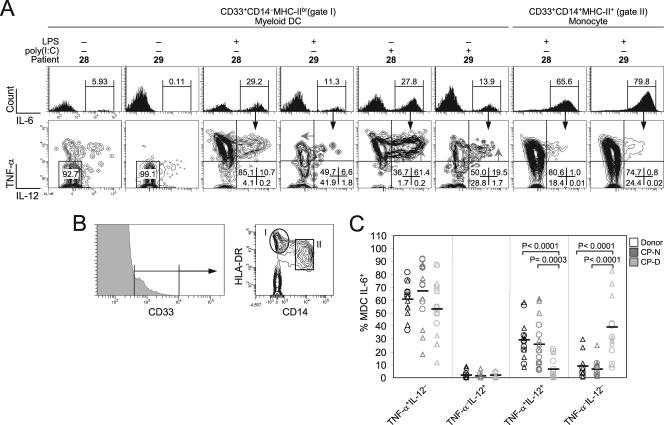
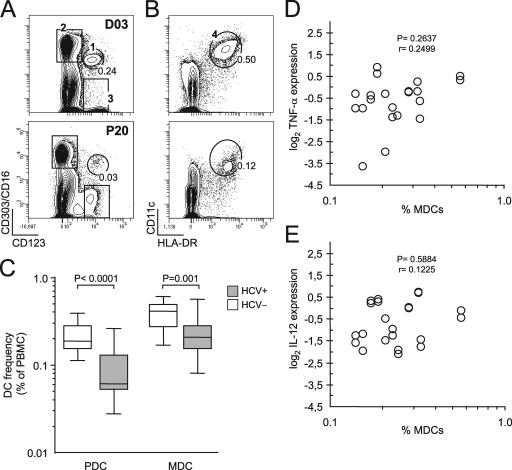
The role of peripheral dendritic cells (DCs) in hepatitis C virus (HCV) infection is unclear. To determine if persistent infection exerts an inhibitory pressure on HCV-specific innate responses, we analyzed DC function in blood through quantification of cell-associated HCV RNA levels in conjunction with multiparametric flow cytometry analysis of pathogen recognition receptor-induced cytokine expression. Independently of the serum viral load, fluorescence-activated cell sorter-purified total DCs had a wide range of cell-associated HCV genomic RNA copy numbers (mean log(10), 5.0 per 10(6) cells; range, 4.3 to 5.8). Here we report that for viremic patients with high viral loads in their total DCs, the myeloid DC (MDC) subset displayed impaired expression of interleukin-12 (IL-12) and tumor necrosis factor alpha (TNF-alpha) but normal IL-6 or chemokine CCL3 expression in response to poly(I:C) and lipopolysaccharide (LPS). IL-6-expressing cells from this subgroup of viremic patients demonstrated a significant increase (sixfold more) in TNF-alpha(-) IL-12(-) cell frequency compared to healthy donors (mean, 38.8% versus 6.5%; P < 0.0001), indicating a functional defect in a subpopulation of cytokine-producing MDCs ( approximately 6% of MDCs). Attenuation of poly(I:C) and LPS innate sensing was HCV RNA density dependent and did not correlate with viremia or deficits in circulating MDC frequencies in HCV-infected patients. Monocytes from these patients were functionally intact, responding normally on a per-cell basis following stimulation, independent of cell-associated HCV RNA levels. Taken together, these data indicate that detection of HCV genomic RNA in DCs and loss of function in the danger signal responsiveness of a small proportion of DCs in vivo are interrelated rather than independent phenomena.
Figures
References
-
- Alexopoulou, L., A. C. Holt, R. Medzhitov, and R. A. Flavell. 2001. Recognition of double-stranded RNA and activation of NF-kappaB by Toll-like receptor 3. Nature 413:732-738. - PubMed
-
- Anthony, D. D., N. L. Yonkers, A. B. Post, R. Asaad, F. P. Heinzel, M. M. Lederman, P. V. Lehmann, and H. Valdez. 2004. Selective impairments in dendritic cell-associated function distinguish hepatitis C virus and HIV infection. J. Immunol. 172:4907-4916. - PubMed
-
- Auffermann-Gretzinger, S., E. B. Keeffe, and S. Levy. 2001. Impaired dendritic cell maturation in patients with chronic, but not resolved, hepatitis C virus infection. Blood 97:3171-3176. - PubMed
-
- Boisvert, J., X. S. He, R. Cheung, E. B. Keeffe, T. Wright, and H. B. Greenberg. 2001. Quantitative analysis of hepatitis C virus in peripheral blood and liver: replication detected only in liver. J. Infect. Dis. 184:827-835. - PubMed
Publication types
MeSH terms
Substances
LinkOut - more resources
Full Text Sources
