Comparative Study
. 2007 Mar 21;27(12):3285-94.
doi: 10.1523/JNEUROSCI.5202-06.2007.

Segment specificity of load signal processing depends on walking direction in the stick insect leg muscle control system

Affiliations
Comparative Study

Segment specificity of load signal processing depends on walking direction in the stick insect leg muscle control system

Turgay Akay et al. J Neurosci. .

Abstract

In terrestrial locomotion, sensory feedback from load sensors is important for altering ongoing motor output on a step-by-step basis. We investigated the influence of load signals from the leg on motoneuron pools of the thorax-coxa (ThC) joint in the stick insect walking system. Load sensors were stimulated during rhythmic, alternating activity in protractor coxae (ProCx) and retractor coxae (RetCx) motoneuron pools. Alternating activity in the segment of interest was induced by mechanical stimulation of the animal or pharmacological activation of the isolated thoracic ganglia. Load signals from the legs altered the timing of ThC motoneuron activity by resetting and entraining the activity of the central rhythm generating network of the ThC joint. In the front and middle legs, load signals induced or promoted RetCx activity and decreased or terminated ProCx activity. In the hindleg, reverse transitions were elicited, with increasing load terminating RetCx and initiating ProCx activity. Studies in semi-intact walking animals showed that the effect of load on the ThC-joint motoneurons depended on walking direction, with increased load promoting the functional stance phase motoneuron pool (in forward walking, RetCx activity; in backward walking, ProCx activity). Thus, we show that modifications of sensory feedback in a locomotor system are related to walking direction. In a final set of ablation experiments, we show that the load influence is mediated by the three groups of trochanteral campaniform sensilla.


Figures
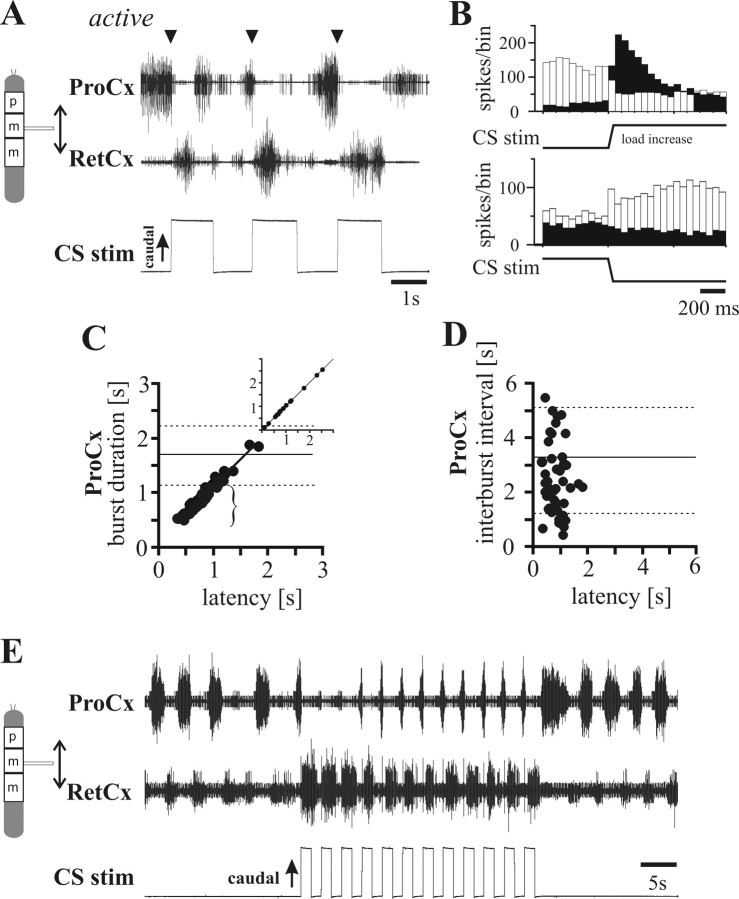
Figure 1.
Figure 1.
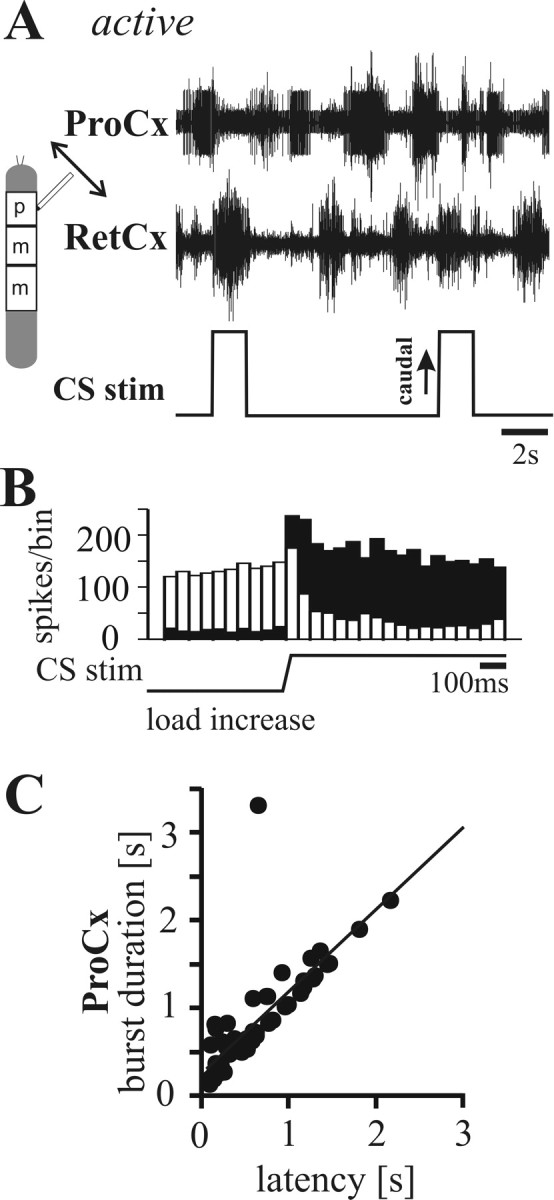
Effect of CS stimulation on the ThC-joint motoneuron activity in insects with activated locomotor systems. A, Extracellular recordings from ProCx (top trace; nerve nl2) and RetCx (middle trace; nerve nl5) nerves during CS stimulation (bottom trace) of a middle leg in a stick insect activated by tactile stimulation. CS stimulation (upward deflection indicates caudal bending of the femur) induced a transition from ProCx to RetCx activity (arrowheads). B, PST histograms (bin width, 50 ms) illustrating that ProCx activity (white bars) decreased and RetCx activity (black bars) increased during CS stimulation by caudal bending of the femur (top histogram; n = 27) in one tactilely activated stick insect. Rostral bending on average increased ProCx activity but only slightly decreased RetCx activity (bottom histogram; n = 27) C, Plot of the duration of ProCx bursts in which a stimulus was applied as a function of latency between ProCx burst onset and the stimulation onset during pilocarpine-induced rhythmic activity in four animals (n = 46; R2 = 0.96) and in one tactilely activated animal (inset, n = 17; R2 = 0.99). Note that, when stimuli occur early in the ProCx burst, the bursts (bracket) were significantly shorter than under control conditions. Horizontal lines indicate mean (solid line) ± SDs (dashed lines) of ProCx burst durations without stimuli (N = 4; n = 140). D, Plot of the interburst intervals after the terminated ProCx bursts (in C) as a function of latency between ProCx burst onset and stimulation onset during pilocarpine-induced rhythmic activity in four animals (n = 46). Note that termination of the ProCx bursts by the CS stimuli did not alter the following interburst interval, indicated by no correlation (R2 = 0.01) and comparable interburst intervals after CS stimulation versus the control intervals. E, Entrainment of ThC-joint motoneuron activity by load signals from the leg. Sample recording of ProCx (top trace) and RetCx (middle trace) activity in the middle leg during repetitive stimulation with a higher frequency than the inherent frequency of the centrally generated rhythm in the presence of pilocarpine (for details, see Results).
Figure 2.
Figure 2.
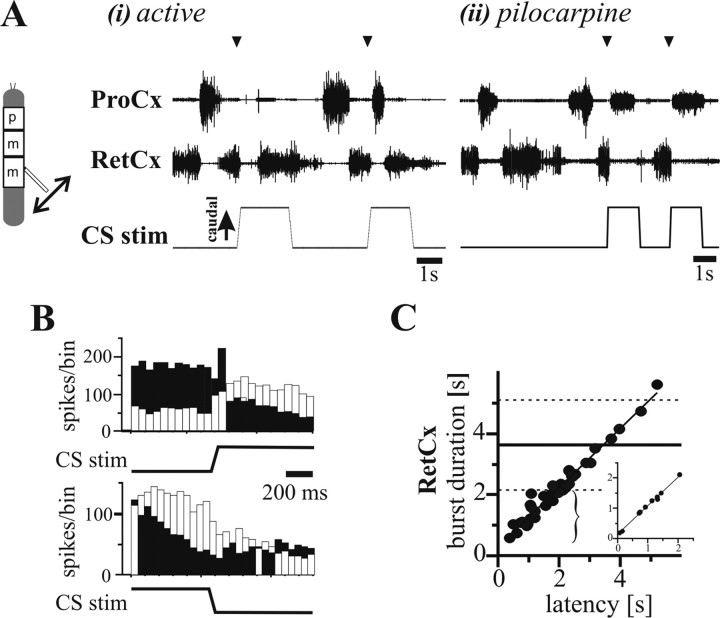
A, Extracellular recordings from ProCx (top trace; nerve nl2) and RetCx (middle trace; nerve nl5) nerves during CS stimulation (bottom trace) of a front leg in a stick insect activated by tactile stimulation. CS stimulation (upward deflection indicates caudal bending of the femur) induces transition from ProCx to RetCx activity. B, PST histograms (bin width, 50 ms) illustrating that ProCx activity (white bars) decreased and RetCx activity (black bars) increased during CS stimulation by caudal bending of the femur (n = 52) in one tactilely activated stick insect. C, Plot illustrating that the ProCx burst durations were significantly correlated with the latency of the onset of CS stimuli in fore legs (N = 3; n = 55; R2 = 0.71) in tactilely activated animals.
Figure 3.
Figure 3.
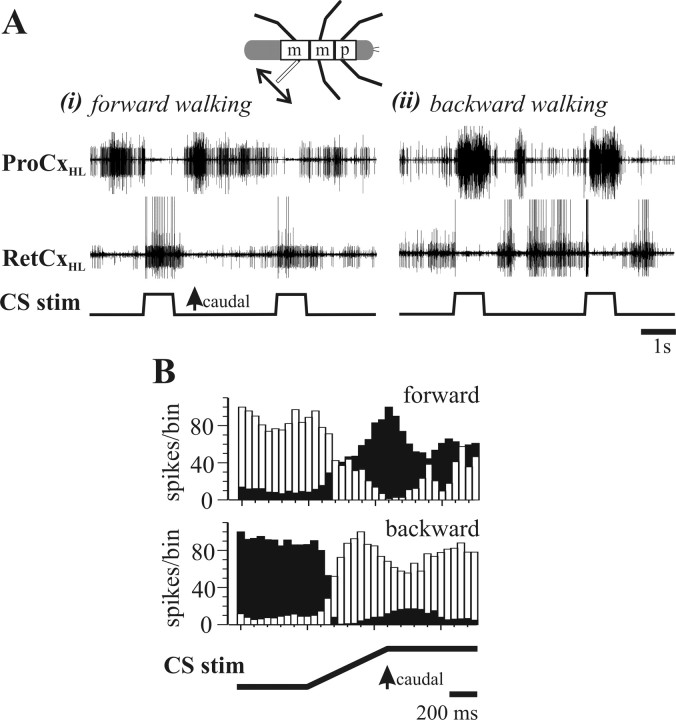
Reversed effect of load signals on ThC-joint motoneuron activity in the metathoracic segment. A, Extracellular recordings from ProCx (top traces) and RetCx (middle traces) nerves during stimulation of load sensors of the hindleg (bottom traces) in experimental animals activated by either tactile stimulation (i) or 5 × 10⁻⁴ m pilocarpine (ii). Stimulation of load sensors induced a transition from RetCx to ProCx activity in both conditions (arrowheads). B, PST histograms (bin width, 50 ms) illustrating that, in the metathoracic segment, ProCx activity (white bars) increased and RetCx activity (black bars) decreased during CS stimulation by caudal bending of the femur (top histogram; n = 16) in one tactilely activated stick insect. On average, rostral bending of the femur does not show stimulation-related changes in ThC-joint motoneuron activity (bottom histogram; n = 16). C, Plot of RetCx burst duration in which the stimulus was applied versus the latency between burst onset and stimulation onset (N = 3 animals; n = 39; R2 = 0.96) in the pilocarpine-induced rhythmic preparation and in the tactilely activated animal (inset; n = 9; R2 = 0.99). Note that, when stimuli occur early in a RetCx burst, the burst was significantly shorter (bracket) than the control bursts. Horizontal lines indicate mean (solid line) ± SDs (dashed lines) of RetCx burst durations without stimuli (N = 3; n = 39).
Figure 4.
Figure 4.
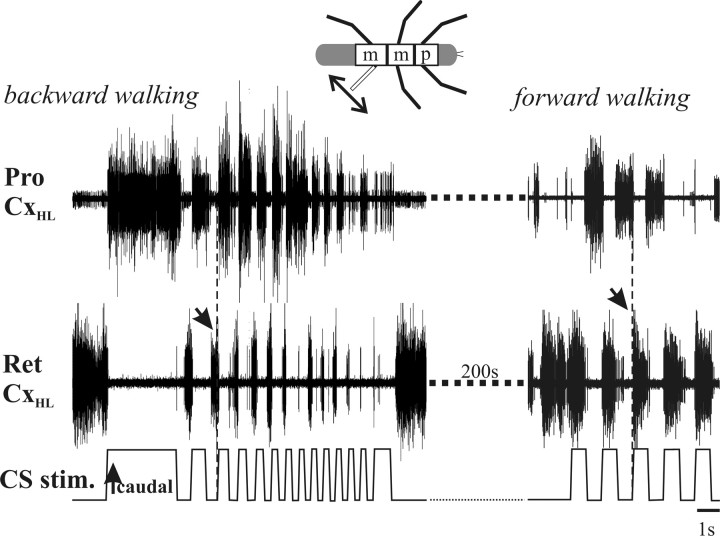
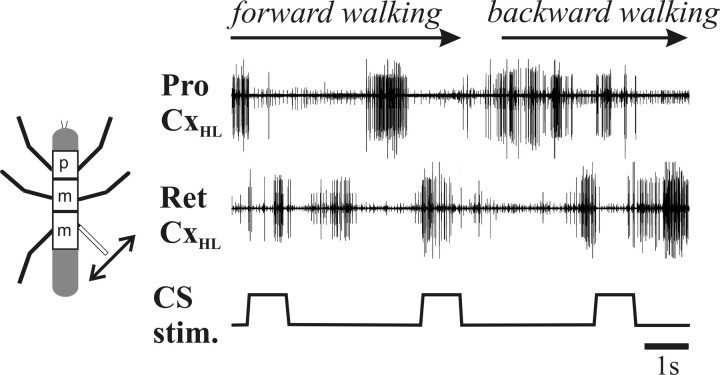
Effect of hindleg load signals on ThC-joint motoneuron activity during forward and backward walking in an intact walking animal. A, Extracellular ProCxHL (ProCx of the hindleg; top trace) and RetCxHL (RetCx of the hindleg; middle trace) nerve recordings during stimulation of load sensors (bottom traces) in the hindleg during forward (i) and backward (ii) walking. Note that motoneuron activity switches from ProCx to RetCx during forward walking (i) and from RetCx to ProCx during backward walking (ii). B, Stimulus time histogram (bin width, 50 ms) showing the mean activity profile of ProCx (white bars) and RetCx (black bars) during stimulation of load sensors during forward walking (top histogram) and backward walking (bottom histogram). Data obtained from one animal from n = 18 (forward) and n = 33 (backward) stimuli.
Figure 5.
Figure 5.
Phase of entrainment of rhythmic ThC-joint motoneuron activity by rhythmic stimulation of hindleg load sensors depends on walking direction. During backward walking (left), entrainment results in ProCx activity being in phase with caudal bending of the femur. In contrast, during forward walking (right), entrainment results in RetCx activity being in phase with caudal bending of the femur. Arrows at stippled vertical lines each denote one transition in activity of coxal motoneurons induced by CS stimulation in backward and forward walking.
Figure 6.
Figure 6.
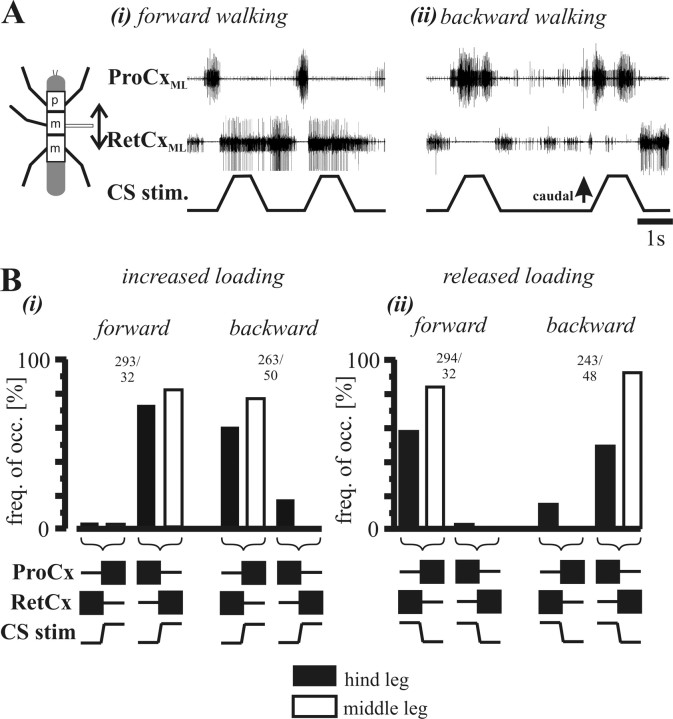
Influence of stimulation of middle and hindleg load sensors on coxal motoneuron activity as a function of walking direction. A, Recording of RetCx and ProCx activity from the appropriate leg nerves of the mesothoracic segment with ongoing stimulation of load sensors. Note the reversed effect during forward (i) and backward (ii) walking. B, Bar diagrams showing the occurrence frequency of transitions in motoneuron activity of the thoraco-coxal motoneurons in middle legs (white bars) and hindlegs (black bars) during stimulation of load sensors during forward and backward walking. i, Increase in load; ii, decrease in load. Numbers above the columns indicate the number (n) of stimuli evaluated for the hindleg (filled bars) and the middle leg (open bars), respectively. The sketches beneath the diagrams outline the two different cases, i.e., ProCx or RetCx motoneurons being currently active (bars) during caudal (upward deflection of the CS stim. trace) or rostral (downward deflection of the CS stim. trace) bending and the subsequent transition in activity.
Figure 7.
Figure 7.
Extracellular recordings from hindleg ProCx and RetCx and CS stimulation during a section of a walking sequence showing that the reversal of the CS effect occurs immediately when walking direction changes.
Figure 8.
Figure 8.
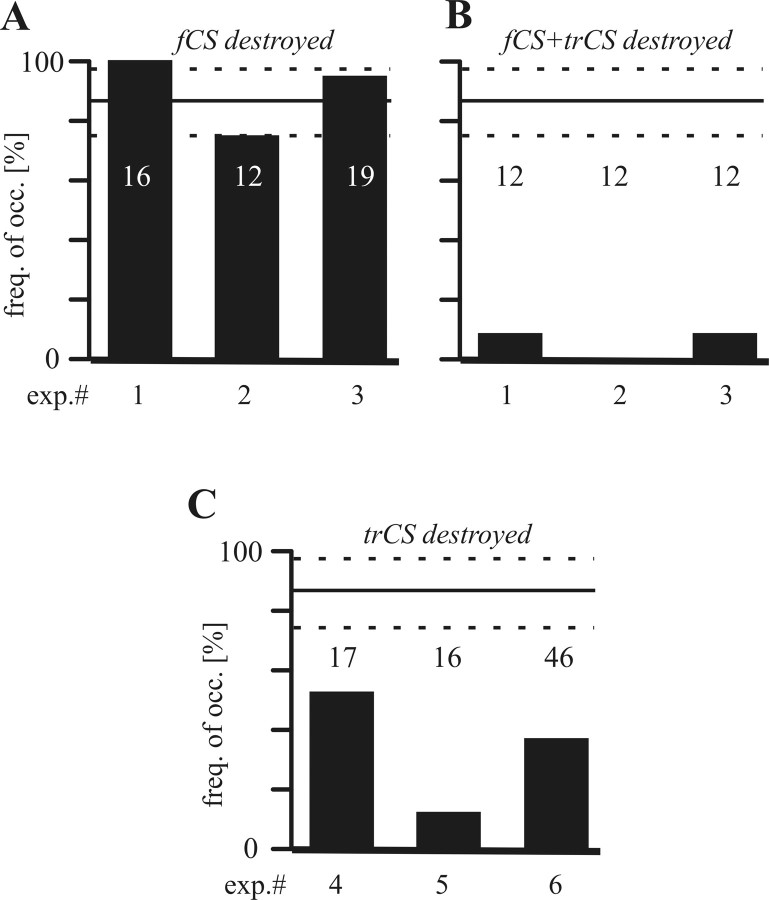
Effect of successive ablation of fCS and trCS on ThC-joint motoneuron activity in pilocarpine-induced rhythmic preparations in the middle leg (N = 3; the numbers on top of the bars give the sample size). In three animals (exp.# 1–3), the influence of the bending of the femur persisted after removal of the fCS (A). In these same animals, the reflex vanished after additional removal of the trCS (B). In A and B, the vertical solid and dotted lines indicate the mean ± SD from seven control experiments in which all CS were intact. The abscissa indicates the frequency of occurrence for transitions in switching from ProCx to RetCx activity induced by the CS stimulation. C, Effect of ablation of trCS only on ThC-joint motoneuron activity in pilocarpine-induced rhythmic preparations in the middle leg (N = 3). In all three animals (exp.# 4–6), the influence of the bending of the femur was strongly decreased after removal of the trCS.

References

    1. Akay T, Bässler U, Gerharz P, Büschges A. Interjoint coordination: the role of sensory signals from the coxa-trochanteral joint on controlling motoneuronal activity of the femur-tibia joint in stick insects. J Neurophysiol. 2001;85:594–604. - PubMed
    1. Akay T, Haehn S, Schmitz J, Büschges A. Signals from load sensors underlie interjoint coordination during stepping movements of the stick insect legs. J Neurophysiol. 2004;92:42–51. - PubMed
    1. Angel M, Guertin P, Jiménez I, McCrea DA. Group I extensor afferents evoke disynaptic EPSPs in cat hindlimb extensor motoneurons during fictive locomotion. J Physiol (Lond) 1996;494:851–861. - PMC - PubMed
    1. Ayers JL, Davis WJ. Neuronal control of locomotion in the lobster Homarus americanus. J Comp Physiol. 1977;115:29–46.
    1. Bartling CH, Schmitz J. Reaction to disturbances of a walking leg during stance. J Exp Biol. 2000;203:1211–1233. - PubMed

Publication types

LinkOut - more resources