Review
. 2006:71:1-11.
doi: 10.1101/sqb.2006.71.016.

Small RNA regulators and the bacterial response to stress

Affiliations
Review

Small RNA regulators and the bacterial response to stress

S Gottesman et al. Cold Spring Harb Symp Quant Biol. 2006.

Abstract

Recent studies have uncovered dozens of regulatory small RNAs in bacteria. A large number of these small RNAs act by pairing to their target mRNAs. The outcome of pairing can be either stimulation or inhibition of translation. Pairing in vivo frequently depends on the RNA-binding protein Hfq. Synthesis of these small RNAs is tightly regulated at the level of transcription; many of the well-studied stress response regulons have now been found to include a regulatory RNA. Expression of the small RNA can help the cell cope with environmental stress by redirecting cellular metabolism, exemplified by RyhB, a small RNA expressed upon iron starvation. Although small RNAs found in Escherichia coli can usually be identified by sequence comparison to closely related enterobacteria, other approaches are necessary to find the equivalent RNAs in other bacterial species. Nonetheless, it is becoming increasingly clear that many if not all bacteria encode significant numbers of these important regulators. Tracing their evolution through bacterial genomes remains a challenge.


Figures
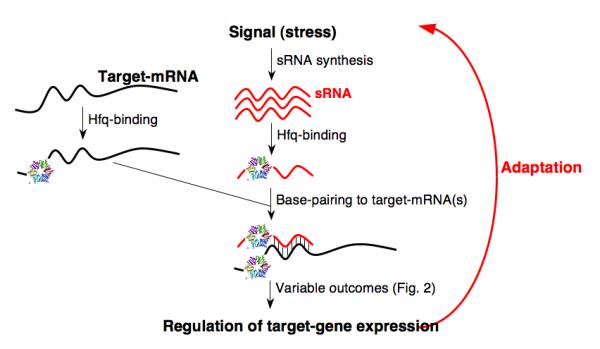
Figure 1
Figure 1
Cycle of activity of Hfq-dependent regulatory RNAs
Figure 2
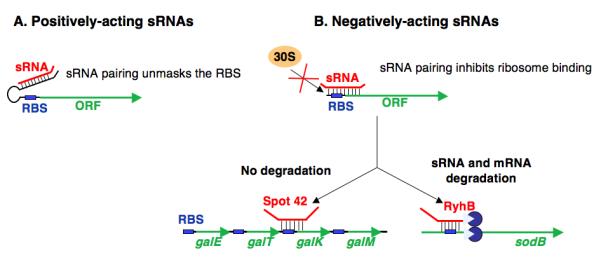
Figure 2. Outcomes of pairing for Hfq-dependent regulatory RNAs
A. Positively-acting RNAs are exemplified by DsrA and RprA action in stimulating rpoS translation [reviewed in (Repoila et al. 2003)]. B. Negatively-acting sRNAs generally pair with target mRNAs near the ribosome binding site, but it is not yet clear what distinguishes cases where there is degradation of the mRNA (RyhB and sodB in the figure) and those where there is no degradation (Spot 42 and galK in the figure).
Figure 3
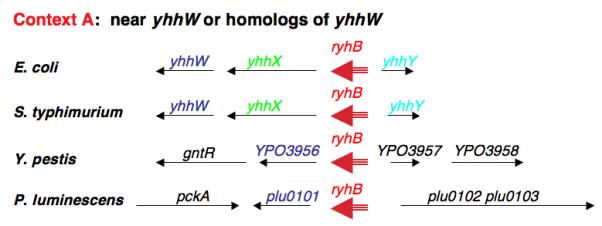
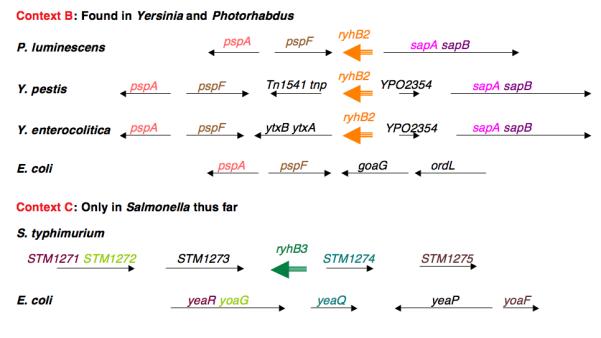
Figure 3. RyhB homologs in Enterobacteriacae
Homologous genes are similarly color-coded. The three contexts shown are far from each other on the bacterial chromosome. We have arbitrarily named those RNAs in the same context as E. coli ryhB and second genes elsewhere ryhB2 or ryhB3 (depending on the context). These are not meant to be permanent names. Information on genes is adapted from information provided on the Comprehensive Microbial Resource of TIGR (The Institute for Genome Research) [http://cmr.tigr.org/tigr-scripts/CMR/CmrHomePage.cgi],(Peterson et al. 2001).
Figure 3
Figure 3. RyhB homologs in Enterobacteriacae
Homologous genes are similarly color-coded. The three contexts shown are far from each other on the bacterial chromosome. We have arbitrarily named those RNAs in the same context as E. coli ryhB and second genes elsewhere ryhB2 or ryhB3 (depending on the context). These are not meant to be permanent names. Information on genes is adapted from information provided on the Comprehensive Microbial Resource of TIGR (The Institute for Genome Research) [http://cmr.tigr.org/tigr-scripts/CMR/CmrHomePage.cgi],(Peterson et al. 2001).
Figure 4
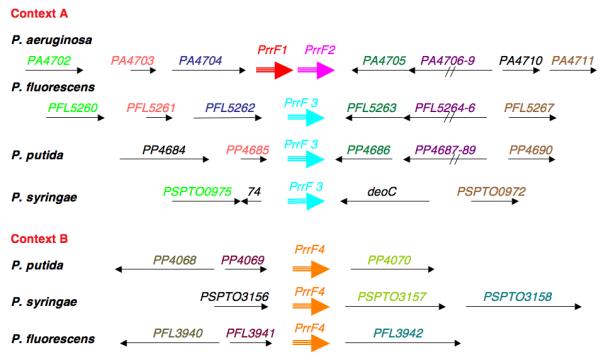
Figure 4. PrrF homologs in Pseudomonads
Homologous genes are similarly color-coded. We have arbitrarily named the PrrF like RNAs in context A PrrF3 and those in Context B PrrF4.
Figure 5
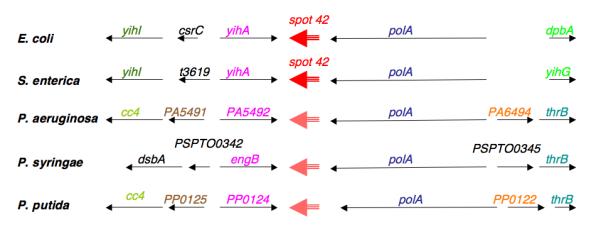
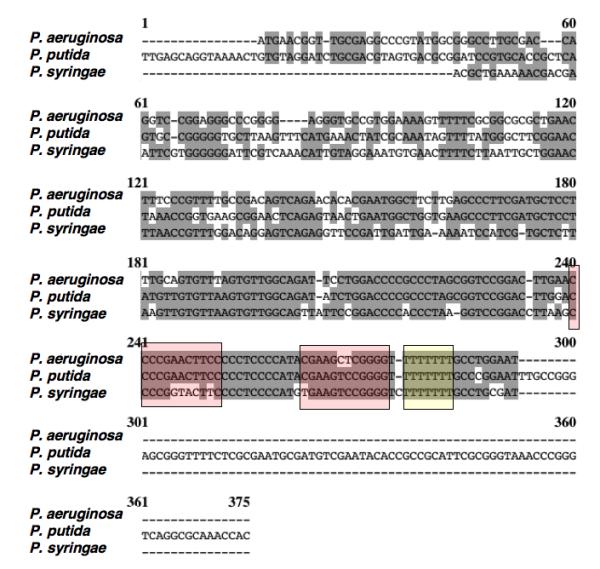
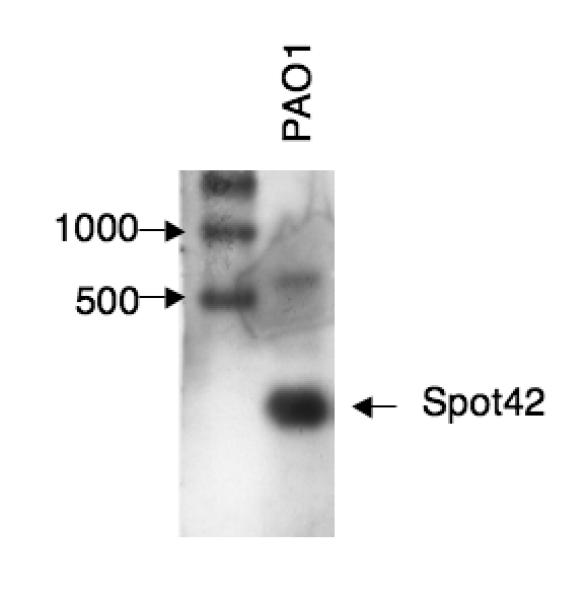
Figure 5. A possible Pseudomonas Spot 42 RNA
A. Conserved genome context around an sRNA in E. coli, Salmonella, and Pseudomonads. Homologous genes are similarly color-coded. polA: DNA polymerase I; engB: GTP-binding protein. B. Multiple sequence alignment of Pseudomonas intergenic region between polA and engB. The sequences overlapping the putative sRNAs are shown, with conserved regions in grey and the putative terminator stem-loop boxed in color. Sequences are from Genbank files AE004091 (P. aeruginosa PA01), AE015451 (P. putida KT2440), and AE016853 (P. syringae pv tomato str. DC3000). Other sequenced Pseudomonads are also conserved in this intergenic region. C. Detection of a Spot 42 sRNA in P. aeruginosa. RNA extracted from P. aeruginosa strain PA01 was probed for an RNA of the sequence predicted in Fig. 5B. The RNA isolation and Northern blot procedure is as previously described (Wilderman et al. 2004).
Figure 5
Figure 5. A possible Pseudomonas Spot 42 RNA
A. Conserved genome context around an sRNA in E. coli, Salmonella, and Pseudomonads. Homologous genes are similarly color-coded. polA: DNA polymerase I; engB: GTP-binding protein. B. Multiple sequence alignment of Pseudomonas intergenic region between polA and engB. The sequences overlapping the putative sRNAs are shown, with conserved regions in grey and the putative terminator stem-loop boxed in color. Sequences are from Genbank files AE004091 (P. aeruginosa PA01), AE015451 (P. putida KT2440), and AE016853 (P. syringae pv tomato str. DC3000). Other sequenced Pseudomonads are also conserved in this intergenic region. C. Detection of a Spot 42 sRNA in P. aeruginosa. RNA extracted from P. aeruginosa strain PA01 was probed for an RNA of the sequence predicted in Fig. 5B. The RNA isolation and Northern blot procedure is as previously described (Wilderman et al. 2004).
Figure 5
Figure 5. A possible Pseudomonas Spot 42 RNA
A. Conserved genome context around an sRNA in E. coli, Salmonella, and Pseudomonads. Homologous genes are similarly color-coded. polA: DNA polymerase I; engB: GTP-binding protein. B. Multiple sequence alignment of Pseudomonas intergenic region between polA and engB. The sequences overlapping the putative sRNAs are shown, with conserved regions in grey and the putative terminator stem-loop boxed in color. Sequences are from Genbank files AE004091 (P. aeruginosa PA01), AE015451 (P. putida KT2440), and AE016853 (P. syringae pv tomato str. DC3000). Other sequenced Pseudomonads are also conserved in this intergenic region. C. Detection of a Spot 42 sRNA in P. aeruginosa. RNA extracted from P. aeruginosa strain PA01 was probed for an RNA of the sequence predicted in Fig. 5B. The RNA isolation and Northern blot procedure is as previously described (Wilderman et al. 2004).

References

    1. Afonyushkin T, Vecerek B, Moll I, Blasi U, Kaberdin VR. Both RNase E and RNase III control the stability of sodB mRNA upon translational inhibition by the small regulatory RNA RyhB. Nucleic Acids Res. 2005;33:1678–1689. - PMC - PubMed
    1. Altuvia S, Weinstein-Fischer D, Zhang A, Postow L, Storz G. A small stable RNA induced by oxidative stress: role as a pleiotropic regulator and antimutator. Cell. 1997;90:43–53. - PubMed
    1. Antal M, Bordeau V, Douchin V, Felden B. A small bacterial RNA regulates a putative ABC transporter. J. Biol. Chem. 2005;280:7901–7908. - PubMed
    1. Argaman L, Altuvia S. fhlA repression by OxyS RNA: Kissing complex formation at two sites results in a stable antisense-target RNA complex. J. Molec. Biol. 2000;300:1101–1112. - PubMed
    1. Argaman L, Hershberg R, Vogel J, Bejerano G, Wagner EGH, Margalit H, Altuvia S. Novel small RNA-encoding genes in the intergenic region of Escherichia coli. Curr. Biol. 2001;11:941–950. - PubMed

Publication types

MeSH terms

LinkOut - more resources