Perception of risk of adverse drug reactions by medical students: influence of a 1 year pharmacological course
- PMID: 17381466
- PMCID: PMC2000624
- DOI: 10.1111/j.1365-2125.2007.02882.x
Perception of risk of adverse drug reactions by medical students: influence of a 1 year pharmacological course
Abstract
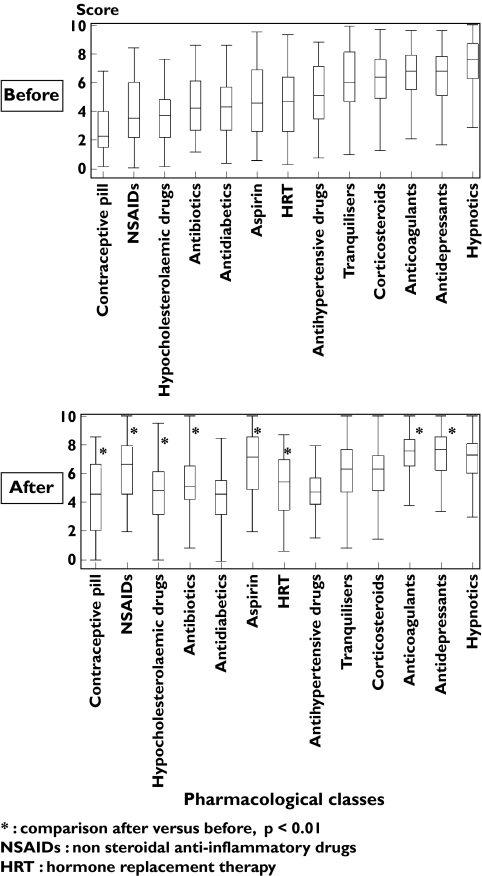
Aims: To investigate how adverse drug reactions (ADRs) to several classes of drugs are perceived by young medical students before and after a 1 year pharmacology course.
Methods: The whole cohort of 92 medical students (63 females and 29 males) was questioned during their third year. A visual analogue scale was used to define a score (ranging from 0 to 10) of perceived risk of ADRs associated with each drug class before and at the end of the pharmacological training period.
Results: Before the pharmacology course, hypnotics were ranked as the most dangerous drugs by the medical students, followed by antidepressants and anticoagulants. Contraceptive pills were listed in the last position. After pharmacological training, antidepressants moved into the first position, followed by anticoagulants and hypnotics. When all different drug classes were taken as a whole, the mean (+/-SD) of median scores of the perceived risk were 4.8 (+/-1.3) before and 5.8 (+/-1.5) at the end of the pharmacology course (P < 0.0001). Except for antidiabetics, antihypertensive drugs, tranquillizers, corticosteroids and hypnotics, the perceived risk significantly increased after the pharmacology course for the other drugs. The highest increases were observed for contraceptive pills (+104%, P < 0.01), NSAIDs (+86%, P < 0.01) and aspirin (+56%, P < 0.01).
Conclusions: Pharmacological training allows young medical students to be aware of potentially serious ADRs associated with drugs, in particular with drugs considered relatively safe (such as NSAIDs and aspirin) by nonhealth professionals.
Figures
References
-
- Montastruc JL, Bongard V, Lapeyre-Mestre M. Perception of the risk of gastrointestinal adverse drug reactions with non-steroidal anti-inflammatory drugs (including coxibs): differences among general practitioners, gastroenterologists and rheumatologists. Eur J Clin Pharmacol. 2003;59:685–8. - PubMed
-
- Grove ML, Hassel AB, Hay EM, Shadforth MF. Adverse reactions to disease-modifying anti-rheumatic drugs in clinical practice. Q J Med. 2001;94:309–19. - PubMed
-
- Cosentino M, Leoni O, Oria C, Michielotto D, Massino E, Lecchini S, Frigo G. Hospital-based survey of doctors' attitudes to adverse drug reactions and perception of drug-related risk for adverse reaction occurrence. Pharmacoepidemiol Drug Safety. 1999;8:S27–S35. - PubMed
MeSH terms
LinkOut - more resources
Full Text Sources