


Is abuse causally related to urologic symptoms? Results from the Boston Area Community Health (BACH) Survey
- PMID: 17383083
- PMCID: PMC2139977
- DOI: 10.1016/j.eururo.2007.03.024
Is abuse causally related to urologic symptoms? Results from the Boston Area Community Health (BACH) Survey
Abstract
Objectives: We investigated (1) whether sexual, physical, or emotional abuse experienced either as a child or as an adolescent/adult is associated with symptoms of urinary frequency, urgency, and nocturia, and (2) the extent to which the observed association between abuse and urologic symptoms may be causal.
Methods: Analyses are based on data from the Boston Area Community Health (BACH) survey, a community-based epidemiologic study of many different urologic symptoms and risk factors. BACH used a multistage stratified cluster sample to recruit 5506 adults, aged 30-79 yr (2301 men, 3205 women; 1770 black [African American], 1877 Hispanic, and 1859 white respondents).
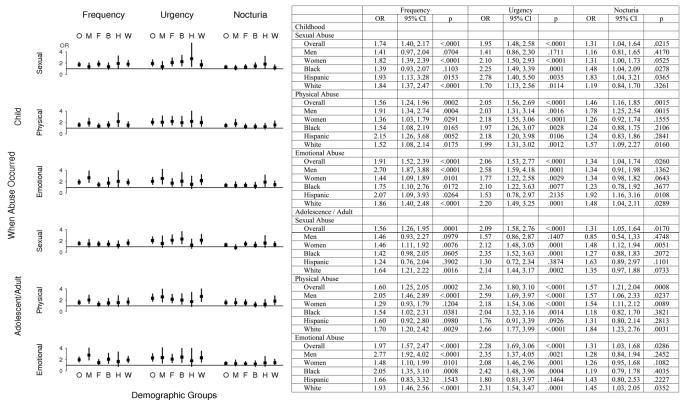
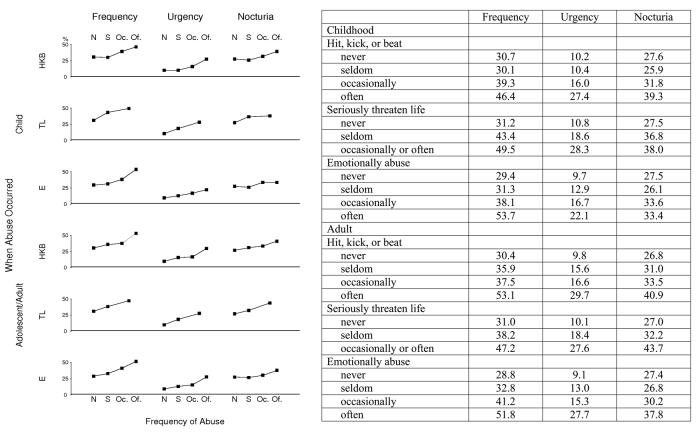
Results: The symptoms considered are common, with 33% of BACH respondents reporting urinary frequency, 12% reporting urgency, and 28% reporting nocturia. All three symptoms are positively associated with childhood and adolescent/adult sexual, physical, and emotional abuse (p<0.05), with abuse significantly increasing the odds of urinary frequency by a factor ranging from 1.6 to 1.9, the odds of urgency by a factor from 2.0 to 2.3, and the odds of nocturia by a factor from 1.3 to 1.5.
Conclusions: Our analyses extend previous work. First, we show a strong association between abuse and urinary frequency, urgency, and nocturia in a community-based random sample. Second, we move beyond discussion of statistical association and find considerable evidence to suggest that the relationship between abuse and these symptoms may be causal.
Figures
Comment in
-
The Boston Area Community Health (BACH) Survey: urologic and sexual symptoms results or origins from physical or behavioral conditions. Data mining of the submerged portion of the urology iceberg.Eur Urol. 2007 Aug;52(2):326-30. doi: 10.1016/j.eururo.2007.04.058. Epub 2007 Apr 25. Eur Urol. 2007. PMID: 17467887 No abstract available.
References
-
- Scher CD, et al. Prevalence and demographic correlates of childhood maltreatment in an adult community sample. Child Abuse Negl. 2004;28:167–80. - PubMed
-
- Davis J, Smith T, Marsden P. General social surveys, 1972[en]2002, 2nd ICPSR Version. Roper Center for Public Opinion Research, University of Connecticut, Inter-University Consortium for Political and Social Research; Ann Arbor, MI: 2003.
-
- Tjaden P, Thoennes N. Full report of the prevalence, incidence, and consequences of violence against women: findings from the National Violence Against Women Survey. National Institute of Justice and the Center for Disease Control and Prevention; Washington, DC: 2000.
-
- Fact Sheets. 2002. World Health Organization: http://www.who.int/violence_injury_prevention/violence/world_report/fact....
-
- Talley NJ, et al. Gastrointestinal tract symptoms and self-reported abuse: a population-based study. Gastroenterology. 1994;107:1040–9. - PubMed
Publication types
MeSH terms
Grants and funding
LinkOut - more resources
Full Text Sources
Medical
Miscellaneous
