


Soft tissue elastometer
- PMID: 17383214
- PMCID: PMC2581446
- DOI: 10.1016/j.medengphy.2007.02.007
Soft tissue elastometer
Abstract
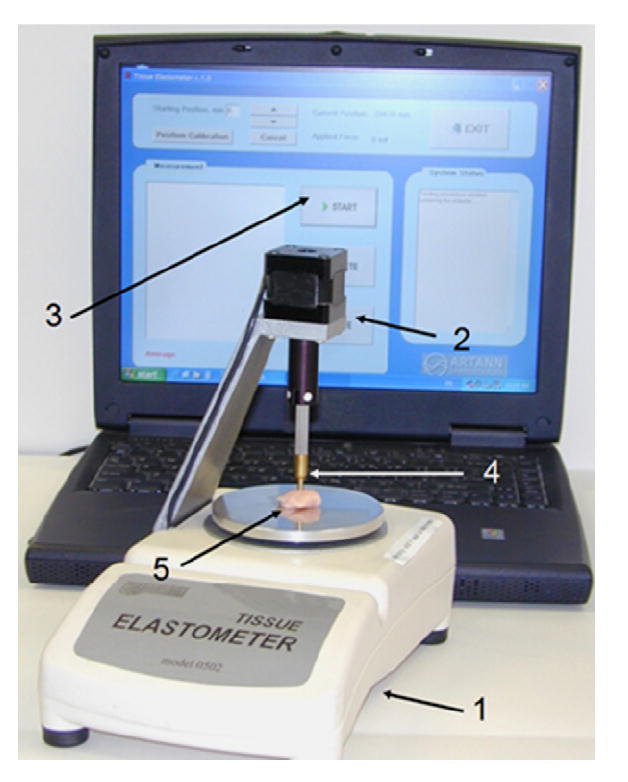
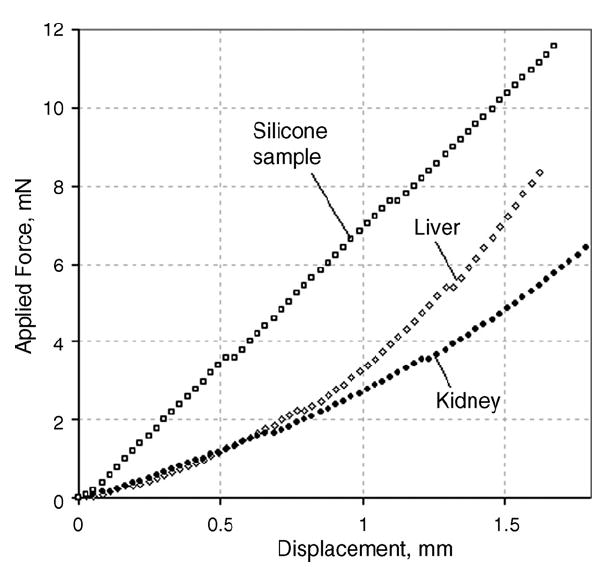
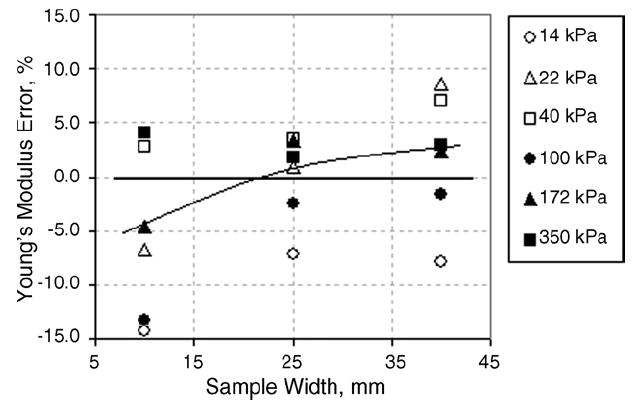
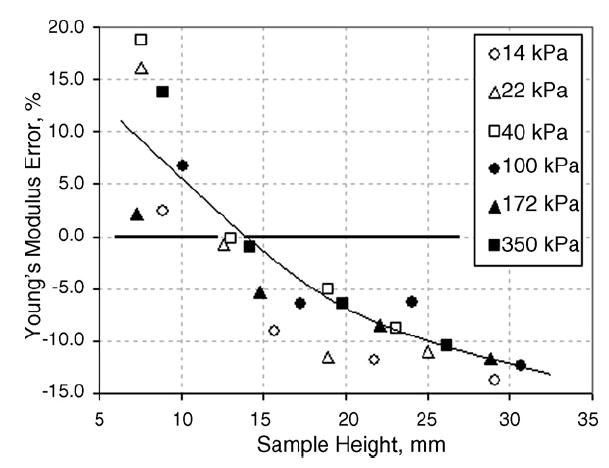
We have developed a device entitled the 'Tissue Elastometer' (TE) for evaluating the Young's modulus of soft tissues. Soft tissue specimens are compressed between the object plate of an electronic balance and a linearly actuated indenter with a small rounded tip. The hardware of the device was designed such that a deformation model for semi-infinite media is applicable for calculating the Young's modulus of test specimens from their collected force-displacement data. Force-elongation measurements were performed on long strips of cured silicone mixtures to produce calibrated, tissue-mimicking test samples for the TE in a Young's modulus range of 10-400 kPa. When tested with the TE, the Young's moduli of the silicone samples demonstrated accuracy to within 1-10% of their calibrated values. Testing on excised tissue samples (fresh store-bought poultry breast; bovine liver, kidneys, hind shanks; porcine) was also performed, and a repeatability of elasticity measurements was demonstrated in the range of 8-14%. Results indicate that the TE can be effectively used in laboratory and clinical environments to evaluate the elasticity modulus of tissues.
Conflict of interest statement
Figures
References
-
- Sarvazyan A. In: Elastic properties of soft tissues handbook of elastic properties of solids, liquids, and gases. Levy, Bass, Stern, editors. III. New York: Academic Press; 2001. pp. 107–127. Chapter 5.
-
- Krouskop TA, Wheeler TM, Kaller F, Garra BS, Hall T. Elastic moduli of breast and prostate tissues under compression. Ultrason Imaging. 1998;20(4):260–74. - PubMed
-
- Hamhaber U, Grieshaber FA, Nagel JH, Klose U. Comparison of quantitative shear wave MR-Elastography with mechanical compression tests. Magn Reson Med. 2003;49(1):71–7. - PubMed
-
- Srinivasan S, Krouskop T, Ophir J. A Quantitative comparison of modulus images obtained using nanoindentation with strain elastograms. Ultrasound Med Biol. 2004;30(7):899–918. - PubMed
-
- Skovoroda AR, Klishko AN, Gusakian DA, Maevskii EI, Ermilova VD, Oranskaia GA, Sarvazyan AP. Quantitative analysis of the mechanical characteristics of pathologically changed biological tissues. Biophysics. 1995;40(6):1359–64. - PubMed
Publication types
MeSH terms
Substances
Grants and funding
LinkOut - more resources
Full Text Sources
