. 2007 May;144(1):445-54.
doi: 10.1104/pp.106.095208. Epub 2007 Mar 23.

Synergistic substrate inhibition of ent-copalyl diphosphate synthase: a potential feed-forward inhibition mechanism limiting gibberellin metabolism

Affiliations

Synergistic substrate inhibition of ent-copalyl diphosphate synthase: a potential feed-forward inhibition mechanism limiting gibberellin metabolism

Sladjana Prisic et al. Plant Physiol. 2007 May.

Abstract

Gibberellins (GAs) or gibberellic acids are ubiquitous diterpenoid phytohormones required for many aspects of plant growth and development, including repression of photosynthetic pigment production (i.e. deetiolation) in the absence of light. The committed step in GA biosynthesis is catalyzed in plastids by ent-copalyl diphosphate synthase (CPS), whose substrate, (E,E,E,)-geranylgeranyl diphosphate (GGPP), is also a direct precursor of carotenoids and the phytol side chain of chlorophyll. Accordingly, during deetiolation, GA production is repressed, whereas flux toward these photosynthetic pigments through their common GGPP precursor is dramatically increased. How this is accomplished has been unclear because no mechanism for regulation of CPS activity has been reported. We present here kinetic analysis of recombinant pseudomature CPS from Arabidopsis (Arabidopsis thaliana; rAtCPS) demonstrating that Mg(2+) and GGPP exert synergistic substrate inhibition effects on CPS activity. These results suggest that GA metabolism may be limited by feed-forward inhibition of CPS; in particular, the effect of Mg(2+) because light induces increases in plastid Mg(2+) levels over a similar range as that observed here to affect rAtCPS activity. Notably, this effect is most pronounced in the GA-specific AtCPS because the corresponding activity of the resin acid biosynthetic enzyme abietadiene synthase is 100-fold less sensitive to [Mg(2+)]. Furthermore, Mg(2+) allosterically activates the plant porphobilinogen synthase involved in chlorophyll production. Hence, Mg(2+) may have a broad role in regulating plastidial metabolic flux during deetiolation. Finally, the observed synergistic substrate/feed-forward inhibition of CPS also seems to provide a novel example of direct regulation of enzymatic activity in hormone biosynthesis.


Figures
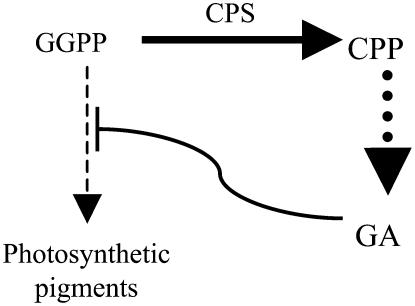
Figure 1.
Figure 1.
Relationship between GAs and plant pigment production in the dark. GGPP is a common precursor for photosynthetic pigments and GAs. CPS converts GGPP into CPP as the committed step in GA biosynthesis. In the dark, high concentrations of GA inhibit production of pigments from GGPP. Dashed arrows indicate multiple steps in biosynthetic pathways.
Figure 2.
Figure 2.
Committed steps in GA biosynthesis. CPS converts GGPP into CPP via a protonation-initiated (i.e. class II) mechanism. Further cyclization of CPP into kaurene is catalyzed by KS, which removes the pyrophosphate group from the substrate, as is characteristic of prototypical (i.e. class I) terpene cyclases.
Figure 3.
Figure 3.
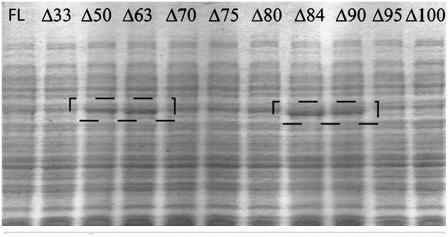
Expression analysis of AtCPS truncation series. SDS-PAGE of recombinant bacterial soluble extracts obtained from OverExpress C41(DE3) clones transformed with plasmids carrying genes for full-length or truncated AtCPS. The four truncations that showed better expression are indicated by the dashed boxes. FL, Full-length AtCPS.
Figure 4.
Figure 4.
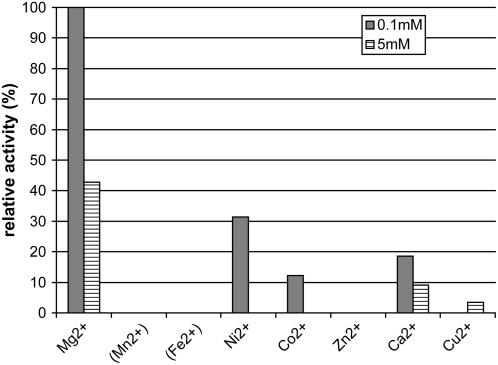
Relative enzymatic activities (% turnover) of rAtCPS in the assays with 0.1 and 5 mm divalent metal ions. Enzymatic activities are normalized to 0.1 mm Mg2+ turnover. Mn2+ and Fe2+ interfered with the assay and therefore their effect on CPS activity could not be determined.
Figure 5.
Figure 5.
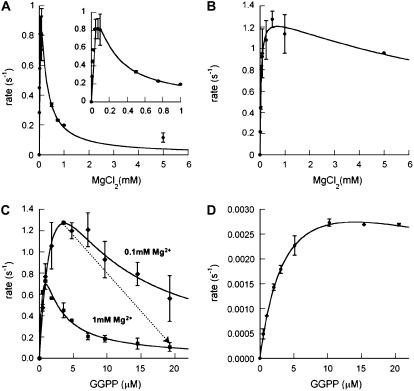
Effect of magnesium on class II diterpene cyclase activity. A, Mg2+ dependence of rAtCPS activity. Inset depicts activity over the lower concentration range of Mg2+. B, Mg2+ dependence of rAgAS:D621A activity. Saturation experiments shown in A and B were performed with 9 μm GGPP and fit to the substrate inhibition equation, treating Mg2+ as a cosubstrate. C, Synergistic effects of Mg2+ and GGPP on rAtCPS activity. Squares represent data from a kinetic experiment with 1 mm Mg2+ and diamonds are with 0.1 mm Mg2+. Dotted arrow indicates a combined decrease of AtCPS activity with increasing concentrations of GGPP and Mg2+. D, Reduced substrate inhibition effects from GGPP on rAtCPS activity in the presence of 2 mm EDTA. Error bars represent sd from two independent measurements in all cases.
Figure 6.
Figure 6.
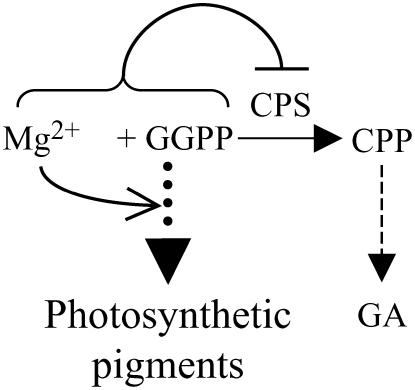
Synergistic substrate/feed-forward inhibition effect of Mg2+ and GGPP on CPS activity limits flux into GA metabolism during deetiolation. Also depicted is the activating effect of Mg2+ on photosynthetic pigment production (i.e. allosteric activation of plant porphobilinogen synthase). Dashed arrows indicate multiple steps in biosynthetic pathways.
Figure 7.
Figure 7.
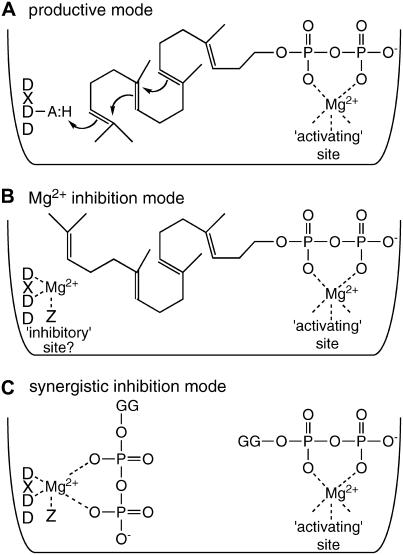
Proposed model for GGPP and Mg2+ binding to class II diterpene cyclases. A, Productive binding mode,GGPP-Mg2+ complex poised for AtCPS catalyzed cyclization. B, Unproductive Mg2+ inhibition mode, binding of Mg2+ at the active site interfering with proper binding of GGPP-Mg2+ complex. C, Unproductive synergistic substrate inhibition mode, double GGPP-Mg2+ complex binding to AtCPS. GG, Geranylgeranyl (either of these hydrocarbon tails may also bind in the hydrophobic portion of the active site). The Z in B and C represents a potential third Mg2+ ligand whose presence varies with metabolic function (e.g. is conserved in GA-specific enzymes but not those involved in secondary metabolism).

References

    1. Aach H, Bose G, Graebe JE (1995) ent-Kaurene biosynthesis in a cell-free system from wheat (Triticum aestivum L.) seedlings and the localisation of ent-kaurene synthetase in plastids of three species. Planta 197 333–342
    1. Ait-Ali T, Frances S, Weller JL, Reid JB, Kendrick RE, Kamiya Y (1999) Regulation of gibberellin 20-oxidase and gibberellin 3β-hydroxylase transcript accumulation during de-etiolation of pea seedlings. Plant Physiol 121 783–791 - PMC - PubMed
    1. Ait-Ali T, Swain SM, Reid JB, Sun T, Kamiya Y (1997) The LS locus of pea encodes the gibberellin biosynthesis enzyme ent-kaurene synthase A. Plant J 11 443–454 - PubMed
    1. Alabadi D, Gil J, Blazquez MA, Garcia-Martinez JL (2004) Gibberellins repress photomorphogenesis in darkness. Plant Physiol 134 1050–1057 - PMC - PubMed
    1. Bensen RJ, Johal GS, Crane VC, Tossberg JT, Schnable PS, Meeley RB, Briggs SP (1995) Cloning and characterization of the maize An1 gene. Plant Cell 7 75–84 - PMC - PubMed

Publication types

MeSH terms